Finland gears up for historic NATO decision
/ Photo: ©

 Starc strikes twice as Australia push for victory
 Does White House ask AI to shape policy? Democrats want the receipts

 Trump tees up Alaska election challenge over same-name candidate 'fraud'
 IMF says engaging with Iraq on preparing new bailout program

 Two dead in rock spire collapse at Turkey's touristic Cappadocia
 No surprise to Carrick he's still Man Utd manager

 Two dead in rock spire collapse at tourist site in Turkey's Cappadocia

 ECB holds rates steady after Lagarde says to quit early
 US economy posts strong growth, inflation stubbornly high in challenge to Trump

 What we know about Spain's deadly train crash
 ECB chief Lagarde to step down early, triggering succession race

 'Horrific' Russian drone strike kills 14 at Ukraine train station: Kyiv

 VW says 'no time to lose' to slash costs after 5.8 billion euro loss

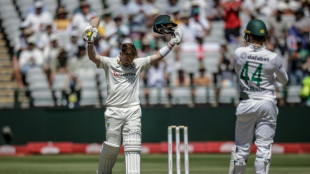 Australia lead by 100 after Inglis century
 Martin to ride with broken wrist in Malaysian MotoGP practice

 England forward Toney to stand trial for alleged assault in June 2028
 Warrican's five-wicket haul leads West Indies fightback in Bangladesh Test

 Oil majors reap bumper profits as Mideast war drives prices
 Christine Lagarde: unifying ECB chief in turbulent times
 Rybakina secures year-end top rank with Tokyo win

 Rains bring relief to Indonesian city weary of fire haze

 Osaka vows to return stronger after Tokyo exit
 Hello Kitty firm apologises, scraps Japan TV tie-up after China anger

 Taiwan says Pakistan briefly closed airspace to Taiwanese flights

 'My blood was spilled here': a year on, Tanzania unable to mourn election violence

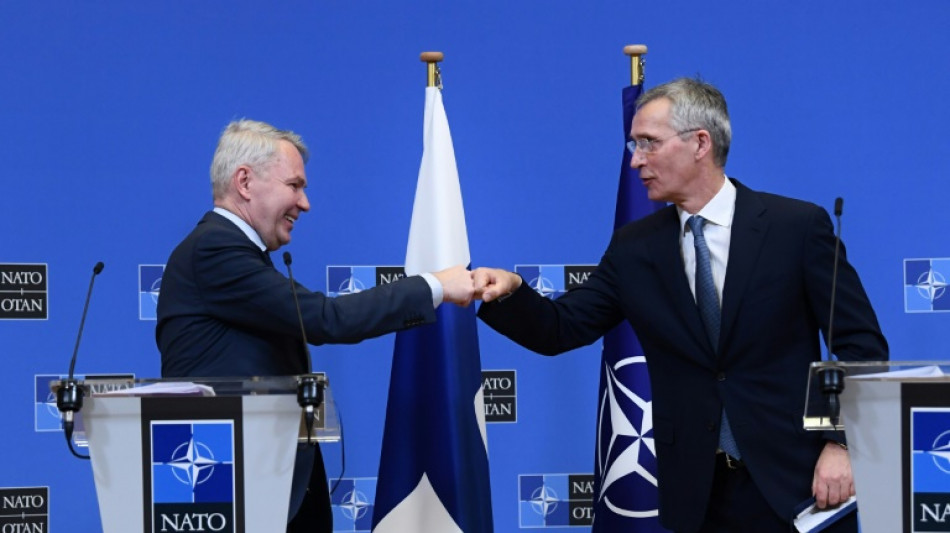
Finland is preparing for a potentially historic decision "before midsummer" on whether to apply to join NATO as a deterrent against Russian aggression.
The Nordic nation of 5.5 million has traditionally been militarily non-aligned, in part to avoid provoking its eastern neighbour, with which it shares a 1,300 kilometre (830 mile) border.
But Russia's invasion of Ukraine on February 24 saw public support for joining NATO double from 30 to 60 percent, according to a series of polls.
"Never underestimate the capacity of Finns to take rapid decisions when the world changes," former Finnish prime minister Alexander Stubb told AFP.
Himself a long-time NATO advocate, Stubb now believes Finland making a membership application is "a foregone conclusion" as Finns re-evaluate their relationship with their neighbour.
Next week a government-commissioned national security review will be delivered to parliament, the Eduskunta, to help Finnish MPs make up their own minds, before it is put to a vote.
"We will have very careful discussions but not taking any more time than we have to," Prime Minister Sanna Marin told a news conference on Friday.
"I think we will end the discussion before midsummer," she added.
"My guess is that the application will be filed sometime during the month of May" in time for the June NATO summit in Madrid, Stubb said.
- Change of heart -
Finland declared independence in 1917 after 150 years of Russian rule, only for its vastly outnumbered army to fight off an attempted Soviet invasion during the Second World War inflicting heavy losses on the Red Army.
Hostilities ended in a peace deal that saw Finland ceding several border areas to the Soviet Union.
Finnish leaders agreed to remain neutral during the Cold War in exchange for guarantees from Moscow that it would not invade.
The country's forced neutrality to appease its stronger neighbour coined the term "Finlandization".
Finland has remained outside the transatlantic military alliance, and despite some cuts after the Cold War it has focused on maintaining well-funded defence and preparedness capabilities.
"We're able to mobilise 280,000 to 300,000 men and women within a matter of days," Stubb said, adding that 900,000 reserves could also be called up.
Last week Finland's government agreed a 40-percent hike in defence spending by 2026, to further strengthen the country's position.
"We have walked a long way when it comes to our security policies, and they have worked so far," said Centre Party MP Joonas Kontta.
Like the majority of his parliamentary colleagues, the 32-year-old used to think that NATO membership was "something that we don't need at the moment".
But Russia's invasion "changed something in Europe in a way that can't be changed back", he told AFP, and Kontta recently announced that he now believes it is time to seek to join the alliance.
A number of MPs have also recently announced similar changes of heart regarding Finland's "NATO question" -- although many more are keeping their positions to themselves awaiting more detailed discussions.
- Anti-NATO minority
Only six of Finland's 200 MPs in a recent poll by public broadcaster Yle openly voiced anti-NATO views, including Markus Mustajarvi from the Left Alliance party
Finland and Sweden's non-alignment "has brought stability to the whole of Northern Europe", the Lapland MP told AFP.
Mustajarvi questions whether NATO's Article 5 commitment to mutual defence would provide genuine protection in case of an attack.
Instead he cites Finland's own defence capabilities which are "so strong that they would force Russia to think what price it would pay for attacking".
Despite receiving "all sorts of feedback" from the public and his fellow MPs over his stance, Mustajarvi insists he has "thought this through to the end and so far I don't see a reason to change my position".
- Grey zone -
Since Russia's attack, Finland's leadership has undertaken an intensive series of talks to canvass opinion from other NATO states about a possible membership bid.
Along with neighbouring Sweden, Finland has received public assurances from secretary general Jens Stoltenberg that the alliance's door remains open, as well as expressions of support from numerous members including the US, UK, Germany, France and Turkey.
But attempting to join NATO would likely be seen as a provocation by the Kremlin, for whom the expansion of the US-led alliance on its borders has been a prime security grievance.
Finland's president Sauli Niinisto has warned that Russia's response could be "on the brash side", including airspace, territorial violations and hybrid attacks.
The Kremlin has pledged to "rebalance the situation" in the event of Finland joining NATO.
Meanwhile, Foreign Minister Pekka Haavisto has acknowledged that Russia could seek to destabilise a membership bid during the "grey zone" between an application and its ratification by all 30 NATO states, which could take four months to a year.
"Finland has always tried to stay away from the grey zone," Stubb said, but he believes that Finland has the resilience to withstand potential Russian aggression or hybrid attacks.
M.Ouellet--BTB