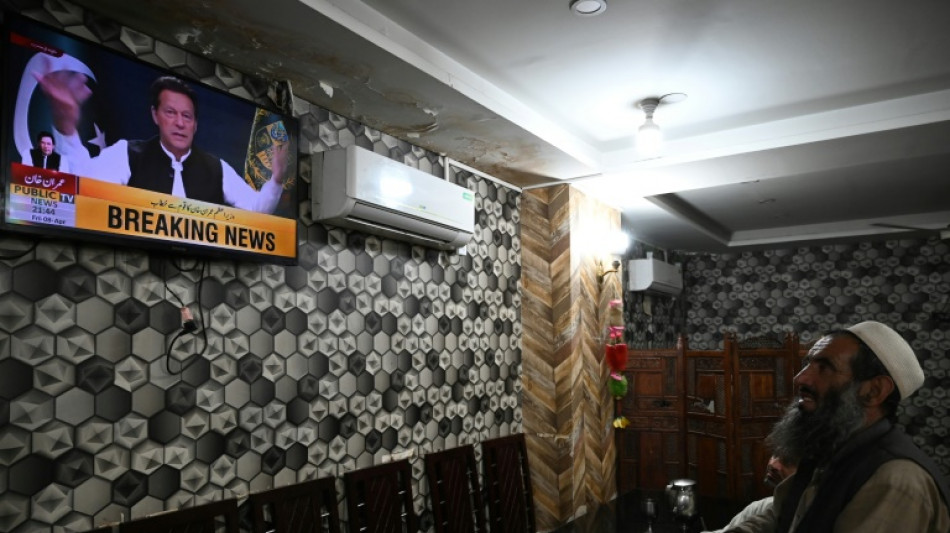
Pakistan PM alleges 'conspiracy' but accepts court ruling on confidence vote / Photo: ©

 New space object 'black hole star' discovered by astronomers

 England captain Root tells players to be 'adults' as he ditches curfew

 US inflation slows slightly in July despite elevated fuel prices

 Total solar eclipse to cast its shadow over Europe

 US consumer inflation slows slightly in July despite elevated fuel prices

 Warholm on track in bid for fourth Euro hurdles gold

 Erdogan eyes expansion of regional defence pact

 Extreme weather, jellyfish knock one-fifth of France's nuclear capacity offline
 Skywatchers gather in Europe to see total solar eclipse

 Zhu Rongji, trailblazing ex-premier who transformed China's economy
 China tech giant Tencent's Q2 profit down as AI push builds

 China's C919 jet makes first international commercial flight

 Mideast war impact on travel bookings fading, TUI says

 Bangladesh get Das fitness boost for daunting Australia task

 One dead, 172 rescued as second ferry in days catches fire in Indonesia

 Foxconn posts quarterly profit surge on AI server demand

 Hazlewood gets Australia nod ahead of Boland for Bangladesh Test
 Toyota ex-chief Okuda, pioneer of the Prius, dead at 93

 Colombia rescuers find woman alive as quake death toll passes 200

 New Zealand PM survives leadership challenge months from election

 Passengers rescued as second ferry in days catches fire in Indonesia

 Oil prices rise, stocks mixed ahead of crucial US inflation data

 UK 'joke' candidate Binface pushes serious point about politics

 New Zealand PM Luxon survives leadership challenge months from election
 Cuba celebrates Castro's 100th as his revolution faces its toughest test

Pakistan Prime Minister Imran Khan said Friday he accepted a supreme court ruling that will likely see him ousted from office, but insisted he was victim of a "regime change" conspiracy involving the United States.
The national assembly will sit Saturday to decide Khan's fate, but the former international cricket star who became premier in 2018 is certain to lose a no-confidence vote following the defection of a coalition partner and several of his own party members.
The session was ordered by the Supreme Court Thursday when ruling that Khan acted illegally by dissolving parliament and calling fresh elections after the deputy speaker of the national assembly -- a loyalist -- refused to allow an earlier no-confidence vote because of "foreign interference".
In a 40-minute address to the nation touching on familiar themes, Khan railed against the Pakistan Muslim League-N (PLM-N) and Pakistan People's Party (PPP), two normally feuding dynastic groups who joined forces to oust Khan and his upstart Pakistan Tehreek-e-Insaf party (PTI).
With his majority gone, Khan accused the opposition of buying support in the assembly with "open horse-trading... selling of lawmakers like goats and sheep".
He said they had conspired with Washington to bring the no-confidence vote because of his opposition to US foreign policy -- particularly in Muslim nations such as Iraq and Afghanistan.
"I was disappointed with the Supreme Court decision but I want to make it clear that I respect the Supreme Court and Pakistan's judiciary," he said.
But he added that the court should also have examined the reason for the first vote being rejected.
"There is a conspiracy from abroad," the 69-year-old Khan said. "This is a very serious allegation... that a foreign country conspired to topple an entire government."
Washington has denied any involvement.
- Doctrine of necessity -
Constitutionalists on Friday praised the Supreme Court verdict, calling it an end to the so-called "doctrine of necessity" that has seen courts throughout Pakistan's history rule against clear illegality, but accept the consequences as being good for the country.
PML-N leader Shehbaz Sharif, brother of three-time prime minister Nawaz Sharif and likely to replace Khan, said the decision "has saved Pakistan and the constitution".
"Democracy is the best revenge", tweeted PPP leader Bilawal Zardari Bhutto, the scion of another political dynasty. His parents are assassinated former prime minister Benazir Bhutto and ex-president Asif Ali Zardari.
How long the next government lasts is also a matter of speculation.
The opposition said previously they wanted an early election -- which must be called by October next year -- but taking power gives them the opportunity to set their own agenda and end a string of probes they said Khan launched vindictively against them.
It could also pave the way for a comeback by Nawaz Sharif, who has not returned from Britain since being allowed to leave jail in 2019 to seek medical treatment abroad.
He was barred by the Supreme Court from holding public office after graft revelations, and sentenced to 10 years in prison by an accountability court.
There had been high hopes for Khan when he was elected in 2018 on a promise of sweeping away decades of entrenched corruption and cronyism, but he struggled to maintain support with soaring inflation, a feeble rupee and crippling debt.
There has also been a rise in violence by Islamic militants encouraged by the return to power of the Taliban in neighbouring Afghanistan.
- Underlying issues remain -
Political analyst Hasan Askari told AFP any new government will still have to deal with the underlying issues.
"Conflict and confrontation will persist... the prospects of political harmony and long-term stability are minimal," he said.
Pakistan has been wracked by political crises for much of its 75-year existence, and no prime minister has ever seen out a full term.
Khan, appearing to have accepted his fate, said Friday he would not work with any new government.
"I will not accept this imported government," he said, urging his supporters to begin protesting against it.
N.Fournier--BTB