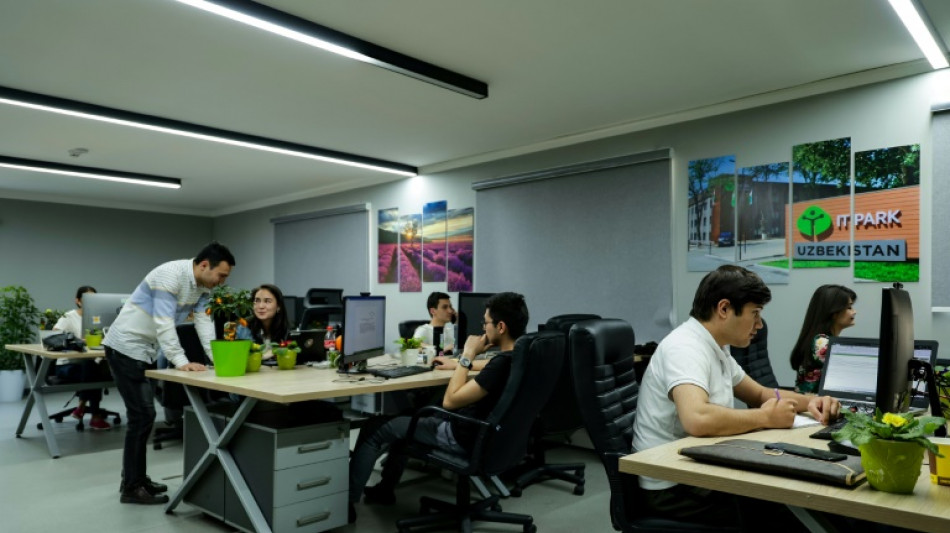
Fleeing Russians help Uzbekistan chase IT dreams / Photo: ©

 New mum Sjostrom wins 50m butterfly for 18th European gold

 Solar eclipse darkens Arctic Russia on course for Spain

 Russian economy rebounds in second quarter despite Ukrainian strikes

 NBA's Los Angeles Lakers to be sold for $12.5 bn: ESPN

 Trump sued over sale of access to Truth Social posts

 Europe looks to the skies as solar eclipse cast its shadow

 At least 44 drown after ferry overturns on Zimbabwe's Lake Kariba

 Grieving Argentine icon Messi unsure about playing on 'much longer'

 Nigeria kidnap victims escape 'hellfire' captivity beaten, malnourished

 Google unveils finder tag, new AI smartphone features

 US equities gain as inflation report eases fear of rate rise

 Colombia declares three days mourning for quake victims

 44 lives lost after ferry capsizes on Zimbabwe's Lake Kariba

 WallStreetPR Releases Report on China’s Gold Purchases and African Mining Investment

 Former Chinese premier Zhu Rongji dies aged 97

 Markets steady awaiting US inflation data

 WHO says Trump vaccine shake-up goes against evidence

 Eclipse chasers flock to Spain for 'breathtaking' experience

 'To make the civilians leave': Russia pummels Ukraine's petrol stations

 Japan brushes off Australian PM's melon drama

 Rod Stewart cancels tour dates after heart surgery

 How Britain's mapmakers track climate change

 Australian delivery drivers win 'world-leading' pay rise

 Meta meets its own 'tobacco' moment in court

 Art or medicine? Japan's cosmetic tattoo artists in limbo

Hit by regular power cuts and with popular sites like Twitter and TikTok blocked, the Central Asian nation of Uzbekistan hardly seems a likely candidate for a tech boom.
But with Russia's invasion of Ukraine driving an exodus of IT specialists to former parts of the Soviet Union, authorities in Uzbekistan are hoping to speed up plans to modernise an economy best known for its vast production of cotton.
It took only one day after Russia's February 24 invasion of Ukraine for Uzbekistan to launch a one-stop government relocation programme for IT specialists and companies.
Offering visas, housing and child care support to individuals, and registration assistance and tax exemptions to companies, the programme has already attracted some 2,000 foreign IT specialists, the government said.
People like Anastasia Markova, a Russian citizen who recently became a public relations manager at Uzbekistan's state-run IT Park in the capital Tashkent.
Markova, 22, had been due to be married in Russia in April, but left Moscow with her fiance -- an employee of a company registered at the park -- for Tashkent and the two are now seeking permanent residence.
Markova said she feels comfortable in the city, where Russian is still widely spoken three decades after Uzbekistan gained independence during the collapse of the Soviet Union.
"The country accepted us as one of their own. The people are so friendly and hospitable," she said.
- Thousands in IT leave Russia -
Markova was more keen to speak about her new home than the country she left behind, saying only that her decision to leave Russia had been "rushed, as it was for many people" and due to "a number of social and economic factors".
Several other Russian citizens contacted by AFP after moving to Uzbekistan and neighbouring Kyrgyzstan refused to talk, saying they feared the consequences of potentially being seen as critical of Russia.
The IT Park in Tashkent is home to some 550 companies and at the heart of plans to increase Uzbek IT exports to more $1 billion by 2028, a 25-fold rise from last year's figure.
The park's motto, "START local and GO Global" is emblazoned on a wood panel facade at the entrance. Inside, young support staff in casual attire and headsets work at desks.
The IT Park is already seeing benefits from the relocation programme dubbed TashRush -- "a name that seemed most suited to the phenomenon we are witnessing," the park's deputy director Bakhodir Ayupov said.
The Russian Association of Electronic Communications, a lobby group, said on March 22 that 50,000 to 70,000 specialists had left Russia and up to 100,000 more may follow them out of the door this month.
For the moment, Uzbekistan is a less popular destination for departing Russian IT workers than Georgia, Turkey or Armenia.
Uzbekistan has lagged behind other ex-Soviet nations in developing the sector. The country has of late battled winter energy shortages, while power cuts are not uncommon, even in Tashkent.
- 'Flywheel of repression'
But internet speed has "improved greatly" in Uzbekistan, driving a doubling of IT exports last year in comparison with 2020, Ayupov said.
In an apparent nod to business, Uzbek authorities last month lifted a long-term block on the Skype communications platform.
Microblogging service Twitter, video-sharing platform TikTok and Russia's most popular social network VKontakte remain blocked in the authoritarian republic of around 35 million people.
Despite these difficulties, some of the Russians who left said they would rather stick it out in Uzbekistan than return home.
Olga, a 42-year-old who moved to the historic Uzbek city of Samarkand with her husband immediately after the invasion, said she had fallen in love with the former Silk Road citadel and hoped her experience as a content curator for digital museums would help her find work.
"To begin with we thought we would be here for a few days, but we decided to stay longer. People who were complete strangers have been so good to us," said Olga, who asked that she not be fully identified.
She has no plans to return to Russia, where "the flywheel of repression is spinning and may be spinning for a long time to come," she said.
K.Brown--BTB