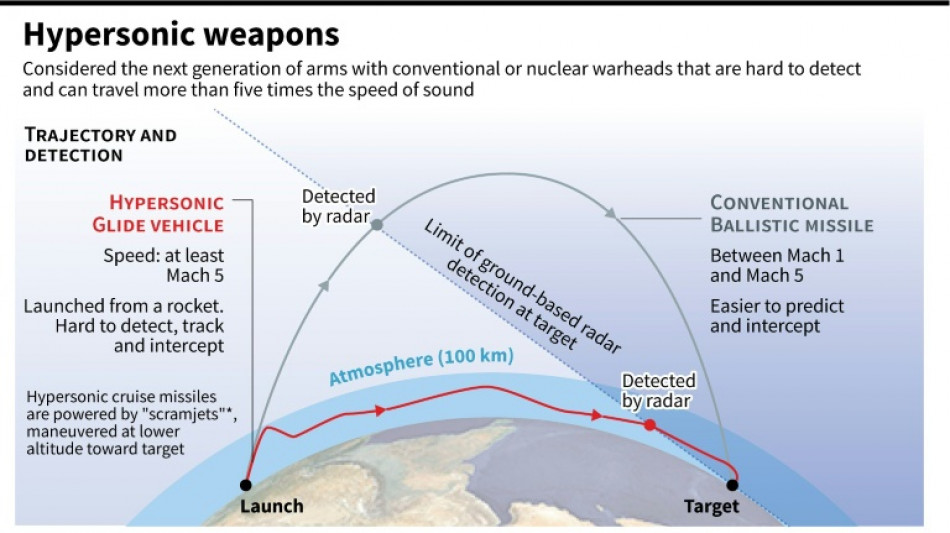
US, UK, Australia to cooperate on hypersonic weapons / Photo: ©

 'Trying to bury the science': US climate research under siege

 Eurovision to bar countries at war from hosting

 Italian teenager Curtis breaks 50m backstroke world record at Europeans

 New mum Sjostrom wins 50m butterfly for 18th European gold

 Solar eclipse darkens Arctic Russia on course for Spain

 Russian economy rebounds in second quarter despite Ukrainian strikes

 NBA's Los Angeles Lakers to be sold for $12.5 bn: ESPN

 Trump sued over sale of access to Truth Social posts

 Europe looks to the skies as solar eclipse cast its shadow

 At least 44 drown after ferry overturns on Zimbabwe's Lake Kariba
 Grieving Argentine icon Messi unsure about playing on 'much longer'

 Nigeria kidnap victims escape 'hellfire' captivity beaten, malnourished

 Google unveils finder tag, new AI smartphone features

 US equities gain as inflation report eases fear of rate rise

 Colombia declares three days mourning for quake victims

 44 lives lost after ferry capsizes on Zimbabwe's Lake Kariba

 WallStreetPR Releases Report on China’s Gold Purchases and African Mining Investment

 Former Chinese premier Zhu Rongji dies aged 97
 Markets steady awaiting US inflation data

 WHO says Trump vaccine shake-up goes against evidence

 Eclipse chasers flock to Spain for 'breathtaking' experience
 'To make the civilians leave': Russia pummels Ukraine's petrol stations

 Japan brushes off Australian PM's melon drama

 Rod Stewart cancels tour dates after heart surgery

 How Britain's mapmakers track climate change

The United States, Britain and Australia said Tuesday they will begin jointly collaborating on hypersonic weapons and "electronic warfare capabilities", as part of their new AUKUS alliance aimed at countering China.
The three countries said the joint initiatives will bolster existing efforts to deepen cooperation in numerous areas that they already agreed when forming the new defensive pact last September.
"We... committed today to commence new trilateral cooperation on hypersonics and counter-hypersonics, and electronic warfare capabilities, as well as to expand information sharing and to deepen cooperation on defence innovation," they said in a joint statement.
"These initiatives will add to our existing efforts to deepen cooperation on cyber capabilities, artificial intelligence, quantum technologies, and additional undersea capabilities.
"As our work progresses on these and other critical defense and security capabilities, we will seek opportunities to engage allies and close partners."
Russia, China, the United States and North Korea have all test-launched hypersonic missiles, with Tuesday's announcement coming just weeks after Moscow said it had launched them for the first time in its war in Ukraine.
Hypersonic missiles, like traditional ballistic missiles which can deliver nuclear weapons, can fly at more than five times the speed of sound.
While ballistic missiles fly high into space in an arc to reach their target, a hypersonic weapon flies on a trajectory low in the atmosphere, potentially reaching a target more quickly.
Crucially, a hypersonic missile is manoeuvrable -- like the much slower, often subsonic cruise missile -- making it much harder to track and defend against.
Russia is seen as the most advanced nation in this field, while China is also aggressively developing the technology, according to the US Congressional Research Service (CRS).
France, Germany, Australia, India and Japan have been working on hypersonics, and Iran, Israel and South Korea have conducted basic research on the technology, the CRS has previously said.
The US, Britain and Australia launched their landmark security pact last September, alongside Canberra scrapping a multi-billion-dollar submarine deal with France that infuriated Paris.
The pact, known as AUKUS, was proclaimed at the time as allowing the three allies to share advanced technologies.
O.Bulka--BTB