'There to die': Nepali mercenaries fight for Russia in Ukraine / Photo: © AFP

 Man City's perfect start ended by Aston Villa, Arsenal go joint-top

 Arsenal sink Everton to join Man City at Premier League summit
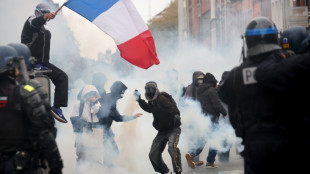
 France protests: Latest developments
 French ice dancers Cizeron and Fournier make golden start to season
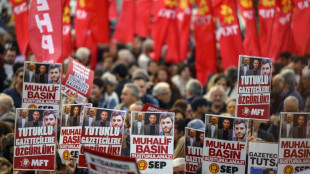 Thousands protest crackdown on media in Turkey

 Brazil's Andrade returns to take vault gold at worlds
 Lula, Bolsonaro hold final rallies ahead of Brazil election

 Ukraine has 'stable connection' to Starlink: govt

 French protests kick off amid heavy security blanket

 250,000 rally in Madrid demanding state pension guarantees
 UK police says 'claims' over Meghan Markle's dad not sent to other law enforcement
 Top-ranked Rybakina to face Fernandez for Ningbo title
 Late India charge seals thrilling second T20 win over New Zealand

 Seen and heard at France protests
 White says Fiji can have 'massive' World Cup after beating Japan
 England thrash France 82-0 to keep Rugby League World Cup hopes alive
 Security high as France braces for new protests
 White makes winning start as Fiji edge Eddie Jones's Japan
 Lula, Bolsonaro strike calmer tone in final Brazil election debate

 'How is it possible?': Students protest Indonesian haze
 Israel launches major West Bank operation after soldiers killed

 Typhoon Champi knocks out power to thousands in Taiwan

 As Israeli election nears, campaign turns ugly

 Oscar hopeful 'La Bola Negra' offers lessons about communicating, directors say

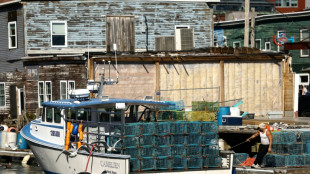 Trapped: Soaring fuel costs hurt Maine lobster industry before midterms

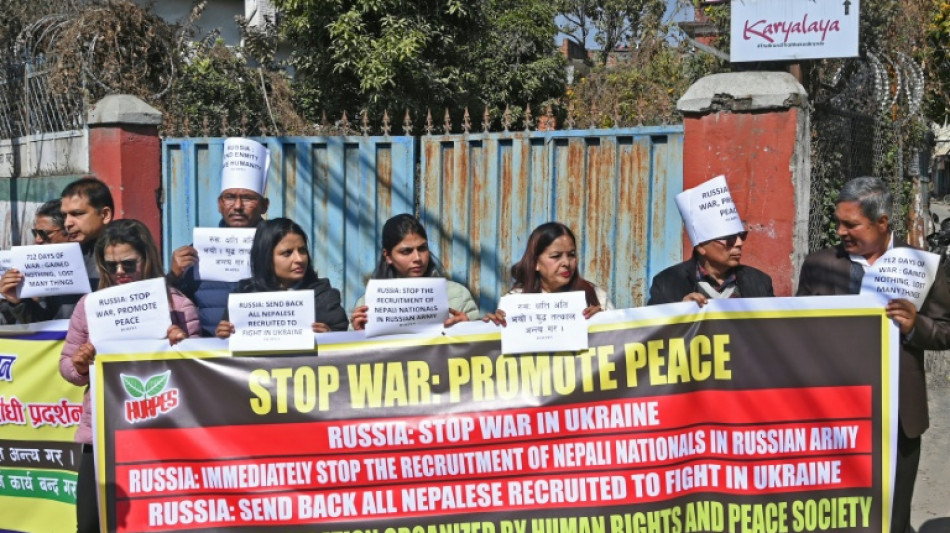
Nepali mercenaries are fighting for Russia in Ukraine, lured to kill far from their Himalayan homeland by promises of a passport and cash, but wounded returnees warn anyone tempted to join the war: "Do not come."
While Nepali soldiers-for-hire can bank in a month nearly double what they could earn in a year back home, conditions are brutal and many have been killed or wounded.
"I watched my friends die in front of me," said Surya Sharma, who asked to use a pseudonym for legal reasons.
"Nepalis going probably cannot even imagine how horrific the war is."
Shortly after the 24-year-old underwent basic training with Russian forces, his unit was attacked on their way to a frontline in eastern Ukraine.
"When the bombs and bullets were raining, I thought my life was ending, that that was it," he said. "I was there to die."
Combining tough Himalayan terrain with grinding poverty, Nepal has long been a source of ferocious soldiers to fight others' wars, with the British army's Gurkhas the best-known example.
But it is only legal for Nepalis to sign up for combat with a foreign military if there is a government agreement in place -- which only applies to Britain and India.
From early on in its war in Ukraine, Russia has used mercenaries, including the paramilitary group Wagner, before its aborted mutiny last June.
Neither Russia nor Ukraine will provide figures for how many foreign fighters are in their militaries, nor the number they are holding as prisoners of war.
But the Nepali government says more than 200 of the country's citizens have enlisted in the Russian army since it invaded Ukraine two years ago.
Sharma believes there could be 10 times as many, including students, ex-soldiers and even former Maoist combatants.
"We were among the early ones to join, but now there are many Nepalis, there must be 2,500 to 3,000," he said.
At least 12 Nepalis have been killed and another five are prisoners of war in Ukraine, the foreign ministry in Kathmandu said.
Returnees say the true number of dead is also much higher, and according to local media Nepalis have fought for Ukraine too.
To attract fighters, Russian President Vladimir Putin has offered Russian citizenship -- which allows recipients to work -- on top of monthly salaries as high as $2,200.
That tempts some in a country with a GDP per capita of little more than $1,300, according to the World Bank -- one of the lowest in Asia.
- 'Like a movie' -
Videos by Nepali recruits undergoing military training in Russia started to surface on TikTok last year, prompting one former veteran to enlist in July.
"It is a war, and we are taking a risk," the 39-year-old told AFP, asking not to be named because of the illegality of his actions.
The man, who had served for more than a decade in Nepal's army before working for the police in Dubai, accumulated about $15,000 in six months before being wounded and having to return to Nepal, and is using it to build a house.
"If there were good employment opportunities in Nepal, no one would go," he added.
Sharma, the 24-year-old, suffers searing pain every step he takes from the metal fragments buried in his legs.
He says he was duped by a Nepali agent.
Every year, hundreds of thousands of Nepalis seek employment abroad -- 400,000 officially, many others illicitly -- and many pay agents thousands of dollars to facilitate their journeys.
Sharma borrowed money to go to Russia on a student visa but discovered he was not allowed to work, and the only job he found was to fight.
"I had loans to pay at home and couldn't send money," he said in his rented room in Kathmandu.
Despite having no prior military experience, he "chose to join the army because I had heard that the money was good. It was not because I wanted to, but my situation forced me to."
He underwent a medical check-up before two months of basic training.
"I was employed with the government, but I've heard there are Nepalis fighting in private forces too," he said.
The recruits -- 15 of them Nepalis -- woke at six to start the drills.
"We learnt firing positions, how to make bunkers and how to target drones," he said.
But "the language is also a problem", he added. "We cannot understand the instructions they give, and in the battleground that can be dangerous."
Sent to the frontlines in Ukraine, Sharma's unit -- mostly Russian, with six Nepalis -- was ambushed even before they reached Kupiansk in the east.
Explosions killed several of Sharma's comrades and he was wounded in the legs and hand.
"Sometimes it felt like a movie."
He spent months in hospital before deserting as he neared recovery to seek help from Nepal's embassy in Moscow.
"I just couldn't return" to the front, he said. "So, I took a risk to return to Nepal, thinking I will either go to jail or home."
- 'Do not come' -
Nepal has banned its citizens from working in Russia or Ukraine in any capacity, to try to prevent their recruitment.
At least 12 people have been arrested in Nepal for sending people to fight for Russia.
The men are often taken via India or the United Arab Emirates and taught elaborate lies to dupe authorities, say police.
"Nepal is a country that believes in non-alignment and in peace," Nepal's Foreign Minister NP Saud told AFP.
"We do not have an agreement with Russia and have requested immediate return of those people."
The Russian embassy in Kathmandu did not respond to requests for comment.
Speaking to AFP by phone from his Russian hospital bed, one wounded Nepali warned his countrymen to resist the lure.
"No matter how much you prepare, it does not work when the bombs fall and the drones attack," said the 27-year-old.
"I request others -- do not come."
H.Kuenzler--VB