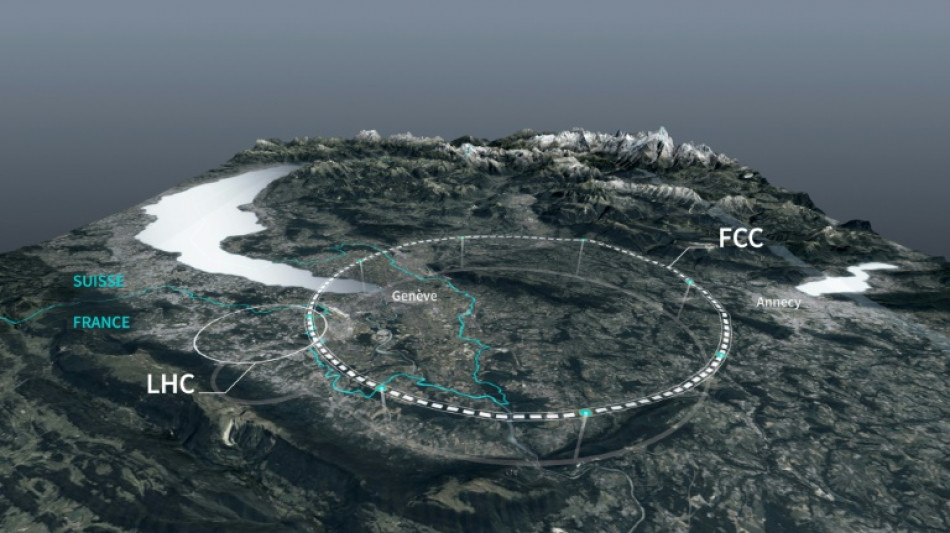
Plan for Europe's huge new particle collider takes shape / Photo: © European Organization for Nuclear Research (CERN)/AFP/File

 Obama blasts Trump's 'chaos and cruelty' while campaigning for Democrats

 Bolsonaro leads Lula in final Brazil election polls

 Antonelli storms to pole for US Grand Prix

 Alvarez fires Atletico to win against Deportivo

 Japan's Nakai wins Grand Prix de France for second straight year

 Ronaldinho to make comeback in Italian third tier

 Israeli forces displace Hebron families after deadly attack

 Hamilton on top with Antonelli fourth in final practice at US Grand Prix

 Beier late show sends Dortmund top of Bundesliga

 Police and protesters clash again at Albanian anti-government rally

 Arteta hails mentality as Arsenal go level with Man City

 Clashes break out in Paris, other cities amid fresh protests

 Bouthier kicks Vannes to first Top 14 win of season

 Thousands rally for Lula and Bolsonaro on eve of tight Brazil vote

 Red-hot Fuellkrug bags Bremen brace, Leipzig win

 Thousands gather at new Albanian anti-government rally

 French police fire tear gas during fresh protests

 Suspect detained after fire wrecks Hitler's mountain retreat

 Alexander Skarsgard and his viral 'Wicker' transformation

 Thousands protest in Turkey over journalists' arrests, media shutdowns

 Man City beaten by Aston Villa to end perfect Premier League start
 Luis Enrique says PSG unbothered by Lyon match switch

 US gymnast Richard wins floor exercise gold at worlds

 Moltzan upstages Shiffrin to win season-opening World Cup giant slalom

 Infantino says backed by 'vast majority' in bid for re-election

Europe's CERN laboratory revealed more details Monday about its plans for a huge new particle accelerator that would dwarf the Large Hadron Collider (LHC), ramping up efforts to uncover the underlying secrets of the universe.
If approved, the Future Circular Collider (FCC) would start smashing its first particles together around the middle of this century -- and start its highest-energy collisions around 2070.
Running under France and Switzerland, it would be more than triple the length of CERN's LHC, currently the largest and most powerful particle accelerator.
The idea behind both is to send particles spinning around a ring to smash into each at nearly the speed of light, so that the collisions reveal their true nature.
Among other discoveries, the LHC made history in 2012 when it allowed scientists to observe the Higgs boson for the first time.
But the LHC, which cost $5.6 billion and began operating in 2010, is expected to have run its course by around 2040.
The faster and more powerful FCC would allow scientists to continue pushing the envelope. They hope it could confirm the existence of more particles -- the building blocks of matter -- which so far have only been theorised.
Another unfinished job for science is working out exactly what 95 percent of the universe is made of. About 68 percent of the universe is believed to be dark energy while 27 percent is dark matter -- both remain a complete mystery.
Another unknown is why there is so little antimatter in the universe, compared to matter.
CERN hopes that a massive upgrade of humanity's ability to smash particles could shed light on these enigmas and more.
"Our aim is to study the properties of matter at the smallest scale and highest energy," CERN director-general Fabiola Gianotti said as she presented an interim report in Geneva.
The report laid out the first findings of a FCC feasibility study that will be finalised by 2025.
- $17 billion first stage -
In 2028, CERN's member states, which include the UK and Israel, will decide whether or not to go through with the plan.
If given the green light, construction on the collider would start in 2033.
The project is split into parts.
In 2048, the "electron-positron" collider would start smashing light particles, with the aim of further investigating the Higgs boson and what is called the weak force, one of the four fundamental forces.
The cost of the tunnel, infrastructure and the first stage of the collider would be about 15 billion Swiss Francs ($17 billion), Gianotti said.
The heavy duty hadron collider, which would smash protons together, would only come online in 2070.
Its energy target would be 100 trillion electronvolts -- smashing the LHC's record of 13.6 trillion.
Gianotti said this later collider is the "only machine" that would allow humanity "to make a big jump in studying matter".
After eight years of study, the configuration chosen for the FCC was a new circular tunnel 90.7 kilometres (56.5 miles) long and 5.5 metres (feet) in diameter.
The tunnel, which would connect to the LHC, would pass under the Geneva region and its namesake lake in Switzerland, and loop round to the south near the picturesque French town of Annecy.
Eight technical and scientific sites would be built on the surface.
CERN said it is consulting with the regions along the route and plans to carry out impact studies on how the tunnel would affect the area.
S.Gantenbein--VB