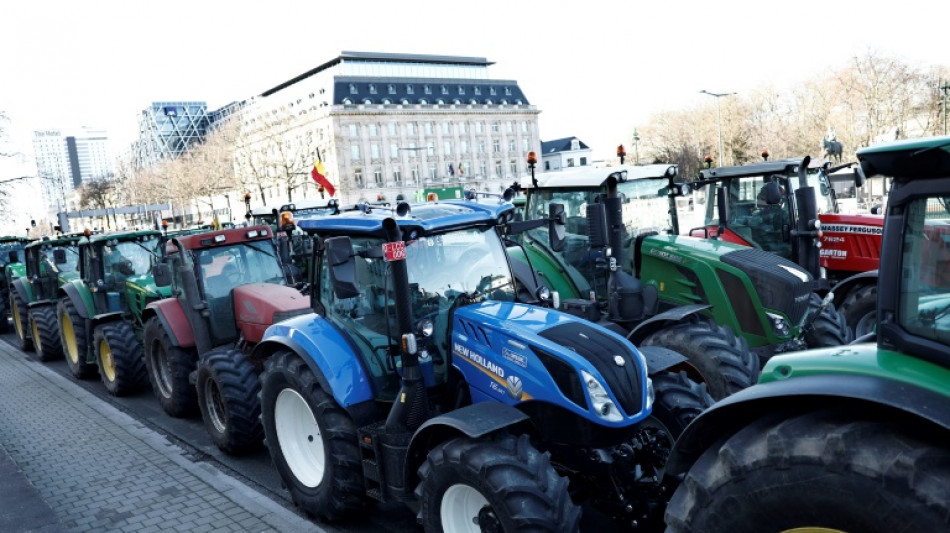
EU walks farming minefield with new climate goals / Photo: © AFP

 Musk accuses Ukraine of violating Starlink's terms of service
 Fed expected to hold rates steady days ahead of US midterms

 More Lula, or back to the Bolsonaros? Brazil votes in cliffhanger
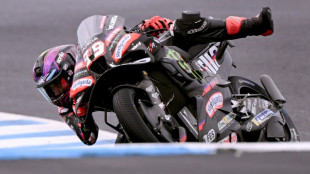 Jorge Martin out of Australian MotoGP with fracture: team

 Antonelli storms to US Grand Prix pole on weekend he can take title

 Apologetic Alvarez fires Atletico to win against Deportivo

 Lens beat PFC in Ligue 1 matchday impacted by social unrest

 Valkyries hit back against Dream to level WNBA Finals

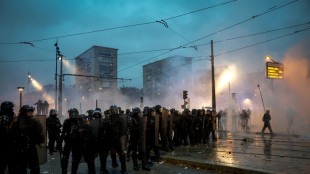 'Fighting for our rights': Paris protesters determined to march on

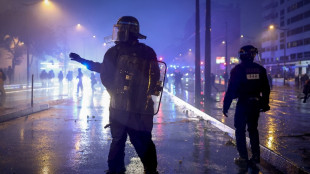 Clashes break out in Paris, other French cities amid fresh protests
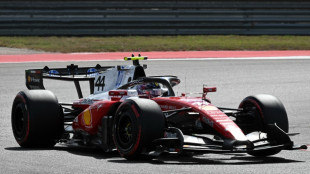
 Spurs seal rare win at Chelsea as Palmer sees red

 Nearly 1,000 arrested in French protests marred by 'elevated' violence: minister

 France extends detention of suspected racist shooter

 Andrade and Nemour star as Biles cheers at world gymnastics champs

 Nigeria's Tinubu defends record as economy bites ahead of election

 'Guiding star' Fuellkrug bags Bremen brace, Leipzig win

 Man City's perfect start ended by Aston Villa, Arsenal go joint-top

 Arsenal sink Everton to join Man City at Premier League summit
 France protests: Latest developments
 French ice dancers Cizeron and Fournier make golden start to season

 Thousands protest crackdown on media in Turkey

 Brazil's Andrade returns to take vault gold at worlds
 Lula, Bolsonaro hold final rallies ahead of Brazil election

 Ukraine has 'stable connection' to Starlink: govt

 French protests kick off amid heavy security blanket

The EU's climate goals for 2040 are set to further dial up the pressure on a farm sector that has yet to get tough on greenhouse gas emissions -- but is already up in arms over existing environmental rules.
With European elections just months away, the European Commission will Tuesday put forward its next major target for cutting the bloc's global warming emissions, and agriculture -- which emits 11 percent of them -- is a key part of the equation.
Politically the timing could hardly be worse, with farmer protests simmering across Europe -- thronging Brussels with tractors last week -- and populist politicians swooping in to ride the wave of discontent.
Environmental constraints are high on the farmers' list of grievances -- both longstanding rules stemming from the bloc's common agricultural policy (CAP), and new ones from the sprawling environmental Green Deal that have yet to come into force.
The 27-nation EU has pledged to be carbon neutral by 2050, and to get there implies massive adaptation by industry and consumers.
A first target has been set for 2030: cutting emissions by at least 55 percent compared with 1990. For the next milestone, 2040, working documents suggest the EU will aim for a net drop of 90 percent.
But the Green Deal -- having taken on emissions in transport, energy and manufacturing -- has hit a rock when it comes to farming, faced with stiff resistance from the sector and from conservative lawmakers.
Emissions from agriculture -- two thirds of which are linked to methane and manure from livestock farming, and the rest to nitrogen-based fertilisers -- have been stable since 2005, according to Ottmar Edenhofer, chair of the European Scientific Advisory Board on Climate Change.
According to projections by the board, achieving a 90 percent target would require halving the bloc's livestock herd and slashing nitrogen fertilisers by 60 percent.
Edenhofer blames the status quo on a lack of incentives, since the CAP "continues to provide financial support to emission-intensive agricultural practices, including livestock production."
A report from the advisory board has recommended the CAP become "better aligned" with the bloc's climate goals: setting mandatory best practices, shifting support away from livestock production, and encouraging a less meat-heavy diet.
- 'Missing piece' -
But the EU knows it must tread cautiously: in The Netherlands, an ambitious scheme to cut livestock numbers and nitrogen emissions sparked a farmers revolt -- and a populist surge at the ballot box.
A working document from the commission points towards a more conciliatory approach on Tuesday.
Instead of singling out farmers, the focus appears to be on pushing agri-business as a whole towards more sustainability, while promising farmers aid and alternative sources of revenue from biofuels or carbon capture.
For Pascal Canfin, the chair of the European Parliament's environment committee, this is the "missing piece" of the political puzzle.
"The pressure has to apply not just to farmers, but to the entire food industry chain," said Canfin.
Canfin argues big food groups should be submitted to a carbon-pricing mechanism and pushed to finance large-scale reform by their suppliers -- so the cost of sustainability is split fairly between farmers, and industry giants like Nestle or Danone.
- 'Fantasy' -
Another touted solution is to pay farmers for capturing carbon in their soils and forests, with EU legislation in the works on a system of certification for these so-called carbon sinks.
In an impact study seen by AFP, Brussels puts forward net emissions targets that merge the impact of farming and natural carbon sinks.
But some advocates question that logic.
"When the commission says it will offset farm emissions with forestry, that's a little too easy, unfortunately," says the WWF's Michael Sicaud-Clyet.
"The only safe solution is to cut emissions," he added.
And advocates are also sceptical about the promise of bioenergy as a source of revenue for farmers, questioning the technology this hinges on, known as BECCS, which pairs biomass with carbon capture and storage.
Martin Pigeon, forest and climate campaigner at the NGO Fern, dismisses BECCS as a "fantasy".
"No one has ever managed to generate 'negative carbon dioxide emissions' from burning wood," he said.
If a drastic reduction in farming emissions turns out to be unattainable, the bloc will have to look elsewhere to meet its 2040 goals.
There could still be a path: the Strategic Perspectives think tank has devised models for attaining a 90-percent emissions cut that rely mostly on power generation, industry and transport -- not farming.
But to meet a more ambitious target of 95 percent would require societal change -- namely for a much greater reduction in meat consumption, says its director Neil Makaroff.
J.Marty--VB