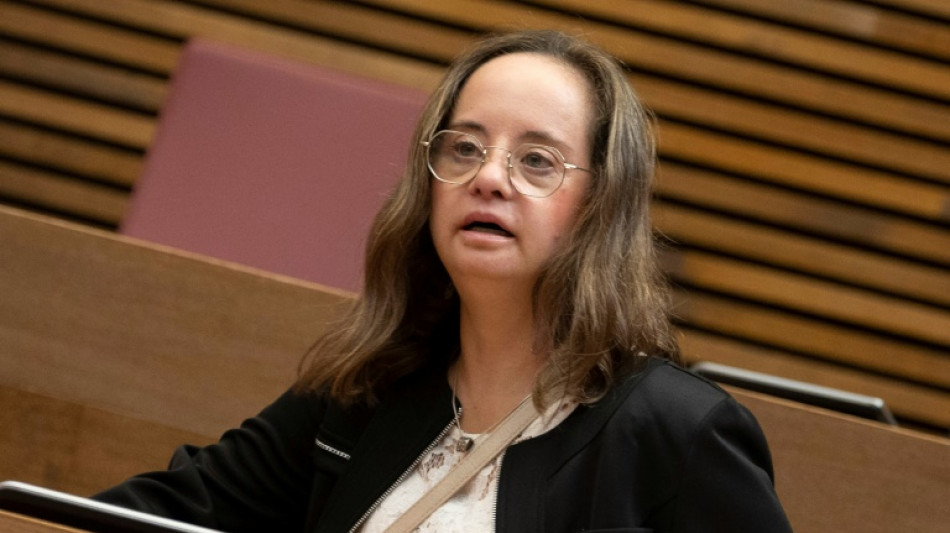
Pioneering MP hails disability reform in Spain / Photo: © AFP

 Russia says open to mini Ukraine ceasefires, but no let up in war

 Bangladesh measles crisis 'warning sign' of other outbreaks: report

 'Historic victory': World leaders celebrate Lula's re-election

 Stock markets mixed ahead of tech earnings, central bank decisions

 Mother renews anti-bullying appeal a decade after son’s death

 'Historic victory': Leftist leaders in the Americas celebrate Lula's re-election

 African players in Europe: Jackson brace ends City's perfect record

 Argentine police arrest stepfather after pregnant 10-year-old reaches hospital

 Mother dies after rescuing sons from riptide in the Bahamas

 James Blunt reportedly sought extra underwear during Celebrity Traitors filming

 Trump says Canada trade deal coming 'soon'

 Police urge home-security checks as darker evenings return

 Kane primed to pip Yamal, Mbappe to Ballon d'Or glory

 UK households advised to prepare for three days without essential services

 Chiefs and 49ers suffer first losses of NFL season, Vikings stay unbeaten

 Obama mocks Trump tariffs on Canada during Michigan campaign stop

 Brewers erase four-run deficit as Rays lose World Series Game 2

 Shadab century and record last-wicket stand carry Pakistan past England
 Baylor dismisses Dave Aranda and appoints Joe Klanderman interim coach

 Stocks sink as traders brace for tech earnings, central bank decisions

 Albert Zahn’s carved birds find a lasting home in Wisconsin museums

 NPS Vatsalya offers three choices when a child turns 18

 China's Communist Party elite gather for governance talks

 Maine logging, cross-border ties whipsawed by US-Canada tariff war

 From Carnegie to Claude: AI wealth could reshape philanthropy

Addressing Valencia's regional parliament, Mar Galceran's confidence is striking: she is Spain's first lawmaker with Down syndrome and one of just a few elected across Europe.
She is fighting to change Spanish society's approach to people with disabilities, the formal description of which was amended in the Constitution on Thursday.
Galceran, 46, was voted into Valencia's regional parliament in September, the first person with Down syndrome to be elected in Spain at regional or national level.
Elected as an MP for the right-wing opposition Popular Party (PP), she wants "to change the way society views people with disabilities".
And she has welcomed the rare move to revise Spain's Constitution to replace the word "handicapped" ("disminuido") with "people with disabilities" which was approved by the Senate upper house on Thursday.
Using the term "disminuido" or its colloquial equivalent "minusvalido" ("less valid") has long been "offensive and insulting to the collective of people with disabilities", she told AFP.
"Because we are not 'diminished' nor are we 'less valid'. We are not worth less than other people."
The reform, which also expands their rights, is only the third-ever change to Spain's Constitution since it was approved in 1978, and the first of a social nature.
"Words matter," she said, explaining the importance of "seeing the people and not the disability they have".
- A 'necessary' reform if late -
A member of the PP since she was 18, she spent many years as a civil servant, and always took a stand against the discrimination she faced over her genetic condition.
She spent four years as head of Asindown, a foundation in the Valencia region which helps the families of children with Down syndrome.
An avid runner who loves dancing and once worked in childcare, Galceran says her teenage years were marked by "rejection".
Growing up, she had "acquaintances but never friends, because they saw me as different and didn't really count me as a friend".
Her network of real support always came from her family, who "have always supported me in my decisions".
Since being sworn in, Galceran has been active in the parliamentary committee on people with disabilities, which she believes needs a "cross-party" approach within the healthcare sector, within families, within work and education.
"And there's still a lot left to be done."
For her, the constitutional reform was one of the top priorities.
While it remains largely symbolic, Galceran sees it as a "fair" and "necessary" step -- even if it should have happened earlier.
- 'With different abilities' -
Until now, the wording of article 49 of the Constitution has said that Spain's public authorities are responsible for policies involving the "treatment, rehabilitation and integration of the physically, sensory and mentally handicapped".
The new version says "persons with disabilities are entitled to rights" that must be exercised in "freedom and genuine equality, without discrimination", and stresses the importance of attention to "the specific needs of women and girls with disabilities".
A large majority of Spanish Senators approved the reform in its final reading on Thursday. Only the three from far-right party Vox voted against, arguing they did not want to vote in unison with the ruling left.
Socialist Prime Minister Pedro Sanchez said the measure settled "a moral debt owed to more than four million Spaniards" with one degree or another of disability.
"There is still a long way to go to achieve full inclusion, to embrace the diversity that defines us and to make visible what for so long was painfully ignored," he added during a debate in the lower house of parliament last week, acknowledging the reform was "late".
"The first thing we must do is ask their forgiveness" for using "such an offensive term for so many years," he added.
For Galceran, the debate over language needs to go even further: one day she hopes that even the term "disabled" will be changed to refer to "people with different capacities".
ctpe/vab/hmw/ds/giv
L.Wyss--VB