
EU to ramp up efforts to shield sensitive assets from China / Photo: © AFP

 Netanyahu, rivals trade attacks over Iran as clock counts down to Israel vote
 Townsend urges Scotland to use Nations Championship as World Cup springboard

 Microsoft offers voluntary exit packages to 60,000 staff
 S.Africa ambassador calls for talks with US over 'tense' ties
 'Smells of freedom': Serbians hopeful after landmark election

 South Africa select 'enforcer' Coetzee for Australia decider
 Botanists comb Gabon's rich rainforests with nature on the line
 New levy on non-EU parcels kicks in Sunday
 Stocks climb ahead of tech earnings, central bank calls

 Part of London's Oxford Street pedestrianised 'forever'

 Canadian youth seek climate action in landmark trial
 Trump blasts Norway over Nobel Peace Prize snub
 Japan PM vows swift response to wave of cyberattacks
 Stocks mostly rise before tech earnings, central bank calls
 France's Macron to visit Marseille after protest violence

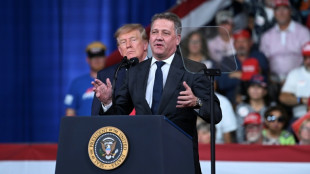 German union slams Audi boss's appearance at Trump rally
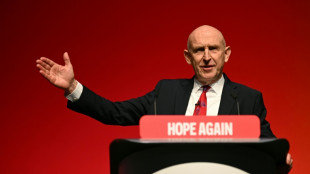 UK set for 'limited' budget giveaways as borrowing costs surge
 Anthropic's AI model accessed US voter data: Axios
 Malaysia's Johor reopens schools as haze eases
 Carragher says Fernandes benching was intended as public punishment

 Canada-EU summit seeks deepened alliance as US ties fray
 Senegal to host Youth Games, Africa's first ever Olympics

 ITV drama Adultery examines temptation, class and family consequences

 New levy on non-EU parcels kicks in November 1

 Saudi coalition says struck Houthi missile facilities after Riyadh airport attack

The European Union will unveil a raft of measures Wednesday to better coordinate action on protecting sensitive technology and stopping critical infrastructure from falling into the hands of geopolitical rivals like China.
Brussels has bolstered its trade armoury to tackle what it deems to be risks to European economic security, following Moscow's invasion of Ukraine and global trade tensions.
The European Union has already proposed new rules that it says are necessary to keep the bloc competitive during the global transition to clean technology and to bring more production to Europe.
The fallout from the war in Ukraine hit Europe particularly hard, forcing the bloc to find alternative energy sources. Now, it wants to avoid a similar over-reliance on China, which dominates in green technology production and critical raw materials.
"The change in EU-China relations has been the driving force of this embrace of economic security, which is something extremely new for the EU," said Mathieu Duchatel, director of international studies at the Institut Montaigne think tank.
Wednesday's package is part of the EU's focus on de-risking but not decoupling from China, pushed strongly by European Commission President Ursula von der Leyen.
It is about addressing "risks to EU economic security, while ensuring that the EU remains a most attractive destination for business and investment", according to a draft text seen by AFP.
"Geopolitical tensions and the pace of technological change mean there is a need for more coordinated action at EU level," the document said.
- Screening investment -
When the European Commission publishes the package on Wednesday, there will be five initiatives including toughening rules on the screening of foreign direct investment (FDI).
The others include improved coordination of export controls, ways to promote research and development of dual-use technologies, and measures to strengthen research security.
Another draft text seen by AFP says member states must establish screening mechanisms.
"A significant share of FDIs in the EU still goes to member states that do not have a screening mechanism and this leaves vulnerabilities because potentially critical FDIs remain undetected," the document said.
The commission will also propose looking at the risks that could result from investments in certain sensitive technologies from the EU to third countries, and whether mitigating measures are needed.
In October the EU unveiled a list of four critical technologies -- advanced semiconductors, artificial intelligence, quantum computing and biotechnology -- that present the most sensitive and immediate risks related to technology security and leakage.
- 'Challenging' coordination -
Experts said that tools must be paired with the political will to act.
Niclas Poitiers, a research fellow at Bruegel think tank, pointed to a 2021-2022 dispute between Lithuania and China over Taiwan as an example that tools are "part of the picture".
"The big problem we have right now is that every member state does whatever they want in the realm of foreign policy, and coordinating these things is very challenging," he said.
Not all EU countries are supportive of the commission's efforts.
"The ideas of decoupling, de-risking, isolating Eastern and Western economies are something that we definitely do not support," Hungary's Trade and Foreign Minister Peter Szijjarto said on Tuesday before meeting with his EU counterparts in Brussels.
He also said that screening foreign investments would be "a political procedure".
A.Zbinden--VB