Struggles of family farms fuel German discontent / Photo: © AFP

 Oil passes $100 a barrel again: why it's more serious this time

 Who are the six candidates vying to lead the UN?

 Hamilton proud of recovery after hitting rock bottom a year ago

 Carapaz eyes polkadot mountains jersey after stage win
 Fields medal awarded to four young mathematicians

 Carapaz claims Tour de France stage as Pogacar loses key team-mate
 Alonso welcomes Aston Martin upgrade, warns against unreal expectations

 Anderson declares Man City 'kings of Manchester' after £116 mn move

 Relieved Russell says Mercedes have solved his power problems mystery

 Oil soars above $100 as Middle East fears grow

 Venezuelans turn to scrap collecting in quake-hit beach 'paradise'

 Heptathlon champion Johnson-Thompson joins list of Commonwealth Games absentees

 Nigeria's Dangote raises $2.5bn to expand Africa's largest refinery

 Oil soars to $100 on fresh Mideast attacks

 Coal-fired power generation rising globally on Mideast war: IEA

 Premier League champions Arsenal sign Greece winger Tzolis from Brugge

 French Jewish DJ sues after activists disrupt gig: lawyer

 Venice film festival promises Pattinson, Oasis and Musk doc

 ASEAN calls for open straits as US-Iran war casts shadow

 Ford and Geely to form joint venture at struggling Spain plant

 Russia warns US against Ukraine arms sales in Manila meeting
 New UK PM announces tax cut for struggling pubs

 Supporters flood India's 'cockroach' protesters with food

 Modi vows punishment for exam leaks fuelling India protests

 Norway set to make formal complaint to FIFA over Balogun red card saga

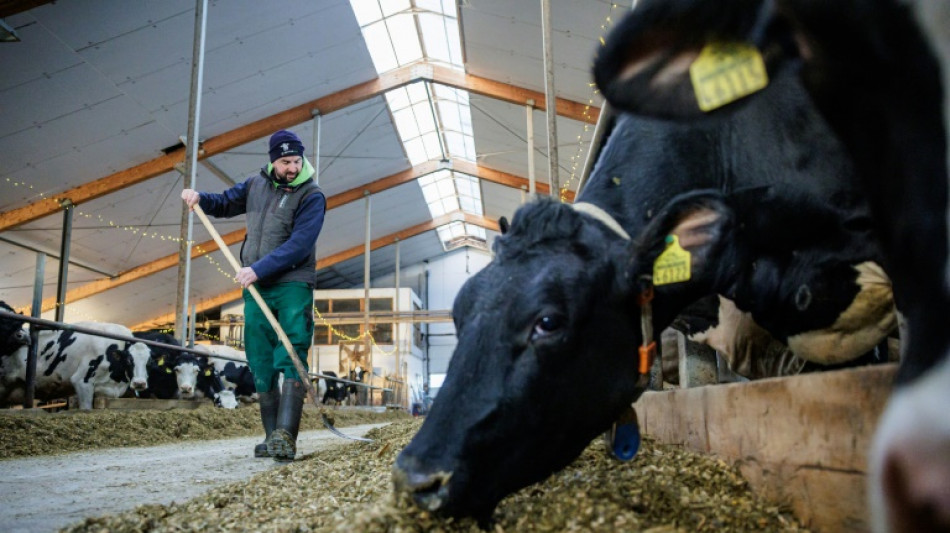
For more than a century, Marc Bernhardt's family has been running a dairy farm in eastern Germany's Saxony region. But passing the torch to the next generation will prove a challenge, he warns.
His production costs have increased by 40 percent since the stat of the war in Ukraine, he told AFP, and his electricity costs are up by 50 percent.
"If it continues like this, we'll have to do something else," said the 37-year-old farmer, based in Freital, south of Dresden.
Although the average income of German farmers increased last year as food prices rose, family farms -- which make up around half of the sector's businesses -- are struggling to cope with increased operating costs.
Anger boiled over after the government unexpectedly announced cuts to subsidies for the agricultural sector, resulting in tractor blockades across the country last week.
The protests culminated in a major demonstration by thousands of farmers in Berlin on Monday.
- 'Unfair' -
At his dairy farm, where he also grows cereal crops and maize, Bernhardt works side by side with his father, the head of the business.
Production is entirely automated. The farm's 100 or so cows, guided by a scent, make their own way to the milking machine, which operates without human intervention. A robot vacuum regularly cleans out the stable.
For Bernhardt, the planned cuts by the government will result in a loss of "10 to 15 percent" in subsidies.
In Germany, more than half of agricultural incomes are supplemented by public aid.
"It's unfair to have to provide the same amount of work for less money," the bearded farmer said.
As a member of an independent farmers' collective, Bernhardt has been active in the protests that erupted at the start of the year.
Berlin announced plans to cut subsidies and tax breaks on diesel and agricultural vehicles after a court ruling tore a multi-billion-euro hole in the government's budget, forcing Chancellor Olaf Scholz's coalition to find savings.
The government, which has already partially walked back on the plans, defended the reductions by pointing to increases in farmers' income in recent years.
In the financial year 2022/2023, farms made a record profit of 115,400 euros ($126,000) on average, a 45-percent increase on the year before, according to industry figures.
- Diversifying -
The strong performance was down to "short-term price increases" amid high inflation in developed countries, explained Martin Odening, professor of agricultural economics at Humboldt University in Berlin.
But, he added, "we must not forget the losses of previous years, especially since prices remain volatile". Some food prices have already started to come down, such as those for milk.
The increased income level was also "just an average", he said.
"Some farms, especially the smaller ones, have not necessarily managed to offset the rising costs with this increase in turnover."
As well as costly investments to meet environmental regulations, smaller farms face difficulties finding skilled workers and a successor when the head of the business retires, according to a study by DZ Bank.
Growing international competition has further added to the plight of family farms and small and medium-sized agricultural outfits.
"We really wonder if it's still worth having a small farm like ours," said 26-year-old Nathalie Diebow, currently in training, who joined a farmers' protest in the eastern city of Cottbus last week.
The number of farms in Germany decreased by 12 percent between 2010 and 2020 and is expected to drop from around 256,000 currently to 100,000 by 2040, according to DZ Bank.
Consolidation in the agricultural sector will see the average farm size increase from 64.8 hectares to 160 hectares.
To diversify his income, Bernhardt has decided to open a guest house, host educational events and install solar panels at the farm.
But for Bernhardt, nothing could ever replace dairy farming. "It's in my blood," he said.
T.Germann--VB