
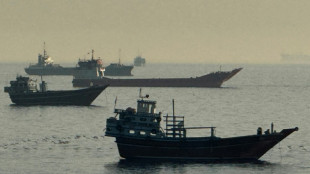
Attacks on Red Sea shipping mount, but confronting Huthis carries risks / Photo: © AFP

 Six candidates to lead UN take stage for televised debate

 King Charles opens slimmed down Commonwealth Games in Glasgow

 US unveils new tariffs on 60 partners as Trump rebuilds trade agenda

 WNBA viral star Cunningham wades into trans athletes row
 Hearn dismisses Fury talk of Joshua no-show for super fight

 'Like a war zone': France evacuates 20,000 due to wildfires

 Ships avoid Ukrainian grain ports after Russian attacks

 Oil passes $100 a barrel again: why it's more serious this time

 Who are the six candidates vying to lead the UN?

 Hamilton proud of recovery after hitting rock bottom a year ago

 Carapaz eyes polkadot mountains jersey after stage win
 Fields medal awarded to four young mathematicians

 Carapaz claims Tour de France stage as Pogacar loses key team-mate

 Alonso welcomes Aston Martin upgrade, warns against unreal expectations

 Anderson declares Man City 'kings of Manchester' after £116 mn move

 Relieved Russell says Mercedes have solved his power problems mystery

 Oil soars above $100 as Middle East fears grow

 Venezuelans turn to scrap collecting in quake-hit beach 'paradise'

 Heptathlon champion Johnson-Thompson joins list of Commonwealth Games absentees

 Nigeria's Dangote raises $2.5bn to expand Africa's largest refinery

 Oil soars to $100 on fresh Mideast attacks

 Coal-fired power generation rising globally on Mideast war: IEA

 Premier League champions Arsenal sign Greece winger Tzolis from Brugge

 French Jewish DJ sues after activists disrupt gig: lawyer

 Venice film festival promises Pattinson, Oasis and Musk doc

A spate of attacks by Yemeni rebels on Red Sea shipping has disrupted the vital trade route, but experts say stopping them appears difficult at best -- and risky at worst.
Dozens of drone and missile attacks have been launched on ships by the Huthis, part of the Iran-backed "axis of resistance" reinvigorated by Israel's war on Hamas.
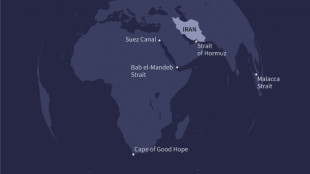
The rebels, who control large swathes of war-torn Yemen, are targeting supposedly Israel-linked ships passing through the Bab al-Mandeb strait, the Red Sea's southern gateway.
Their attacks, often with home-assembled drones and missiles, has forced some companies to divert around southern Africa to avoid the Red Sea, the key conduit for Asia-Europe shipping which usually carries about 12 percent of maritime trade.
Washington says more than 20 nations have joined the US-led Operation Prosperity Guardian to guard the commercially sensitive Red Sea.
And last week, the United States and Britain were among 12 countries who jointly warned the Tehran-aligned rebel forces of unspecified consequences if the attacks continue.
Undaunted, the Huthis this week fired their biggest salvo yet: 21 missiles and drones that were shot down by US and British forces.
"Enough is enough," UK Defence Minister Grant Shapps said afterwards. "We must be clear with the Huthis that this has to stop."
The bellicose language is at odds with the reality that the Huthis have little to lose and much to gain from a military confrontation, experts say.
"Offensive military operations in Yemen will be counter-productive," said Gerald Feierstein, a former US ambassador to Yemen and the director of the Arabian Peninsula Affairs programme at the Middle East Institute think-tank in Washington.
Bombing the Huthis, who have weathered years of airstrikes by a Saudi-led coalition, would have little impact and would only raise their standing and legitimacy in the Arab world, he said.
- 'New costly conflict' -
"The best option would be to continue the defensive operations to protect international shipping until the conflict in Gaza winds down," Feierstein told AFP.
The situation is also delicate for Arab governments, who risk being seen as traitors to the Palestinian cause if they openly oppose the Huthi attacks which the rebels say are in solidarity with Gaza.
Yemen's powerful neighbour Saudi Arabia -- which is trying to extricate itself from a fruitless, nine-year war against the Huthis -- has stayed silent on the attacks raining down close to its territorial waters.
"The Saudis don't want to jeopardise their talks with the Huthis or trigger a new round of Huthi attacks against Saudi targets," said Feierstein, referring to the Huthis' targeting of Saudi oil facilities between 2019 and 2022.
The Saudi-led military coalition intervened in 2015 in support of the Yemeni government, the year after the rebels took control of the capital Sanaa.
The war has claimed hundreds of thousands of lives and plunged the Arabian Peninsula's poorest country into a deep humanitarian crisis, but fighting has largely been on hold for the past two years.
Apart from Iran which holds the most influence over the Yemeni rebels, Oman plays a significant role, too.
But the Omanis "are reluctant to pressure the Huthis at this time because they don't want to be perceived as supporting Israeli operations in Gaza", said Feierstein.
Regional retaliation by the Yemeni rebels to a major military offensive remains a risk, said Thomas Juneau, assistant professor at the University of Ottawa's School of Public and International Affairs.
"Large-scale strikes would... risk entrapping the US into a new costly conflict, especially if the Huthis retaliate regionally," he said.
The Huthis have struck the United Arab Emirates in 2022 and launched missiles towards Israel during its war with Hamas, triggered by the Palestinian group's attacks in early October.
Karim Bitar, a professor of international relations at Beirut's Saint Joseph University, said the military option was a "last resort" for the Western powers.
"I think (US officials) are using their channels of communications through the other regional powers, specifically Oman, to deter the Huthis from striking again."
To Bitar, "the cold hard truth is that threats to freedom of navigation and to international trade in the Red Sea have mobilised the international community more than 20,000 civilian deaths in Gaza."
L.Wyss--VB