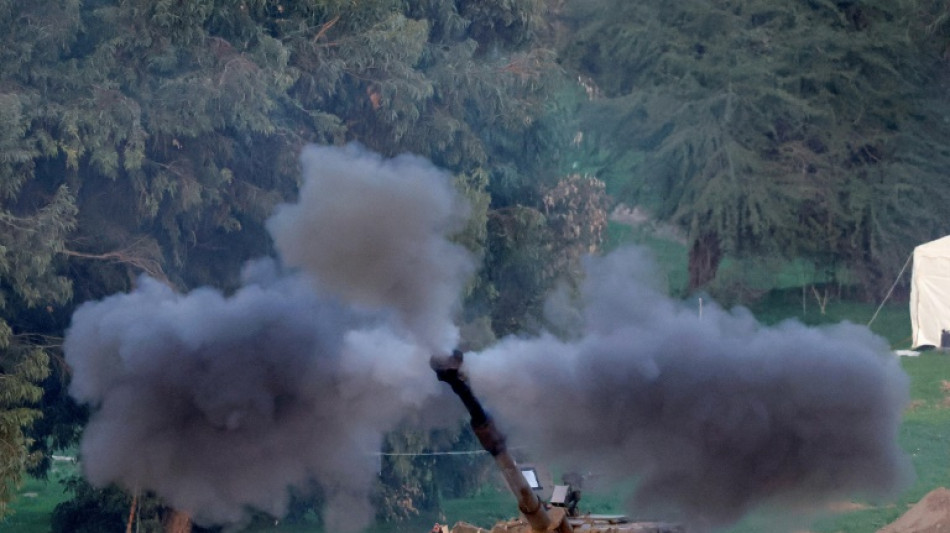
Israel bombs Gaza as Blinken ends regional tour / Photo: © AFP

 Six candidates to lead UN take stage for televised debate

 King Charles opens slimmed down Commonwealth Games in Glasgow

 US unveils new tariffs on 60 partners as Trump rebuilds trade agenda

 WNBA viral star Cunningham wades into trans athletes row
 Hearn dismisses Fury talk of Joshua no-show for super fight

 'Like a war zone': France evacuates 20,000 due to wildfires

 Ships avoid Ukrainian grain ports after Russian attacks

 Oil passes $100 a barrel again: why it's more serious this time

 Who are the six candidates vying to lead the UN?
 Hamilton proud of recovery after hitting rock bottom a year ago

 Carapaz eyes polkadot mountains jersey after stage win
 Fields medal awarded to four young mathematicians
 Carapaz claims Tour de France stage as Pogacar loses key team-mate

 Alonso welcomes Aston Martin upgrade, warns against unreal expectations

 Anderson declares Man City 'kings of Manchester' after £116 mn move
 Relieved Russell says Mercedes have solved his power problems mystery

 Oil soars above $100 as Middle East fears grow

 Venezuelans turn to scrap collecting in quake-hit beach 'paradise'

 Heptathlon champion Johnson-Thompson joins list of Commonwealth Games absentees
 Nigeria's Dangote raises $2.5bn to expand Africa's largest refinery

 Oil soars to $100 on fresh Mideast attacks
 Coal-fired power generation rising globally on Mideast war: IEA

 Premier League champions Arsenal sign Greece winger Tzolis from Brugge

 French Jewish DJ sues after activists disrupt gig: lawyer

 Venice film festival promises Pattinson, Oasis and Musk doc

Israel bombarded the southern Gaza Strip Thursday as US Secretary of State Antony Blinken ended a days-long regional tour aimed at preventing the Israel-Hamas war from spreading.
His final stop in Egypt coincided with a hearing at the UN's top court over an urgent appeal for Israel to immediately suspend its military operations in the Gaza Strip.
Adila Hassim, a top lawyer for South Africa which has brought the case against Israel, said Israel's bombing campaign aimed at the "destruction of Palestinian life" and had pushed Palestinians "to the brink of famine".
In Cairo, Blinken met Egyptian President Abdel Fattah al-Sisi, whose country is a mediator in the Gaza war now in its fourth month.
Blinken's nine-country Middle East trip concluded after Wednesday's UN Security Council resolution that demanded Iran-backed Yemeni rebels "immediately cease" attacks which have disrupted shipping in the Red Sea and stoked fears the conflict could spread.
Violence involving Iran-backed armed groups in Lebanon, Iraq, Syria as well as Yemen has spiked during the war, leading to heightened fears it could spread.
"I don't think the conflict is escalating," and nobody wants that, Blinken told reporters on the airport tarmac at the end of his brief Cairo stop.
"Israel doesn't. Lebanon doesn't. I actually don't think Hezbollah does," he said referring to the Lebanese movement, a Hamas ally, which has exchanged regular fire with Israeli forces over their border.
South Africa accused Israel before the International Court of Justice of breaching the United Nations Genocide Convention in its response to Hamas's October 7 attack, which triggered the war.
"No armed attack on a state territory, no matter how serious... can provide justification for or defend breaches of the convention," said Pretoria's Justice Minister Ronald Lamola, setting out his country's case at the court in The Hague.
South Africa is a longtime backer of the Palestinian cause.
- 'Above the law' -
In Gaza's southern city of Rafah, on the border with Egypt and overrun with displaced people fleeing fighting further north, Palestinians mourned their dead and expressed hope the ICJ could render justice on their behalf.
"Israel considers itself above the law. We ask... the international judges to judge Israel" and its government, Hisham al-Kullah said, holding a dead baby whose body was one of several to arrive at Rafah's Al-Najjar hospital.
Another mourner, Mohammad al-Arjan, expressed hope that "the court stops the war".
Israel, which will lay out its defence on Friday, has already accused South Africa of serving as Hamas's "legal arm".
The war began when Hamas launched its unprecedented October 7 attack, which resulted in about 1,140 deaths in Israel, mostly civilians, according to an AFP tally based on official figures.
Militants also took around 250 hostages, 132 of whom Israel says remain in Gaza, including at least 25 believed to have been killed.
Israel has responded with a relentless military campaign that has killed at least 23,469 people, mostly women and children, according to the health ministry in Hamas-run Gaza.
Hamas's press office said early Thursday that 62 people had been killed in strikes overnight, including around Gaza's main southern city of Khan Yunis.
The wounded included several children who arrived at the city's Al-Nasser hospital. A boy with a pained expression and blood down one side of his face walked in. A man carried the limp body of a girl from an ambulance.
Israel's military said in a statement on Thursday that "underground combat" led to the discovery of more than 300 tunnel shafts under Khan Yunis, and that "Israeli hostages had been inside" one vast tunnel.
During a visit with troops in central Gaza, Israeli army chief Herzi Halevi said the militants had prepared their defences "over a very long period of time in a very organised way", adding it is "a very, very complex battlefield".
- Makeshift clinic -
The war has triggered an acute humanitarian crisis, with an Israeli siege sparking shortages of food, water, fuel and medicine.
World Health Organization chief Tedros Adhanom Ghebreyesus on Wednesday said there are "nearly insurmountable challenges" to aid delivery in Gaza.
"Intense bombardment, restrictions on movement, fuel shortages, and interrupted communications make it impossible for WHO and our partners to reach those in need," he told reporters.
The WHO says only a few Gaza hospitals are even partly functioning.
In Rafah, former Gaza health ministry staffer Zaki Shaheen converted his shop into a makeshift clinic.
"We got help from the health ministry," aiming to ease pressure on overburdened hospitals, Shaheen told AFP.
"We receive no less than 30 or 40 cases per day, morning to night. I'll be sleeping, then someone comes in with an injury or a burn, so we treat them," he told AFP.
The United Nations estimates 1.9 million Gazans have been uprooted by the war.
Before his final stop in Egypt, Blinken sketched out a possible post-war future for Gaza after meeting Palestinian president Mahmud Abbas and Bahrain's King Hamad bin Isa Al-Khalifa.
In Cairo Blinken said movement towards a Palestinian state, alongside a rapprochement between Israel and Arab countries, is the way to isolate Iran.
"There's a path that brings Israel's needs and desires for integration," he said. "If you make the necessary commitment to security and you move down the path to a Palestinian state, it's the single best way to isolate Iran and the proxies."
Yemen's Huthi rebels, who say they are acting in support of the Palestinians, have carried out numerous attacks on merchant ships in the Red Sea, a vital artery for international trade.
On Thursday armed men in "military-style" uniforms boarded an oil tanker in the Gulf of Oman, a maritime risk management company said, before Iranian state media reported Iran's navy had seized an American oil tanker following "a court order".
M.Betschart--VB