
Between China and the US, trade takes a different route / Photo: © AFP

 Six candidates to lead UN take stage for televised debate

 King Charles opens slimmed down Commonwealth Games in Glasgow

 US unveils new tariffs on 60 partners as Trump rebuilds trade agenda

 WNBA viral star Cunningham wades into trans athletes row
 Hearn dismisses Fury talk of Joshua no-show for super fight

 'Like a war zone': France evacuates 20,000 due to wildfires

 Ships avoid Ukrainian grain ports after Russian attacks

 Oil passes $100 a barrel again: why it's more serious this time

 Who are the six candidates vying to lead the UN?

 Hamilton proud of recovery after hitting rock bottom a year ago

 Carapaz eyes polkadot mountains jersey after stage win
 Fields medal awarded to four young mathematicians

 Carapaz claims Tour de France stage as Pogacar loses key team-mate

 Alonso welcomes Aston Martin upgrade, warns against unreal expectations
 Anderson declares Man City 'kings of Manchester' after £116 mn move
 Relieved Russell says Mercedes have solved his power problems mystery

 Oil soars above $100 as Middle East fears grow

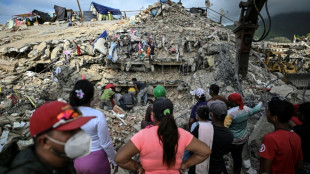
 Venezuelans turn to scrap collecting in quake-hit beach 'paradise'

 Heptathlon champion Johnson-Thompson joins list of Commonwealth Games absentees

 Nigeria's Dangote raises $2.5bn to expand Africa's largest refinery

 Oil soars to $100 on fresh Mideast attacks
 Coal-fired power generation rising globally on Mideast war: IEA

 Premier League champions Arsenal sign Greece winger Tzolis from Brugge

 French Jewish DJ sues after activists disrupt gig: lawyer

 Venice film festival promises Pattinson, Oasis and Musk doc

Are the US and Chinese economies on the verge of decoupling? Trade data might suggest so, as the Asian giant, Washington's largest trading partner for a decade, has been supplanted by Mexico and is seeing its market share shrink.
"Decoupling" or "derisking" vis-à-vis China are themes repeated over and over by President Joe Biden's administration, but also by his Republican rivals, led by Donald Trump, in this general election year during which China is likely to be the main foreign policy topic.
But the reality is not necessarily so obvious, analysts say, pointing to the growing complexity of supply chains which make it more difficult to identify the trade flows between the world's two largest economies.
On the face of it, there can be no doubt the divergence of the US and Chinese economies is underway; in absolute terms, Chinese imports have not fallen particularly sharply, but regarding market share the decline is significant.
China's share of US imports fell from 22 percent in 2017 to 16 percent today, according to Caroline Freund, an economist specialising in international trade at the University of California.
"That's a really sharp decline in China's share of US imports," she told AFP. "It takes it back to the level China was in 2007, before the global financial crisis."
"Decoupling is definitely happening," she said, adding this isn't necessarily due to shrinking imports from China, but rather the result of a more rapid expansion of trade with other partners like Mexico.
Trade data published by the US Department of Commerce show a more marked increase in Mexican imports, benefiting in particular from the US-Mexico-Canada agreement, or USMCA.
But Mexico is far from alone.
Asian countries -- and Vietnam in particular -- are also benefiting greatly from the redefinition of trans-Pacific trade.
"Yes, Mexico has captured some of that, but the majority of the relocating of production away from China, is now occurring in Taiwan, South Korea, India, Vietnam," former Mexican ambassador to Washington, Arturo Sarukhan, told AFP.
The main reason for the shift, according to Dragoman Global analyst Henry Storey, is that these countries take advantage of their proximity to China, and are therefore able to attract Chinese investment.
- Investing to circumvent -
Vietnam in particular has seen its exports to the United States soar in recent years, rising from $21 billion in 2012 to $136 billion in 2022, to become one of its major trading partners, although the majority of operations there are actually final assembly.
US Treasury Secretary Janet Yellen visited the Southeast Asian nation last summer to stress the importance of Vietnam in US supply chains without China, underscoring the dramatic change in America's trading relationships.
While the symbol of this visit was a photo of Yellen on an electric scooter assembled in Vietnam, it later transpired that most its components had come from China, the US press discovered afterwards.
It is difficult to trace the origin of products entering the United States, even though assembly is most often the stage at which the famous "made in" label is applied.
And so Chinese companies can often get around trade restrictions.
"Although China is losing market share, I think overall its exports are still trending very strongly," said Storey from Dragoman Global.
"Since Trump's tariffs were imposed in 2018, the fastest growing area of exports is actually the central and western provinces of China," he added.
"The value added share of US imports from China has fallen less than the direct imports," said Freund from the University of California. "So we're getting indirect imports from China via places like Mexico and Vietnam."
This has had a knock-on effect: Chinese investment in Mexico, which until now has been very low, is now rising sharply, causing concern in Washington.
"Mexico is an outlier if you compare it to the rest of Latin America because the Chinese footprint in Mexico is nowhere close to what it is in South American countries that are commodity exporters," said Sarukhan, the former ambassador.
Although the country is not a commodity exporter, there has nevertheless been "an increase in Chinese investment in Mexico," he added.
Washington has been paying close attention to this growing relationship.
During a visit to Mexico City in early December, Janet Yellen agreed with Economy Minister Raquel Buenrostro Sanchez to set up a US-Mexican working group to evaluate Chinese investment in the country, particularly in sectors deemed key by the United States.
L.Meier--VB