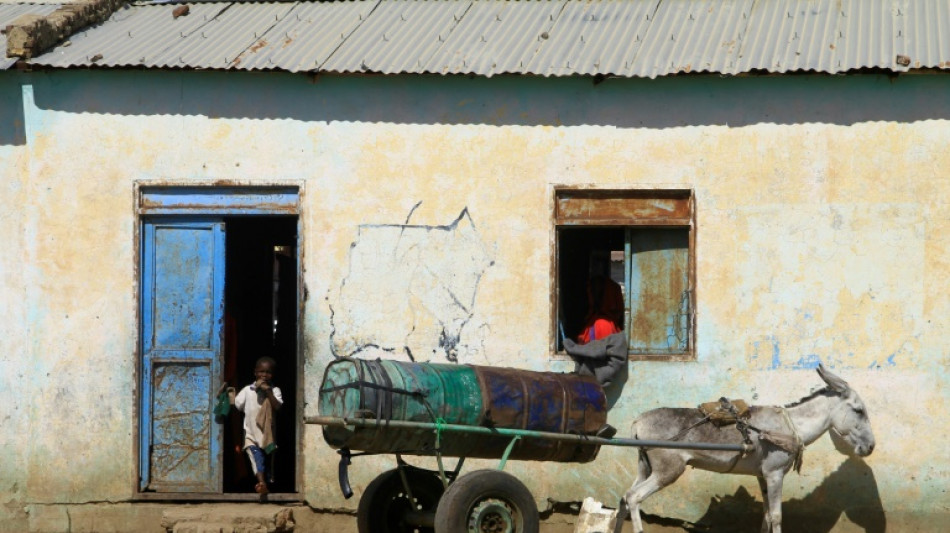
Harvest lost as war expands in famine-threatened Sudan / Photo: © AFP

 Six candidates to lead UN take stage for televised debate

 King Charles opens slimmed down Commonwealth Games in Glasgow

 US unveils new tariffs on 60 partners as Trump rebuilds trade agenda

 WNBA viral star Cunningham wades into trans athletes row

 Hearn dismisses Fury talk of Joshua no-show for super fight

 'Like a war zone': France evacuates 20,000 due to wildfires

 Ships avoid Ukrainian grain ports after Russian attacks

 Oil passes $100 a barrel again: why it's more serious this time

 Who are the six candidates vying to lead the UN?

 Hamilton proud of recovery after hitting rock bottom a year ago

 Carapaz eyes polkadot mountains jersey after stage win
 Fields medal awarded to four young mathematicians
 Carapaz claims Tour de France stage as Pogacar loses key team-mate

 Alonso welcomes Aston Martin upgrade, warns against unreal expectations

 Anderson declares Man City 'kings of Manchester' after £116 mn move

 Relieved Russell says Mercedes have solved his power problems mystery

 Oil soars above $100 as Middle East fears grow

 Venezuelans turn to scrap collecting in quake-hit beach 'paradise'

 Heptathlon champion Johnson-Thompson joins list of Commonwealth Games absentees

 Nigeria's Dangote raises $2.5bn to expand Africa's largest refinery

 Oil soars to $100 on fresh Mideast attacks
 Coal-fired power generation rising globally on Mideast war: IEA

 Premier League champions Arsenal sign Greece winger Tzolis from Brugge

 French Jewish DJ sues after activists disrupt gig: lawyer

 Venice film festival promises Pattinson, Oasis and Musk doc

Since Sudan's war spread to Al-Jazira state south of Khartoum, farmers have watched their livelihoods wither away after fighting between paramilitary forces battling the army wreaked havoc on once-bountiful lands.
"For weeks I haven't been able to reach the wheat I planted in November," Ahmed al-Amin, 43, told AFP from his farm 20 kilometres (12 miles) north of state capital Wad Madani.
After war erupted in April last year between the regular army and the paramilitary Rapid Support Forces (RSF), Al-Jazira -- just south of Khartoum -- became a sanctuary for more than half a million people, according to the United Nations.
But the front line has been edging southwards for months, and in December the fragile peace in Al-Jazira was shattered.
The fight for Wad Madani began, and hundreds of thousands of people were forced to flee from the state.
When the army quickly retreated from the state capital, the RSF took over swathes of agricultural land, laying siege to entire villages and leaving farmers unable to tend to vital crops.
Amin says his crops need water and fertiliser that he and other farmers in the area can no longer provide.
His farm is part of the Gezira agricultural scheme, an important irrigation project that is a key source of food for the northeast African country.
Local officials had announced plans in October to plant 600,000 acres of wheat -- vital to fend off widespread hunger.
Most of its food is imported, and with a war-crippled economy and 5.8 million people displaced within the country, the spectre of famine has stalked Sudan for months.
- Widespread hunger -
According to the UN's World Food Programme (WFP), nearly 18 million people are currently facing acute hunger, with five million at "emergency levels of hunger".
Although a famine has not been officially declared, "there is no other way around what's about to happen in Sudan", according to Norwegian Refugee Council (NRC) country director William Carter.
On Saturday, US agency USAID's Famine Early Warning Systems Network said "fighting in central and eastern Sudan, which is the country's most important region for crop production, is a serious threat to national food availability".
The NRC's Carter is more direct.
"Unless peace magically descends on Sudan, there is going to be famine. At this point, it's not just air strikes and urban warfare killing people," he told AFP.
The fighting has killed more than 12,190 people, according to a conservative estimate from the Armed Conflict Location and Event Data Project.
There are no figures for indirect casualties, including those who have died due to the nationwide breakdown of essential services, infrastructure and hospitals -- 80 percent of which remain out of service.
All along the highway from Khartoum to Wad Madani, the RSF has set up checkpoints, seized land and besieged entire communities.
Kamel Saad, 55, saw this happen to his village, 50 kilometres (31 miles) north of Wad Madani.
He had just begun to collect his vegetable crop -- on which he had spent his life savings -- in a last-ditch effort to make it through this year's harvest season.
"My crop rotted because of the RSF deployment on the road," Saad told AFP. He now has nothing left to his name.
- Rotting crops -
Others were lucky enough to have gathered in their harvest before the tanks arrived. But now they have nowhere to take their produce.
At this time of year, markets across the state would usually be teeming with farmers and merchants moving their crops, feeding millions.
Now most of these markets are abandoned, looted or closed for fear of attack.
According to officials, local activists and farmers, the RSF fighters have left nearly nothing untouched in their wake.
In a statement, Gezira scheme head Omar Marzouk said "the project's cars and machinery have been looted and workers in every department are unable to reach their work".
Last month, the WFP said paramilitary fighters looted its warehouse in Al-Jazira, stealing "enough stocks to feed nearly 1.5 million severely food insecure people for one month".
By the end of December, "300 cars and farm vehicles" had been looted from the Junaid project on the east bank of the Nile, according to project head Mohamed Gad al-Rabb.
Fertiliser and pesticide warehouses stood empty, their contents looted, and water pumps came to a halt.
"Already we hadn't been paid our profits from the government for two years. Now the water pumps have stopped and our crops are at risk of rotting," farmer Khader Abbas told AFP.
Sudan was already suffering before the war, with triple-digit inflation and a third of the population needing humanitarian aid.
Now, as the fighting spreads southeast, local experts have warned that the damage to the country's agriculture sector could cripple its food security for years to come.
O.Schlaepfer--VB