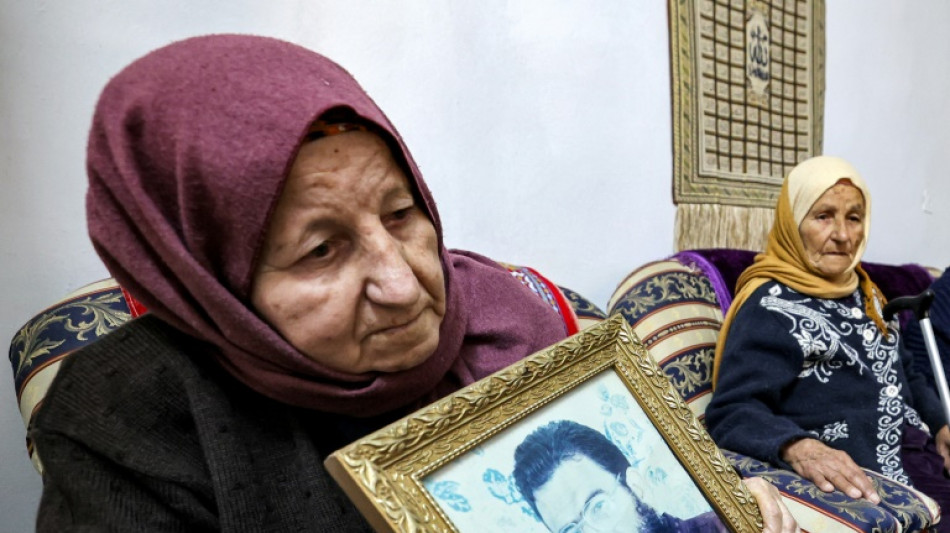
Who was Saleh al-Aruri, Hamas deputy killed in Lebanon? / Photo: © AFP

 Trump under pressure from all sides over Chinese AI surge

 ICC member states decide fate of embattled prosecutor Karim Khan
 Dodgers return to Trump White House despite fan anger

 Lyles, Richardson ease into 100m semis at US athletics championships
 Salman Rushdie testifies at knife attacker's US terror trial

 World Bank confirms plan to phase out China lending by 2031
 US panel backs trendy peptides despite safety concerns

 Justice Dept withdraws NY Times subpoenas over Trump plane report

 Barcelona's De Jong returns from World Cup with torn ligament
 Albania police teargas protesters against Trump-linked resort

 US panel says to loosen restrictions on popular peptide despite safety concerns

 Verstappen swerves around future questions
 EU renews online child sex abuse detection powers

 Airbus, Boeing fly in different directions at Farnborough

 Bab al-Mandeb Strait: another key oil shipping route under threat
 Deadly wildfires in Europe force thousands to flee

 NATO to overhaul European fuel pipeline network
 US trade envoy to make tariff announcement as 10% duty soon expires

 Trump stuns Saudis by pinning nuclear deal to Israel ties

 Tough day for Ubisoft stock topped with weaker revenues
 Swelling jet fuel costs hit American Airlines outlook
 Carapaz climbs unopposed to Tour de France 18th stage win
 Sooryavanshi hits maiden 50 as India thump Zimbabwe in T20

 ECB opens door to September rate-hike as Iran war flares up
 World Bank estimates Venezuela quakes caused $19.6 bn in damage

Saleh al-Aruri, the senior Hamas official killed in a suspected Israeli strike in Lebanon, played a key role in building up the Palestinian group's military capabilities and its links with regional allies.
Aruri, 57, was one of the founders of the Ezzedine al-Qassam Brigades, the armed wing of Hamas, in the early 1990s.
More recently, he was the "channel or link" between the Hamas movement, Iran and Hezbollah, a Hamas source told AFP. He had regularly visited Iran.
Aruri was also considered the leader of Hamas in the West Bank, and the source said that his knowledge and expertise had helped develop the Islamist movement's military capabilities in recent years.
Considered Hamas's number two at the time of his killing, Aruri had been accused by Israel of playing a role in numerous attacks.
These included Hamas's October 7 attack on Israel, which resulted in the deaths of around 1,140 people, mostly civilians, according to an AFP tally based on official Israeli figures.
Militants also took around 250 hostages back to Hamas-ruled Gaza, of whom 129 remain in captivity, according to Israeli figures.
After the attack, the worst in its history, Israel began a relentless bombardment and ground offensive that has killed at least 22,313 people, mostly women and children, according to Gaza's health ministry.
- Living in exile -
Born in the village of Arura, near Ramallah in the occupied West Bank, Aruri studied sharia, the Islamic law based on the teachings of the Koran, at Hebron University.
He joined Hamas's parent movement, the Muslim Brotherhood, as a young man and was also actively involved in Islamic student politics.
Aruri became a member of Hamas when the group was founded in 1987 by the leaders of the Muslim Brotherhood.
He was detained several times in the early 1990s, and in 1992 was sentenced to 15 years in jail on charges of forming the first cells of the Ezzedine al-Qassam Brigades in the West Bank.
He was released in 2007, but detained again three months later until 2010 when he was freed on condition that he go into exile.
Aruri was then deported to Syria, where he remained for three years before relocating to Lebanon.
Following his release in 2010, Aruri was appointed as a member of Hamas's political arm and was on the negotiating team that secured a prisoner exchange involving French-Israeli soldier Gilad Shalit in 2011, along with Egyptian mediators.
On October 9, 2017, Hamas announced the election of Aruri as deputy head of its political arm.
Aruri was married with two daughters and lived in Beirut.
- Who else is left? -
With Aruri out of the picture, Israeli forces will be focusing their attention on other senior Hamas figures.
They include Ismail Haniyeh, the current head of the Hamas political bureau.
Considered a pragmatist, Haniyeh lives in voluntary exile, splitting his time between Turkey and Qatar.
He has long campaigned for a reconciliation between the armed resistance against Israel and a political stance within Hamas, which is blacklisted as a terrorist group by the European Union and the United States.
Another target is Yahya Sinwar, the head of Hamas in Gaza.
He rose through the ranks of Hamas as a fierce advocate of armed struggle against Israel and is considered by the group as their "defence minister".
An aura of mystery surrounds the slightly-built, Hebrew speaker Sinwar, who knows Israel well, having spent 23 years in Israeli jails before his release in 2011 in the Gilad Shalit prisoner exchange.
In the war of words leading up to the start of Israel's ground assault in Gaza, Israeli authorities had said that Sinwar is a "dead man walking".
Mohammed Deif, the head of Hamas's armed wing, has been on the US list of "international terrorists" since 2015 and Israel has tried to assassinate him at least six times.
Considered by Hamas as the group's "chief of staff", Deif is the one who announced in an audio message the start of the Hamas attack on Israel dubbed "Al-Aqsa Flood".
His hiding place is unknown, and he is reported to be a master of disguise who is able to blend seamlessly into the population.
C.Koch--VB