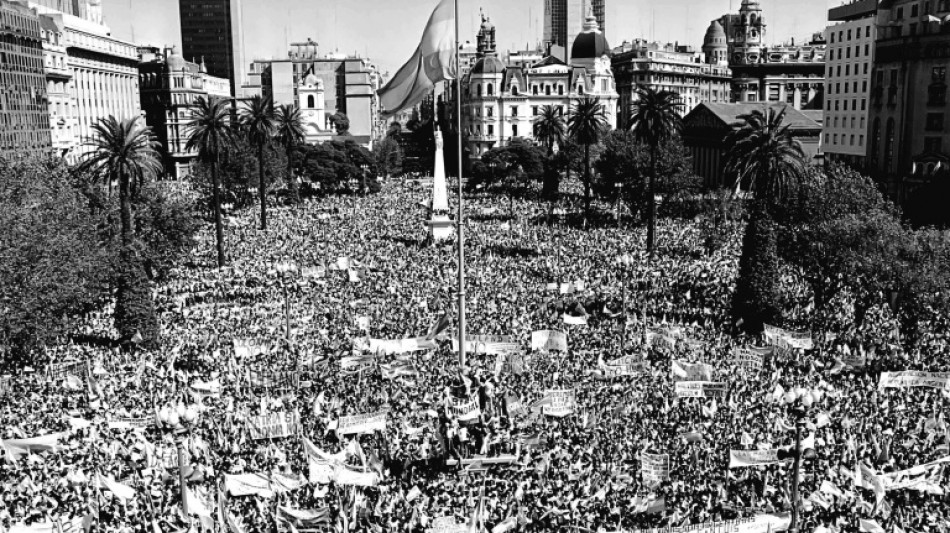
Argentina's dictatorship dug its own grave in Falklands War / Photo: ©

 Trump 'low-key' bets on economic pressure against Iran
 Pitch invaders take selfies with Fernandes during Man Utd friendly

 No-stress Sabalenka won't fret over lackluster 2026 results

 Hometown hero Hudson-Smith basks in Euro glory

 PSG down Aston Villa to retain UEFA Super Cup

 Trump's spokesperson Karoline Leavitt to step down

 'Imposing ignorance': US climate science under siege

 As millions gazed in awe, a swathe of Spain plunged into darkness

 Xavi named first foreign Netherlands coach since 1978

 NBA triple-double king Westbrook to retire after 18 seasons

 'Trying to bury the science': US climate research under siege

 Eurovision to bar countries at war from hosting

 Italian teenager Curtis breaks 50m backstroke world record at Europeans

 New mum Sjostrom wins 50m butterfly for 18th European gold

 Solar eclipse darkens Arctic Russia on course for Spain
 Russian economy rebounds in second quarter despite Ukrainian strikes

 NBA's Los Angeles Lakers to be sold for $12.5 bn: ESPN
 Trump sued over sale of access to Truth Social posts

 Europe looks to the skies as solar eclipse cast its shadow

 At least 44 drown after ferry overturns on Zimbabwe's Lake Kariba

 Grieving Argentine icon Messi unsure about playing on 'much longer'

 Nigeria kidnap victims escape 'hellfire' captivity beaten, malnourished

 Google unveils finder tag, new AI smartphone features

 US equities gain as inflation report eases fear of rate rise

 Colombia declares three days mourning for quake victims

Argentina's embattled military dictatorship was on its last legs when it sought to secure a lifeline with an invasion of the British Falkland Islands 40 years ago this week.
The gambit was initially successful as the attack was feted by a previously hostile public.
Yet the brief misadventure ultimately failed to breathe new life into the dictatorship floundering under social unrest and economic crisis, serving instead to precipitate its demise.
Eight days after the invasion of the South Atlantic archipelago on April 2, General Leopoldo Galtieri, the head of Argentina's military junta, addressed fevered throngs from the balcony of his palace overlooking the central Plaza de Mayo square in Buenos Aires.
"If they want to come, let them come, we will give them battle!" he trumpeted to the cheering crowds in a direct challenge to the British military as a task force traveled south to free the islands.
The public support was a coup by the junta given that just 10 days earlier, tens of thousands of Argentines had filled that same square in the biggest mobilization against the dictatorship since it took power in 1976, chanting: "Elections now!"
The junta thought that by claiming the Falklands -- which Buenos Aires argues it inherited from Spain when it gained independence in the 19th century -- it would be able to turn the tide of public opinion in its favor.
"It was pure political opportunism, without an ounce of patriotism," said historian Felipe Pigna.
"Galtieri had political pretentions to go down in history."
Edgardo Esteban, the director of the Malvinas Museum in Buenos Aires, which uses the Spanish name for the windswept islands, told AFP the invasion was ultimately futile.
It "was the desperate act of a drowning person trying to remain in power forever," said Esteban, who made a film about his experiences as a soldier on the Falklands.
- Geopolitical misstep -
Invasion plans had been drawn up months earlier, with two symbolic dates proposed: May 25, marking the 1810 uprising against the Spanish Crown, and July 9, the date of Argentina's independence in 1816.
But under pressure from a slide into "a severe economic crisis, with a background of large scale human rights violations," according to Pigna, Galtieri's regime needed a publicity victory in short order.
"Faced with social unrest, the dollar jump (against the peso) and financial panic, they brought forward their plans," said Pigna.
But major miscalculations were made.
One key mistake by the junta was its reading of geopolitics, in particular, the expected support from Washington.
"They thought the dictatorship was a 'policeman' for the United States, who would support them," according to Adolfo Perez Esquivel, the 1980 Nobel Peace Prize winner.
"They had not taken into account that the United States has no friends, no allies, only interests. They supported the United Kingdom."
Worse still, said Pigna, was that the initial plan was merely "to occupy, negotiate and leave" the islands in a bid to force Britain to discuss the question of sovereignty, as required by a 1965 United Nations resolution.
"But seeing the Plaza de Mayo full of people from his balcony, Galtieri decided to stay."
Almost 15,000 Argentine soldiers were sent to occupy an archipelago with a population of less than 2,000 at the time and no standing army.
British prime minister Margaret Thatcher, herself facing internal strife, was initially reluctant to act, but finally decided to send an expeditionary force to liberate the islands.
It was a masterstroke for her popularity.
Britain enjoyed "huge military superiority" that was underestimated by the Argentines, who compounded their impetuousness with tactical errors, said Pigna.
- Opposite effect -
The Rattenbach report commissioned by the junta and declassified in 2012 revealed the use of conscripts that had yet to finish training and came from "diametrically opposed" climates to an archipelago battered by icy winds even in summer.
Added to that was poor management of resources that led to "serious malnutrition problems" for the troops.
Dozens of former soldiers have filed a case against their superiors for mistreatment, humiliation and even torture during the conflict that left 649 Argentines and 255 British soldiers dead.
At the announcement of Argentina's surrender on June 14, Plaza de Mayo was filled once again with citizens fuming at their country's capitulation.
Galtieri resigned three days later and the junta called elections for 1983.
"The military adventure" of 1982, as it is called in the Malvinas Museum, produced the opposite of the expected effect and set back decades of diplomatic efforts by previous Argentine governments.
But while the brief and bloody conflict quickened the fall of the dictatorship, 40 years on, Buenos Aires still harbors ambitions of one day making the islands part of Argentina.
C.Meier--BTB