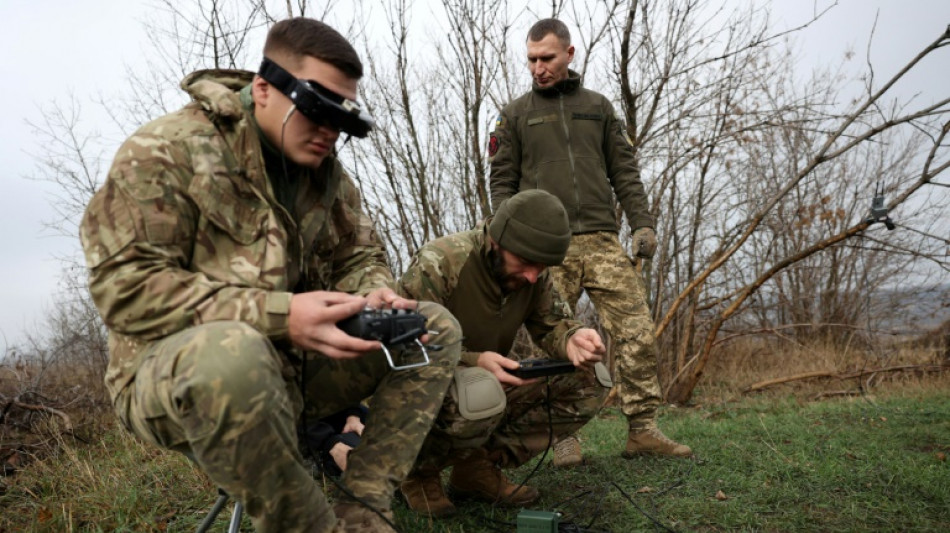
Ukraine sees drones as crucial to battlefield success / Photo: © AFP

 Canada inaugurates US border bridge after cancelling joint ceremony
 ICC members vote to dismiss embattled prosecutor Karim Khan
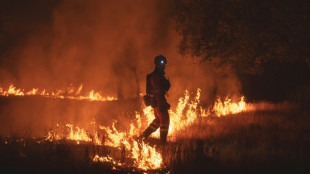
 Over 100,000 flee or hole up indoors as wildfires rage in France and Spain
 Trump says EU to pay 'very big price' for Google fine

 Michael Kim fires 59 at PGA Tour 3M Open

 Pogacar lauds team spirit after 'rough' Tour de France days

 James hopes to bring title magic to Philadelphia 76ers
 Anthropic bets on cheaper AI with new model

 LeBron James: 'King' seeks final NBA conquest with 76ers

 British sprinter Ujah denies alleged cryptocurrency fraud
 Hamilton tops times ahead of Leclerc in Ferrari 1-2 in Hungary

 LeBron James says he will play for Philadelphia 76ers

 Росія після Путіна: «Парламент із шансом в один відсоток»
 Has AI become too powerful to control?

 IOC reject complaint against FIFA chief Infantino over 'political neutrality'
 More than 80,000 flee forest infernos in France and Spain
 Tens of thousands in France flee burning holiday haven, by road and sea
 Maresca says it's a 'privilege' to succeed Guardiola at Man City
 Dutchman van Bommel appointed new Belgium football coach

 Russia after Putin: The ‘parliament with a one-per-cent chance’

 Two wildfires merge near Madrid, 19,000 evacuated or confined
 Peaty begins quest for more Commonwealth gold, Aussie swimmers set for bonus

 US singer Chris Brown admits new affray charge, avoids UK trial
 MEXC Expands Ondo Tokenized Stock Offerings with AI Infrastructure and Mining Assets
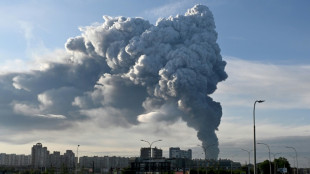 At least 17 killed in Russian and Ukrainian long-range strikes
Sat in a soggy field and strapped into a virtual reality headset, Ukrainian soldier Igor was piloting a military drone test flight using a small control panel in his hands.
The unmanned devices have become a crucial piece of military tech for both Kyiv and Moscow in the war, used extensively to scope out enemy positions, drop explosives and crash into targets.
"Compared to the beginning (of the war), we've made significant progress," 24-year-old Igor, who declined to give his full name for security reasons, told AFP near the frontline city of Bakhmut.
Next to him his colleagues had set up two small masts, signal boosters to increase the drone's range -- and its threat.
"The efficiency of FPV (First Person View) drones has gotten much better. We can fly further and make better use of the ammo carried," he said.
His four-propeller device is equipped with a front-facing camera that allows him to see real-time images as if he were personally aboard the craft.
It can either drop its payload -- typically grenades -- and be flown back for another attack, or set to self-detonate.
Drones are also used extensively for reconnaissance, to spot enemy movements or positions. Another drone can then be sent to attack the target, or the intelligence can by used for artillery and tank fire or advances by infantry units.
Troops on the frontlines have become increasing dependent on -- and fearful of -- their potential.
"Drones are the eyes of our troops," Mykhailo Fedorov, Ukraine's minister of digital transformation, told AFP.
- 120,000 drones a month -
The prevalence of drone warfare has triggered an arms race between Moscow and Kyiv.
Last year, Ukraine's government launched the "Army of Drones" project through its UNITED24 fundraising platform to buy devices, train operators and repair equipment.
Fedorov said the program now had 200 drone manufacturers signed up.
"Last year, only seven (types of) Ukrainian drone could be used on the frontline. Now there are 50 different models made in Ukraine, and the number continues to grow," he said.
FPV drones "cost a couple of hundred dollars but are capable of destroying equipment worth millions when handled by a skilled operator," he added.
Ukrainian officials say they need between 100,000 and 120,000 drones a month.
Fedorov singled out Ukraine's naval drones in the Black Sea as "performing excellent work by destroying the Russian fleet and ensuring maritime safety".
The army uses eight-propeller drones to carry anti-tank mines packed with almost six kilograms (13 pounds) of explosives.
The Russians have allegedly dubbed them "Baba Yaga" after a witch from Slavic folklore who cooked and ate children.
- Artificial intelligence -
In the basement of a house-turned-workshop near Bakhmut, a team led by a 27-year-old commander with the call sign "Banderas" was refitting civilian drones made from Chinese parts for the war effort.
They rejig the devices "so they function with our equipment, antennas and receivers," and install more powerful batteries to increase their range to 18 kilometres (11 miles), he told AFP.
The cellar is also stocked with ammunition for RPG-7 grenade launchers -- a one-kilogram warhead capable of penetrating 500 millimetres (20 inches) of armour -- which is then loaded under the drone before an attack.
Banderas said they lose around a third of the drones, sometimes to enemy fire but usually "because of (Russian) electronic counter-measures" that cut the signal to the drones, causing them to fall from the sky.
Ukraine has also established an "Army of Electronic Warfare" to better defend itself against Russian devices, such as the Lancet tactical attack drones used against artillery.
Kyiv is now planning to use artificial intelligence to better target Russian positions and defend against attacks.
The defence ministry recently approved a system made by Ukrainian firm Saker Scout that uses AI-based algorithms and "advanced optics". It "independently recognises and records the coordinates of enemy equipment (even when camouflaged) and immediately sends the information to the command post," the ministry said in September.
"This eliminates the risk of 'human error', as the eye of the operator is not always able to pick up on every nuance," it added.
To officials like Fedorov, it is impossible to overstate the importance of drones to the situation on the battlefield.
"This war will be won thanks to drones," he said. "Ukraine is doing everything possible -- and impossible -- to succeed."
H.Weber--VB