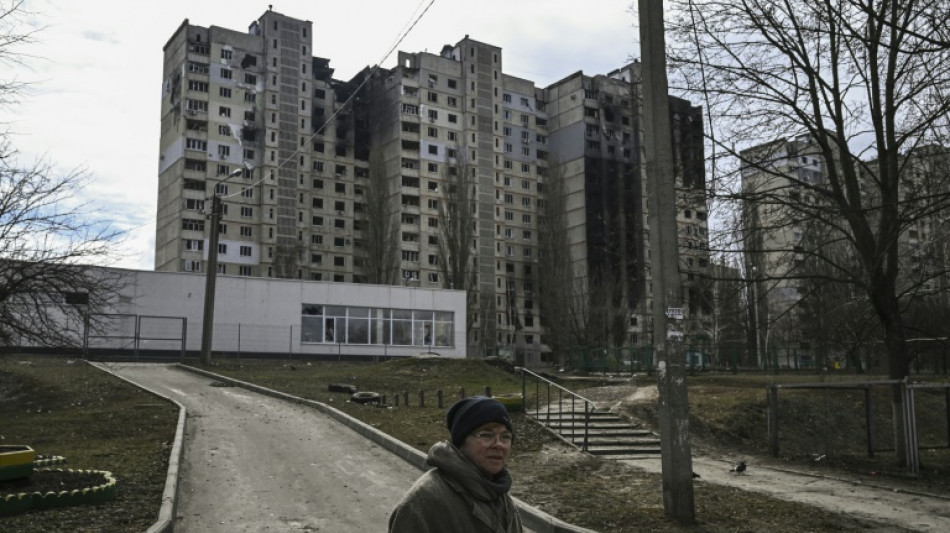
Hanging on in a frontline Ukrainian ghost town / Photo: ©

 Venezuela govt, opposition wrap up round of post-Maduro talks

 Five things to know about Zambia as it goes to the polls

 Nakashima holds off Jodar to book first ATP Masters final in Montreal

 Trump 'low-key' bets on economic pressure against Iran
 Pitch invaders take selfies with Fernandes during Man Utd friendly

 No-stress Sabalenka won't fret over lackluster 2026 results

 Hometown hero Hudson-Smith basks in Euro glory

 PSG down Aston Villa to retain UEFA Super Cup

 Trump's spokesperson Karoline Leavitt to step down

 'Imposing ignorance': US climate science under siege

 As millions gazed in awe, a swathe of Spain plunged into darkness

 Xavi named first foreign Netherlands coach since 1978

 NBA triple-double king Westbrook to retire after 18 seasons

 'Trying to bury the science': US climate research under siege

 Eurovision to bar countries at war from hosting

 Italian teenager Curtis breaks 50m backstroke world record at Europeans

 New mum Sjostrom wins 50m butterfly for 18th European gold

 Solar eclipse darkens Arctic Russia on course for Spain
 Russian economy rebounds in second quarter despite Ukrainian strikes

 NBA's Los Angeles Lakers to be sold for $12.5 bn: ESPN
 Trump sued over sale of access to Truth Social posts

 Europe looks to the skies as solar eclipse cast its shadow
 At least 44 drown after ferry overturns on Zimbabwe's Lake Kariba

 Grieving Argentine icon Messi unsure about playing on 'much longer'

 Nigeria kidnap victims escape 'hellfire' captivity beaten, malnourished

Olga Panchenko, 65, lives with about 20 other locals in a dimly lit basement shelter on a housing estate in northeastern Kharkiv.
She ventures out just twice a day, climbing the six floors to the family's tower block flat, with food for her husband and adult son.
Her husband had a stroke and is paralysed down one side. Her son "lost his mind after an accident" and has to be watched constantly in case he wanders off.
The men are stuck in the flat, in striking distance of Russian shells. They have no electricity or water. The windows are shattered and the curtains hang in sad tatters from the frames.
Saltivka, a run-down suburb in Kharkiv's district number five, is now a ghost town of blackened rubble, mangled playground swings, the unstable carcasses of bombed-out tenement blocks.
Most of the locals have fled the incessant Russian air strikes -- all save a handful who are too old, too unwell or too disabled. Besides, they have nowhere to go.
Russian forces have thrown their full weight at Saltivka, pounding it almost daily since they invaded Ukraine on February 24.
Why here? Saltivka is closer to the rich black soil of the surrounding fields than to the centre of Ukraine's second-largest city.
But a Ukrainian air defence unit was stationed on the edge of the neighbourhood in the early days of the conflict and Ukrainian troops have been firing rocket launchers at the Russians from the vicinity.
- 'Where are the Nazis?' -
Galyna Malakhova, 63, is one of the rare locals not to have moved out. She whiles away the days in her ground-floor flat with her two dogs, Rita and Mafa.
"It's dark and cold in here without electricity," she says apologetically, pulling her woollen coat closer round her.
Sitting on her worn settee under the benevolent gaze of postcard Orthodox icons, she recalls her lucky escape from the missile that rammed the building. It shattered the door of the flat opposite and destroyed the water pipes in the street.
When there is a pause in the shelling, she picks her way around the sodden mattress in the mud outside her door to feed the local cats. They, too, have been left to their fate.
"At first I was petrified. Now I'm a bit used to it," Malakhova says. "When the bombing gets too fierce, I hide in the bathroom. I don't know what's happening outside."
Outside, there is a pause in the shelling. Two hooded silhouettes are stationed in the well of a staircase, in case anyone tries to ransack the abandoned flats.
A man hovers at the entrance to his underground shelter, drawing nervously on a cigarette. His eyes are red with fatigue.
It is dark and dank inside, in the entrails of what was a school just a month ago. You have to stoop to avoid banging your head on the heating pipes.
Forms appear in the candle-lit gloom. A dazed old man behind a school desk, still as a statue. Shapes in blankets huddled on school benches.
Haggard and wan, these locals haven't been outside for days.
"We don't know where to go and we've no idea how to get out of here," says Vadim, one of the rare youngsters in the group. Yevgen, 18, sits nearby with his mother, forlornly stroking his cat.
Russian President Vladimir Putin claimed the invasion was needed to "de-Nazify" Ukraine. But that doesn't wash with the people hiding under the school.
"Where are the Nazis here?" one elderly woman scoffs angrily.
- Just 'staying alive' -
There are 20 or so people living in the shelter. Some managed to salvage a few meagre possessions from home, but they depend for food on volunteers prepared to risk a run for it.
When the power cuts out, they light a fire in the basement to cook.
Two locals died when a rocket landed in front of the school. Roman, 38 and already an army veteran, points to the dried blood stain on the playground wall.
Like Panchenko, others basement residents have relatives trapped in their homes, too frail or ill to negotiate the tower block stairs. The lifts stopped working ages ago.
It takes Panchenko's husband a while to reach their flat door, but he greets visitors with a quiet smile.
"We count the days and nights," Panchenko says, "and just stay thankful for every day we're still alive".
R.Adler--BTB