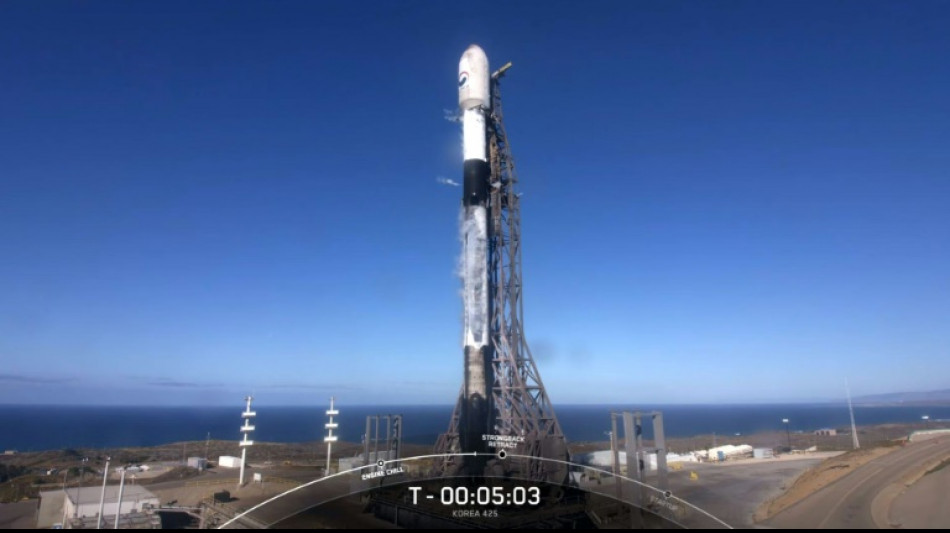
South Korea confirms first spy satellite in orbit / Photo: © SPACEX/AFP

 US panel endorses more unproven if buzzy peptides

 ICC prosecutor Karim Khan removed over 'serious misconduct'

 Venezuela to withdraw from International Criminal Court

 Trump tariff wall set to stay after Supreme Court blow: analysts

 Canada inaugurates US border bridge after cancelling joint ceremony

 ICC members vote to dismiss embattled prosecutor Karim Khan

 Over 100,000 flee or hole up indoors as wildfires rage in France and Spain

 Trump says EU to pay 'very big price' for Google fine

 Michael Kim fires 59 at PGA Tour 3M Open

 Pogacar lauds team spirit after 'rough' Tour de France days

 James hopes to bring title magic to Philadelphia 76ers

 Anthropic bets on cheaper AI with new model

 LeBron James: 'King' seeks final NBA conquest with 76ers

 British sprinter Ujah denies alleged cryptocurrency fraud

 Hamilton tops times ahead of Leclerc in Ferrari 1-2 in Hungary

 LeBron James says he will play for Philadelphia 76ers

 Росія після Путіна: «Парламент із шансом в один відсоток»

 Has AI become too powerful to control?

 IOC reject complaint against FIFA chief Infantino over 'political neutrality'

 More than 80,000 flee forest infernos in France and Spain

 Tens of thousands in France flee burning holiday haven, by road and sea

 Maresca says it's a 'privilege' to succeed Guardiola at Man City

 Dutchman van Bommel appointed new Belgium football coach

 Russia after Putin: The ‘parliament with a one-per-cent chance’

 Two wildfires merge near Madrid, 19,000 evacuated or confined

South Korea confirmed Saturday its first military spy satellite had reached orbit after a successful SpaceX rocket launch and that communication was established with ground control.
Seoul's reconnaissance satellite, carried by one of Elon Musk's SpaceX Falcon 9 rockets, intensifies a space race on the Korean peninsula after the North launched its own first military eye in the sky last week.
South Korea's defence ministry said Saturday its satellite reached orbit soon after the "KOREA"-emblazoned SpaceX rocket lifted off from the Vandenberg US Space Force Base in California at 10:19 am local time (1819 GMT) Friday.
"The satellite was launched 0319 Seoul time and was successfully separated from projectile 11 minutes later and put into targeted orbital trajectory," the ministry said in a statement.
"We have confirmed its communications with the ground command."
Reaching orbit means that South Korea now has its first domestically built spy satellite to monitor nuclear-armed North Korea.
Seoul plans to launch four additional spy satellites by the end of 2025 to bolster its reconnaissance capacity over the North.
Set to orbit between 400 and 600 kilometres (250 to 370 miles) above Earth, the South's satellite is capable of detecting an object as small as 30 centimetres (11.8 inches), according to the Yonhap news agency.
"Considering resolution and its capacity for Earth observation... our satellite technology ranks in the top five globally," a defence ministry official said, as quoted by Yonhap.
The launch comes less than two weeks after Pyongyang successfully put its own spy satellite into orbit.
"Until now, South Korea has relied heavily on US-run spy satellites" when it comes to monitoring the North, Choi Gi-il, professor of military studies at Sangji University, told AFP.
While the South has "succeeded in the launch of a military communications satellite, it has taken much longer for a reconnaissance satellite due to higher technological hurdles", he said.
Following the North's successful launch of its spy satellite, Choi said, "the South Korean government needs to demonstrate it can also pull this off".
- 'Destroy' US spy satellites -
The nuclear-armed North's launch drew international condemnation which the North Korean leader's powerful sister, Kim Yo Jong, called "absurd", declaring that her country would never relinquish its space programme.
North Korea is barred by successive rounds of UN resolutions from tests using ballistic technology, and analysts say there is significant technological overlap between space launch capabilities and the development of ballistic missiles.
On Saturday, Pyongyang threatened to "destroy" US spy satellites if Washington "tries to violate the legitimate territory" of North Korea, referring to its satellite programme.
If the United States attempts to breach its space rights "by weaponizing the latest technologies illegally and unjustly", said a spokesperson of the North's defence ministry in a statement carried by state-run KCNA, "the DPRK will consider taking responsive action measures for self-defence to undermine or destroy the viability of the US spy satellites".
Experts have said putting a working reconnaissance satellite into orbit would improve North Korea's intelligence-gathering capabilities, particularly over South Korea, and provide crucial data in any military conflict.
Since last week's launch, the North has claimed its new satellite has already provided images of major US and South Korean military sites.
It has not yet disclosed any of the satellite imagery it claims to possess.
The North's launch of "Malligyong-1" was Pyongyang's third attempt at putting such a satellite in orbit, after two failures in May and August.
Seoul has said the North received technical help from Moscow, in return for supplying weapons for use in Russia's war with Ukraine.
kjk-burs/sco
T.Suter--VB