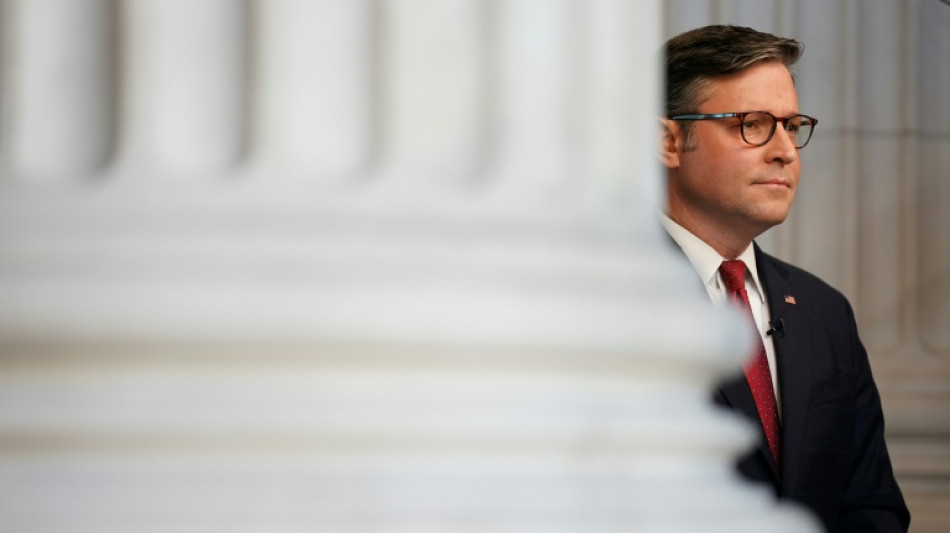
The long-term economic risks of America's budget dysfunction / Photo: © AFP

 Galloway accuser could not foresee publishing-sector fallout, lawyer argues

 New York City Center revives In the Heights as a timely community story

 Godzilla Minus Zero shifts focus toward postwar human drama

 Mehbooba Mufti urges dialogue and renewed Central Asia links for Kashmir

 Seacliff Healthcare Seeks Specialist GP in Thirroul

 US stocks fall before midterm Election Day as technology shares weaken

 BLS Polymers makes strong market debut at ₹248 per share

 Petrol and diesel prices remain broadly steady across major Indian cities

 Reliance shares remain in focus after near-12% surge

 2026 Arizona Midterms: Key Races, Ballot Measures, and Voter Deadlines

 Coal India prepares possible $1 billion Mahanadi Coalfields listing

 Julia Stiles and Ezra Sosa Share Emotional Farewell After 'DWTS' Elimination

 US Buildings Threatened by Wildfires Could Triple by 2060

 Why Pregnancy Cost Estimates Fail: A Family’s $9,000 Surprise

 US Strikes Iranian Targets in Strait of Hormuz Ahead of Midterms

 Brodeur’s Overtime Goal Secures Bethlehem’s Second Consecutive Sectional Title

 Rare 1970 Plymouth ‘Cuda 426 Hemi Listed for $400,000

 The Digital Burden: Why Instant Messaging Feels Like a Full-Time Job

 Alberta Tabled Controversial Riding Boundary Maps Amid Gerrymandering Accusations

 Hong Kong court set to sentence activist Joshua Wong in security case

 Australia raises benchmark rate to highest level in 18 years

 'The Remarried Empress' Cast Discusses Bringing Fantasy Royal Drama to Life

 Asian stocks retreat as AI worries outweigh steep oil-price drop

 Hamad International Airport stages emergency drills during WATAN 2026

The use of stop-gap funding measures to keep the US government open amid frequent political squabbles over how to tackle rising national debt carries long-term risks for the world's largest economy.
While the ongoing stasis in Congress has yet to do any serious damage to the buoyant US economy, the regular budget stand-offs -- and the failure to tackle the country's growing debt burden -- are already having an impact.
Two out of the three major American ratings agencies have now cut their credit rating for US government debt, while Moody's, the sole holdout, recently downgraded its own outlook.
Lower credit ratings reflect higher perceived risk for investors, and typically raise the cost of government borrowing.
"In the context of higher interest rates, without effective fiscal policy measures to reduce government spending or increase revenues, Moody's expects that the US's fiscal deficits will remain very large, significantly weakening debt affordability," the agency said in a statement.
- Punting into 2024 -
"The fiscal situation is challenging and members of Congress, policymakers, the president, have to do something over time," Phillip Swagel, the director of the independent Congressional Budget Office, told CNBC in a recent interview.
The US budget deficit widened to $1.7 trillion in the 12 months to September 30, 2023, pushing up federal debt to 123 percent of economic output, according to the Treasury Department.
Left unchecked, the US debt-to-GDP ratio is on track to surpass its pandemic-era peak in 2027, the International Monetary Fund announced in a recent report.
"We can't escape the fact that we are in over spending and under taxes, given the skew of spending commitments we have made to retirees," KPMG Chief Economist Diane Swonk told AFP.
She called it "that reality that no one wants to actually tackle, especially in an election year."
- Hard deadline ahead -
The risk of a shutdown in early 2024 is likely to be even higher, Goldman Sachs economists wrote in a recent note, pointing to the $120bn gap that still exists between House Republicans and the Democratic-controlled Senate on proposed spending levels.
"The longer the government operates under short-term extensions, the less likely it will be that Congress will reach a deal on full-year spending bills," they said.
If no budget is approved by April next year, the Biden Administration will face a one-percent cut across the board to all non-essential spending, as part of a previous deal to avert a government shutdown.
"The end result would be automatic spending cuts that take effect in May, resulting in a step-down in funding," of around 0.4 percent of GDP in the second and third quarters of 2024, the Goldman Sachs economists said.
"At this point, we can see no realistic path to a resolution of the internal Republican divisions, which are deep and wide," Pantheon Macroeconomics Chief Economist Ian Shepherdson wrote in a recent note to clients.
It is increasingly likely, he said, that Congress will end up passing another stop-gap measure that keeps non-essential spending at 2022 levels until after the 2024 elections -- a significant cut in real terms.
"In any previous Congress this would be a preposterous idea, but this is not any previous Congress," he added.
G.Frei--VB