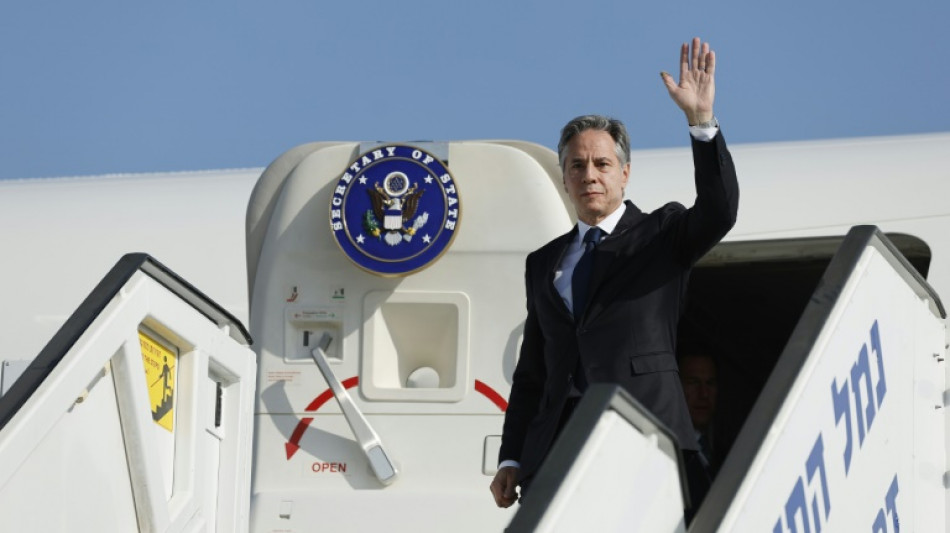
Amid war, US renews talk of Palestinian state but prospects bleak / Photo: © POOL/AFP

 Scotland declares 'major' wildfire in Cairngorms national park

 Spain fights to 'save lives' as wildfire evacuees shelter in Madrid

 Palestinians bury four killed in West Bank clash with Israeli settlers

 49ers coach Shanahan injured in car crash

 China evacuates 340,000 people as Typhoon Noul approaches

 Norris back on pole for Mercedes at Hungarian GP

 Ukraine strikes Siberia refinery as Kazakh leader tells Putin war should end

 Kishan, Varma hit half centuries as India win Zimbabwe T20 series

 Houthis target Saudi oil as new Middle East front

 Madeleine McCann's brother reaches Commonwealth Games final

 Thousands sheltered in Bordeaux as France wildfires trigger exodus

 Houthis say hit Saudi Arabia as fighting spreads on new Middle East front

 Untamed wildfires in Spain, France force over 200,000 to flee

 Spain fights to 'save lives' as wildfires rage near Madrid

 Spain striker Paralluelo joins Lyon from Barcelona

 Untamed wildfires force over 160,000 to flee in France, Spain

 Houthis say hit Saudi Arabia as Trump weighs harder Iran strikes

 Houthis claim strike on Saudi Arabia as conflict deepens

 Teenager allegedly slain by singer D4vd had abortion, court told

 100-year-old Mel Brooks lands at Comic-Con for 'Spaceballs' sequel

 New York's noisy food carts go electric in clean air trial

 Lyles wins US 100m title in world-leading 9.79sec

 Nazgul haunt the hall as 'Rings of Power' trailer airs at Comic-Con
 Trump orders disclaimer signs outside museum of American history

 Mahomes back in full practice, 'optimistic' for NFL opener
With Israel's campaign against Hamas raging, the United States has renewed calls to work toward a Palestinian state, but few expect success now after decades of failure.
President Joe Biden's administration, which has faced heated criticism in the Arab world for supporting Israel's retaliation over an October 7 Hamas attack that largely targeted civilians, has in recent days subtly changed tone by emphasizing the need to minimize harm to Palestinian civilians.
Speaking Friday on his latest trip to Israel, Secretary of State Antony Blinken called for "humanitarian pauses" to let in assistance and said that longer term a two-state solution was "the best viable path -- indeed, the only path."
"That's the only guarantor of a secure, Jewish, and democratic Israel; the only guarantor of Palestinians realizing their legitimate right to live in a state of their own, enjoying equal measures of security, freedom, opportunity and dignity; the only way to end a cycle of violence once and for all," Blinken said in Tel Aviv.
But a two-state solution was blessed almost exactly 30 years earlier by the Oslo Accords and has not come to fruition, with the Palestinian Authority enjoying only limited autonomy in parts of the West Bank, and the United States not leading a concerted diplomatic effort to the goal since John Kerry's efforts a decade ago.
Prime Minister Benjamin Netanyahu is a veteran opponent of a Palestinian state and leads Israel's most right-wing government ever, filled with staunch backers of settlements in the West Bank.
The Palestinian Authority in turn has been increasingly weakened, and has not controled Gaza since 2007 when Islamist militants Hamas took over.
But Brian Katulis, vice president of policy at the Middle East Institute, said that the Biden administration's calls for a two-state solution sent a signal: "We're not going down a dark tunnel here with no end in sight."
"As unrealistic as it sounds in the short term, it's important to keep saying those sorts of things, if only to send the message to regional actors -- Israel, the Palestinians, but some of our Arab partners especially -- that we're recommitting to some sort of horizon" with "at least a figment of a different type of future," he said.
- Forcing talk of future -
Hamas fighters stormed into Israel on October 7, killing more than 1,400 people, mostly civilians, including in homes and at a music festival, according to Israeli officials.
The health ministry in Hamas-run Gaza says more than 9,200 people been killed in relentless Israeli bombardments since then, mostly women and children.
Biden and Blinken, while publicly backing Israel's right to respond to Hamas, have pressed Israel to hand over tax revenue it collects for the Palestinian Authority and to crack down on attacks by settlers against Palestinians in the West Bank.
"Calling for a two-state solution doesn't mean that's the set goal and there will be a Palestinian state after this," said one Washington-based diplomat from a US ally.
"It's more that the Americans want to force the start of a conversation about what comes next," the diplomat said.
- Dwindling support -
Even before the October 7 attack, the deadliest in Israel's history, support was slipping on both sides for a Palestinian state.
A survey taken earlier this year by the Pew Research Center found that just 35 percent of Israelis thought their country could coexist peacefully with an independent Palestinian state, down from 50 percent 10 years ago, with polls showing a similar drop among Palestinians.
Netanyahu, in a UN speech weeks before the attack, cast diplomacy for a two-state solution as the past and said the future was Israeli normalization with Arab states -- a prospect that is also bleaker now.
In an essay after the October 7 attack, Anthony Cordesman, a veteran analyst at the Center for Strategic and International Studies, noted that each serious peacemaking effort for a two-state solution has led to new violence or tension.
The latest fighting shows that a "two-state solution may not be totally dead but is so close to death that efforts to revive it are likely to be little more than acts of zombie diplomacy," he wrote.
But Katulis, who worked in the Palestinian territories after the Oslo Accords, questioned what alternative there was, doubting a future in which Israelis and Palestinians live in the same state.
"As unrealistic as a two-state solution may sound to some folks, it probably is the most realistic of a range of options that are out there," he said.
G.Frei--VB