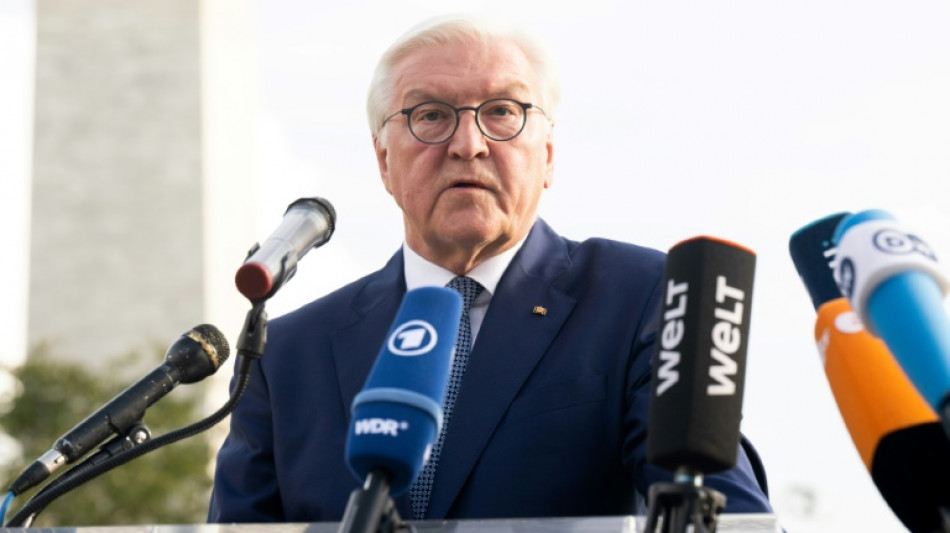
German president asks forgiveness for colonial crimes in Tanzania / Photo: © AFP/File

 Brazil's right-wing party nominates Bolsonaro son to battle Lula
 Norris back on pole at Hungarian GP as rivals handed penalties

 Close to Madrid, those who escaped flames worry what is next
 Messi can skip All-Star Game after grueling World Cup, says MLS
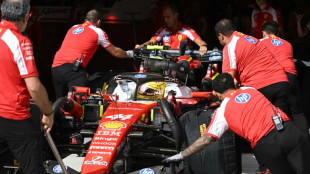 Hamilton stung by three-place grid penalty
 Howe uncertain if Guimaraes will stay with Newcastle amid Arsenal interest
 Varane concussions motivate Como to ban heading in academy teams

 'Amazing' Pogacar-Del Toro friendship lights up Tour de France

 Crisis-hit Flavio Bolsonaro launches presidential candidacy in Brazil

 As wildfires grip France and Spain, what are the risks from the smoke?
 Pogacar set to win Tour de France, Carapaz claims Queen stage

 India's education minister resigns, end called to Delhi protests
 Devastating wildfires send 267,000 fleeing in France and Spain

 Ipswich sign Japan forward Maeda from Celtic
 Norris finds pace to edge Hamilton in last Hungarian practice

 China evacuates 20,000 people as Typhoon Noul nears

 Man City's Khusanov signs new five-year contract
 Atletico complete Lee signing from PSG

 After stellar World Cup, Cape Verde goalkeeper heading to Chile
 Six ancient Comoros medinas join UNESCO's heritage list

 Cameroon leader's absence sparks debate over government inaction
 'Betrayal': The young victims of India's exam leak scandal

 'The Odyssey' sparks IMAX stampede -- and a backlash

 Houthis vow retaliation for Saudi strikes as conflict deepens

 SpaceX carries out successful Starship test flight, first since going public

President Frank-Walter Steinmeier on Wednesday expressed his "shame" at crimes committed during Germany's colonial rule in Tanzania and pledged to raise awareness of the atrocities in his own country.
"I would like to ask for forgiveness for what Germans did to your ancestors here," Steinmeier said during a visit to the Maji Maji Museum in the southern city of Songea, according to a transcript of his speech.
Tanzania was part of German East Africa, which saw one of the bloodiest uprisings in colonial history between 1905 and 1907.
Experts say between 200,000 and 300,000 members of the indigenous population were brutally murdered during the so-called Maji Maji Rebellion, mostly as a result of the systematic destruction of fields and villages by German troops.
Steinmeier said Germany was ready to work with Tanzania towards a "communal processing" of the past.
"What happened here is our shared history -- the history of your ancestors and the history of our ancestors in Germany," he said, promising to "take these stories with me to Germany, so that more people in my country will know about them".
"I want to assure you that we Germans will search with you for answers to the unanswered questions that give you no peace," he added.
The museum visit came on the final day of a three-day trip to Tanzania by Steinmeier, who on Tuesday also opened the door to the return to Tanzania of artefacts looted during the colonial era.
Germany is ready to cooperate on "the repatriation of cultural property and human remains", he said after meeting President Samia Suluhu Hassan in Dar es Salaam.
- Mass killings -
Steinmeier's trip coincides with a visit by Britain's King Charles III to Kenya, also expected to be dominated by conversations about the colonial era.
Over the past 20 years, Germany has been gradually starting to talk more about the crimes it committed during colonial times.
In German South West Africa, now Namibia, Germany was responsible for mass killings of indigenous Herero and Nama people that many historians refer to as the first genocide of the 20th century.
Germany has returned skulls and other human remains to Namibia that it had sent to Berlin during the period.
In 2021, the country officially acknowledged that it had committed genocide in Namibia and promised a billion euros ($1.06 billion) in financial support to descendants of the victims.
Germany has also started to return cultural artefacts looted during the colonial era.
Last year, it began returning items from its collections of Benin Bronzes, ancient sculptures from the Kingdom of Benin, to Nigeria.
The 16th-18th-century metal plaques and sculptures, among the most highly regarded works of African art, are now scattered around European museums after being looted by the British at the end of the 19th century.
Berlin's Museum of Prehistory and Early History has also been carrying out research on around 1,100 skulls from German East Africa since 2017, with the aim of eventually returning the remains to the relevant countries.
In September, the city's museum authority said researchers had identified living relatives in Tanzania of the people whose skulls were pillaged.
F.Mueller--VB