Reality check: what the path to a 1.5C world looks like / Photo: ©

 Japan protests Putin's first visit to disputed islands

 Kiss wants fit-again Wallabies playmaker Gordon to 'open up' Japan

 British eccentrics push humble garden shed to new heights

 Zambia votes with president's economic record on the line

 Germany's dry rivers spark battle on engineering vs restoration

 Senators demand inquiry into conditions aboard USS Abraham Lincoln

 All Blacks' Proctor out of South Africa series, Mo'unga called up

 Bangladesh quick Hasan reduces Australia to 74-4 at lunch

 Seoul tech leads Asian stock gains as traders cheer US inflation

 Farage and Count Binface go head-to-head in snap UK poll
 Afghan students divided over smartphone ban at universities

 Japan go back to school for second Australia Test
 Matthew McConaughey on his sweet return to the big screen
 President's economic record on the line as Zambia votes

 Grieving Messi available for Miami in Leagues Cup clash

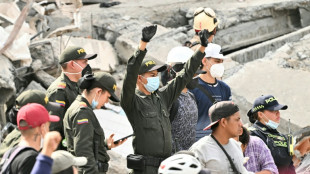 Colombia enters 'final phase' of quake search as toll hits 265

 Father-figure Christie helps guide Kounta to European silver

 McIlroy returns to St. Jude to launch marathon PGA playoff push

 Guimaraes makes Arsenal debut in Como friendly

 Travis Kelce says wedding to Taylor Swift was 'best night of my life'

 US stocks mostly up after data shows slightly lower inflation in July

 Caracas protest denounces secrecy of Venezuela transition talks

 Hudson-Smith regains Euro 400m title on home track

 Rob Reiner son denies grand jury murder charges

 Spain darkens as solar eclipses races south from Arctic

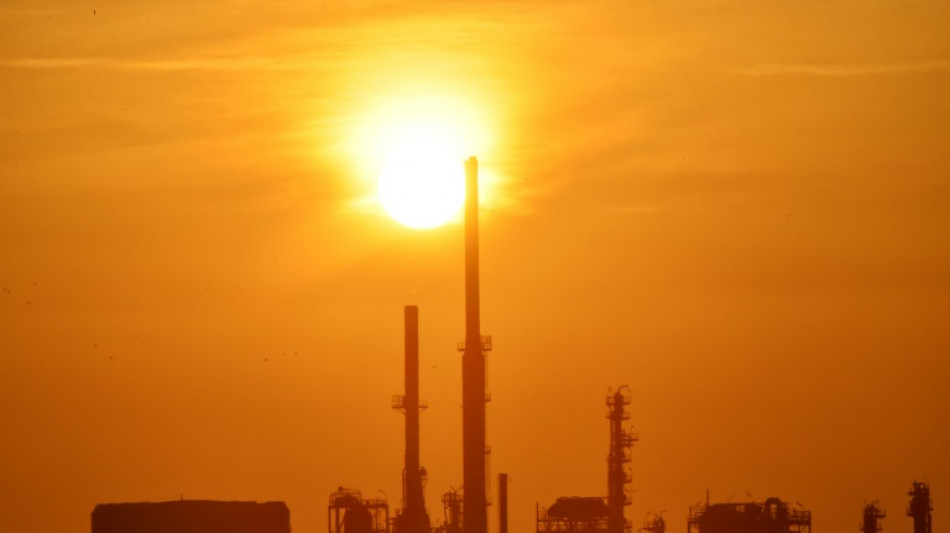
The world needs to rapidly purge fossil fuels from its energy mix if it is to have any hope of limiting global warming enough to avoid disastrous climate impacts, according to a prominent climate scientist.
University of Manchester professor Kevin Anderson is lead author of Tuesday's report from the Tyndall Centre for Climate Change Research detailing how quickly countries must phase-out oil and gas to cap global temperatures at 1.5 degrees Celsius above pre-industrial levels, the more ambitious goal of the Paris Agreement
As the UN's Intergovernmental Panel on Climate Change (IPCC) meets to approve a handbook for eliminating carbon pollution, Anderson talked to AFP about the deep social change needed to address the climate crisis, the tendency to sugar-coat the science, and the dangers of short-term politics.
Q. What is the main takeaway from your new research?
"Delivering on the climate commitments that we've made internationally and nationally -- staying under 1.5C or 2C of global warming -- is far more challenging than we have been prepared to accept. If we are to stay within our carbon budget, the key is eliminating the use of fossil fuels. There are other sources, but carbon emissions are absolutely dominated by fossil fuels."
Q: If rich nation fossil fuel producers must phase out production by 2034, isn't that another way of saying that staying under 1.5C or even 2C is no longer possible?
"As academics, that is not the question we asked. What we're saying is that this is what a 1.5C timeline would look like. Are these the sorts of changes society will choose to make? Is it achievable within the current political point of view? As of now, there's no evidence that's the case. No country -- the EU, the UK, Sweden, the US -- is anywhere near the commitments that we need to make."
Q: Is that a failure to understand the challenge, or something more disingenuous?
"Aside from a few people in the oil majors, I don't think it's deliberate. It stems rather from a longstanding failure to face and understand the problem.
"In the 1990s, we were optimistic about what we could do, but we didn't deliver. Arriving in the 2000s and now the 2020s, it's much harder because it's a cumulative problem. It's a bit like the story of the frog in the pan where you gradually increase the temperature, but the frog never jumps out."
Q. What is the role of climate science in all this?
"Overall, academics have done a fantastic job on the natural climate science, despite oil companies spending a fortune to undermine that.
"But on mitigation -- reducing emissions -- I think we've abdicated our responsibility to speak truthfully from our work to the policy realm, and to wider society as well.
"We've been sweetening the pill for at least 20 years, if not 30 years. And we are now in a position where it's nigh-on impossible, which is why the modellers continue to put forward various techniques that do not exist at scale for removing carbon dioxide from the atmosphere in the future. Otherwise you have to ask very difficult political questions about the choices we are making, and we dare not do that."
Q: Next month the UN's top scientific advisory body, the IPCC, will deliver a landmark report on options for reducing greenhouse gas emissions and removing carbon from the air. You have said this report is deeply flawed. Why?
"How you reduce emissions is innately -- and rightly -- a political issue, not just a scientific one. I don't think this part of the report should even be part of the IPCC process.
"Also, the language of the report dealing with emissions reduction will not fairly reflect what the graphs and the numbers in the database actually show. Virtually all of the models projecting liveable futures assume very high levels of carbon dioxide removal. There is no convenient way to make the number add up otherwise."
"We have to move beyond current short-term politics."
Q: So how can we actually achieve our temperature targets?
"Carrying on with the same approach for another 10 years isn't going to be helpful. We've closed the dialogue down for so long, that's why we are where we are."
"Leaders have to wake up, smell the coffee, and realise what we need to be doing. Right now, we are likely to fail. But if we don't try, we are guaranteed to fail."
C.Kovalenko--BTB