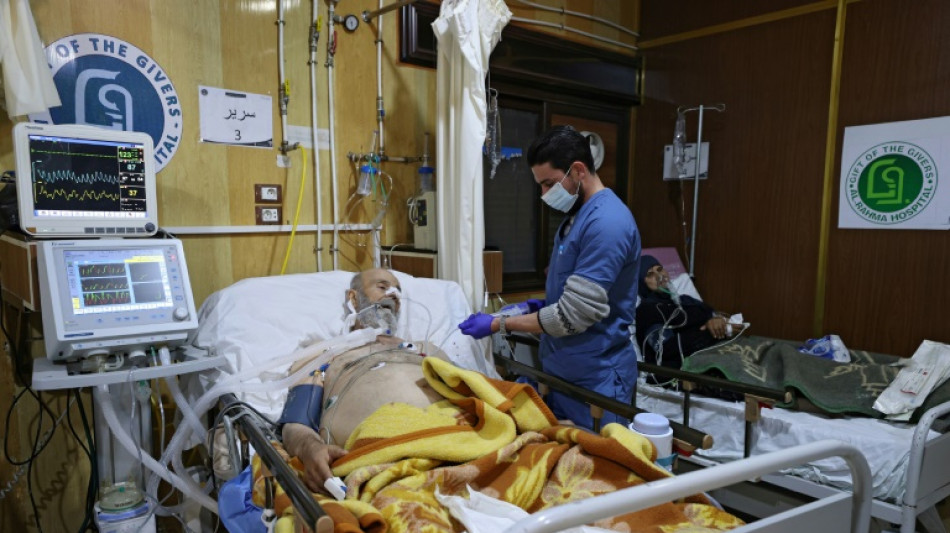
Aid cuts threaten hospitals in Syria rebel enclave / Photo: ©

 Lula win rattles Brazil markets over spending spree fears

 De la Fuente wins men's Ballon d'Or coach of year

 Trump slams 'rigged' Brazil election after ally loses to leftist Lula

 Nadal returns for Vegas hardcourt event

 Fainga'anuku named as loose forward for All Blacks northern tour

 Anthropic points to AI dangers, soaring sales in IPO filing

 Sinner to play rescheduled Saudi Six Kings in December
 Brazilian lawmaker Andre Janones, Lula's social media 'general'

 Swiss Ebola patient repatriated from Nigeria

 Nations far from a deal as UN nature talks enter final stretch

 Brazil markets battered, tech in focus elsewhere

 French court adjourns trial over 2020 death of delivery driver
 Serbian student movement eyes power after election triumph

 Machado ready to meet Venezuela leader after shock return

 Lula celebrates election win as Brazil markets tumble
 France's Macron accuses social media of sowing discord ahead of election
 Anthropic unveils IPO filing showing soaring sales and AI risks

 US singer Chris Brown avoids jail over London nightclub brawl
 US singer Chris Brown avoids jail over UK nightclub brawl
 Man Utd crisis deepens as Carrick faces axe

 Serbian student movement eyes power after resounding snap poll victory
 Eala breezes past world number 411 in Tokyo opener

 Swedish Centre Party leader says government coalition talks failed
 Barca's big-game defeats pose familiar questions
 Russia says open to mini Ukraine ceasefires, but no let up in war
The crowded hospital in Darkush in Syria's rebel-held northwest treats around 30,000 patients every month, for free -- but now foreign aid cuts are threatening its future.
Already dwindling funds have caused dire shortages of medicine and equipment in this and other clinics in the Idlib region, the last Syrian enclave to oppose the regime in Damascus.
The United Nations has appealed for urgent help from donor nations whose largesse has been sapped by the Covid pandemic and fatigue with the decade-old Syrian war.
Umm Alaa said she has been a patient for the past eight days in the Darkush hospital's gynaecological ward.
"I don't want the hospital to close," she said. "I can't afford to go anywhere else.
"Medical care here is good. But the problem is that we have to buy the drugs ourselves -- drugs I can't afford."
A rickety wooden door with a glass window leads to the general surgery ward, where patients lie on narrow beds and on stretchers wrapped in plastic.
The hospital has been financially struggling since November after the major donor, having contributed 80 percent of funding, completely halted aid.
The ambulance service, surgery and paediatric departments, the incubators and the laboratory have now stopped working, said hospital director Ahmed Ghandour.
"We need drugs for our patients and supplies for the lab, radiology, surgery as well as material for the care units and paediatric ward," he said.
The medical staff, he added, has been working without pay since the start of the year, and the hospital only has medicines for about another two months.
- Emergency aid appeal -
The UN's World Health Organization (WHO) has launched an emergency aid appeal for more than $250 million to pull Syria's crumbling health sector through 2022.
If Idlib's medical centres close down, a new catastrophe will hit the region already ravaged by a decade of bloody conflictdoctors warn.
Doctor Salem Abdane, who heads Idlib's health authority, told AFP that international donors used to provide "operational support, salaries and medical supplies".
But he said they had stopped giving aid to around 18 hospitals since the end of last year.
Abdane said that the economic impact of the pandemic and fatigue after 10 years of conflict in Syria drove the aid cuts for health care -- a view echoed by the WHO.
"International support is decreasing while needs are increasing," said Mahmoud Daher, the director of the WHO office in the nearby Turkish city of Gaziantep.
- 'People still suffer' -
Daher said some hospitals had already stopped working, without specifying how many.
The UN will soon provide support to some hospitals in the region, but Daher said it was not enough to mitigate the effects of declining aid.
Most of northwest Syria's more than 490 medical institutions rely on aid to function, Daher said, meaning that funding cuts impact "the lives of hundreds of thousands of people".
Last year, the UN and its partners already fell short of raising even half of the $4.2 billion requested for Syria's humanitarian needs.
In rebel-held areas of the northwest, health facilities have also been targeted by airstrikes.
The group Physicians for Human Rights warned last month that "the health needs of the population far exceed the capacity of available facilities and personnel in northern Syria".
"The dynamic security situation and fluctuating donor priorities threaten humanitarian actors' ability to provide lifesaving care and sustainable support."
Daher said "the Syrian people still suffer everywhere in the country," and he told AFP he was making a plea to donors for help on their behalf. "They need your support."
F.Müller--BTB