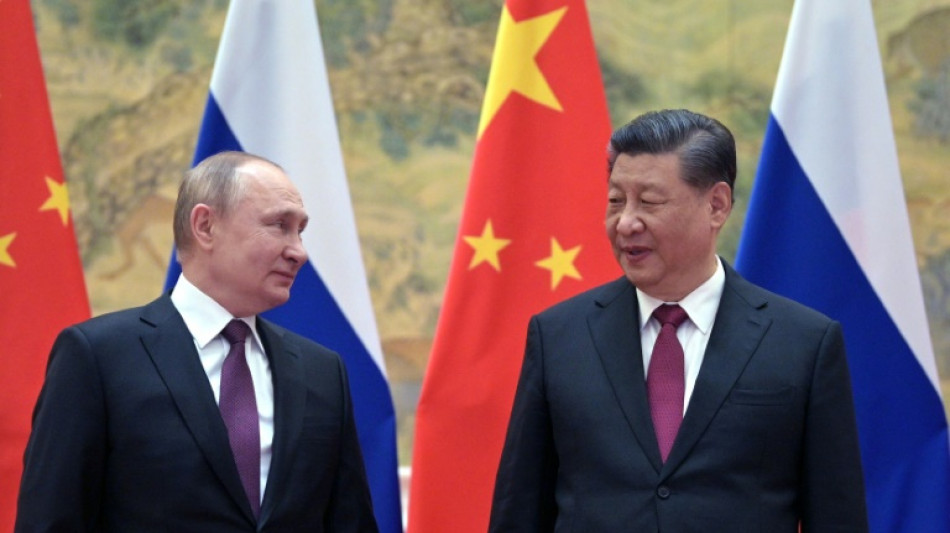
Pressure builds on China to drop its Russian ally / Photo: ©

 Airbus aims for record deliveries despite disappointing quarter
 Cuba wins UN vote against US embargo with weakest backing in 30 years

 Real Madrid, La Liga apology over Mbappe shows power of Chinese market
 From Gaza to Ramallah, Palestinians see little hope in Israeli vote
 US labor leader Dolores Huerta dead: family
 Investors turn cautious ahead of tech results, Fed update on rates

 'Cruise for life' strands passengers in Cambodia as operator goes bust
 Bolsonaro flees Brazil for US after election defeat

 A throne on wheels, popemobiles star in new Vatican show

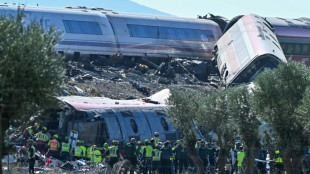 Spain high-speed train crash kills 68, injures over 100

 UK woman drugged by husband tells rape trial she woke up bound

 Clean-up starts as Serbian students movement prepares to govern

 Flavio Bolsonaro: right-wing heir falls from presidential hopeful to exile
 UK budget lifts bank tax to offset surging energy bills

 Spain high-speed train collision kills 64, injures over 100
 Brazil's Bolsonaro lands in Florida after election defeat: AFP
 Russia woos African leaders at Moscow summit

 Local ceasefire in Russia-occupied Ukrainian city holds for second day

 Odegaard urges Arsenal to move on after Fleetwood upset

 Japan, Germany leaders target closer ties on critical minerals
 Spain high-speed train collision kills 31, injures 80

 Turkey hosted Libya east-west reunification talks last week

 Spain high-speed train collision kills 30
 Plane reportedly carrying Brazil's Bolsonaro departs Ecuador

 Springboks pick six uncapped players for Nations Championship

China is under intense diplomatic pressure from the US and its European allies to pull its lifeline from an isolated Russia but, three weeks after the invasion of Ukraine, Beijing has shown few signs of abandoning its friends in the Kremlin.
Washington has driven Russia to the cusp of default since Vladimir Putin's invasion of neighbouring Ukraine, strangling its economy with sanctions and pulling the country from the global payments system.
Isolated, bleeding money and with its currency in freefall, Russia has grasped for the friendship of its giant southwestern ally -- China.
And China appears to have reciprocated, despite the risks to its both reputation and its economic interests as the US-led sanctions unwind.
A senior US official on Monday voiced "deep concerns about China's alignment with Russia" following talks in Rome between US National Security Advisor Jake Sullivan and Yang Jiechi, the Chinese Communist Party's chief diplomat.
The discussions aimed to test the depth of China's commitment to Russia as it struggles to vanquish Ukraine, with images of bomb-scarred buildings and refugees fleeing in their hundreds of thousands horrifying the world.
Since the war erupted, China has refused to condemn Putin's actions - or even describe the invasion as a "war".
Instead, as recently as last week Beijing called the partnership between the two "rock-solid".
Moscow has dangled the prospect of cheap oil and gas to its energy-hungry neighbour, while the west vows to unhook itself from Russian hydrocarbons.
Analysts say President Xi Jinping's challenge is to pick a pathway through the sudden chaos unleashed on the international order by Putin's actions -- and ensure China comes out ahead of its rival, the US.
"China is in it for self-interest, period. A weaker Russia is probably a Russia where you can do more that serves your interests, since you have more leverage," said Alexander Gabuev, senior fellow at the Carnegie Center Moscow.
- Picking a winner -
In its public diplomacy, Beijing seeks to position itself as a neutral player, calling for peace negotiations and condemning NATO for providing military assistance to Ukraine.
But US media reports, citing intelligence briefings, suggest Beijing may be ready to pull the Russian economy back from the brink of default and even meet Moscow's entreaties for weapons and logistical support for its struggling troops in Ukraine.
Alarmed by the potential emergence of a new authoritarian world order, EU officials including its foreign policy chief Josep Borrell have lobbied China over recent weeks to exert its "considerable influence" on Russia to end the war.
Those calls appear to have fallen flat.
"Why would China even consider not to support Russia, or even worse, undermine (its) alliance with Russia?" said Alexander Korolev, Senior Lecturer in Politics and International Relations at the University of New South Wales in Sydney.
"I think China is unlikely to change its position and this will indicate a deeper divide of global geopolitics."
Indications of China's next steps are being scoured out from the oblique comments of its diplomats.
On Tuesday state media carried a message from Wang Yi, Beijing's foreign minister, stating "China is not a party to the crisis, still less wants to be affected by sanctions."
Already global commodity prices have surged -- especially of wheat and corn, which flows from the Russia and Ukrainian breadbasket to China.
Meanwhile Chinese state media has been amplifying Russian propaganda messages.
Those include allegations that the Ukrainian military is using civilians as "human shields" and a conspiracy theory that the United States is developing biological weapons in the former Soviet state.
But for all the chumminess between Xi and Putin, the two countries have a long history of mistrust which is yet to be wiped away.
"China's stance is not so much pro-Russia as anti-US," explains Alexander Gabuev, a China-Russia expert at the Carnegie Center Moscow.
And the unexpected war, which came three weeks after Putin visited Xi in Beijing, may yet challenge a friendship described as having "no limits" following that tour.
"The more protracted and brutal the conflict, the more difficult the situation for China will be," said Ni Lexiong, a professor at the Shanghai Institute of National Defence Strategy.
E.Schubert--BTB