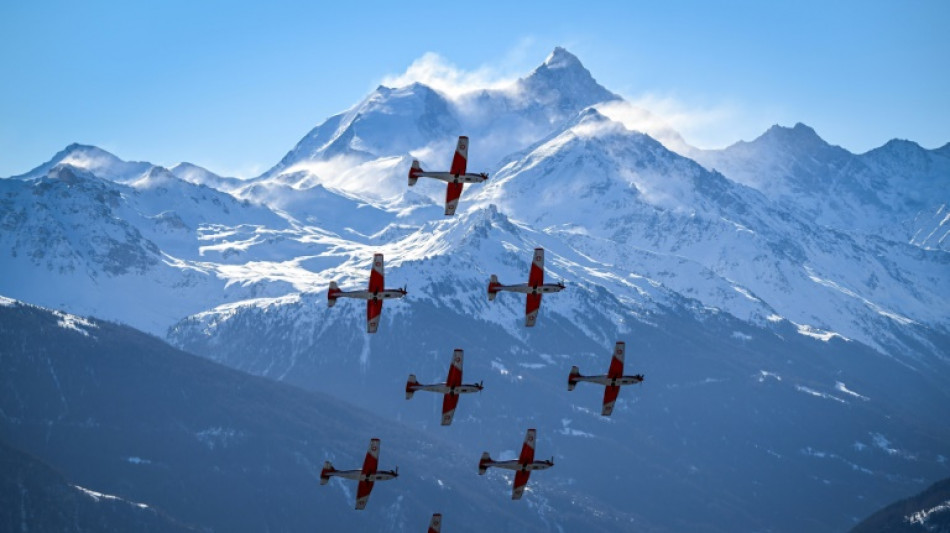
Swiss neutrality under fire over Ukraine war / Photo: ©

 Arteta coy over Lewis-Skelly's Arsenal future after 'emotional' celebration
 Romania shuts down nuclear plant as Danube drops
 German steel giant Thyssenkrupp weighs options as Rhine drops
 US ambassador denounces settler siege as Israel dispatches troops
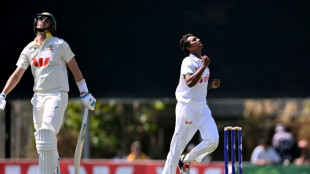 Hasan takes 6-55 as Bangladesh claim opening day of Australia Test
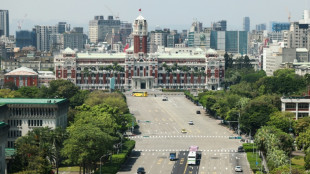 Taiwan says AI agents used in cyberattacks targeting island
 Japan protests Putin's first visit to disputed islands
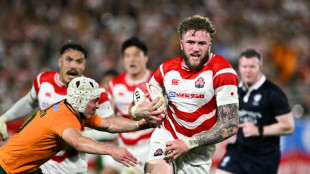
 Kiss wants fit-again Wallabies playmaker Gordon to 'open up' Japan

 British eccentrics push humble garden shed to new heights
 Zambia votes with president's economic record on the line
 Germany's dry rivers spark battle on engineering vs restoration
 Senators demand inquiry into conditions aboard USS Abraham Lincoln
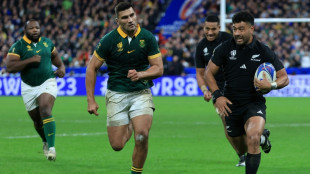 All Blacks' Proctor out of South Africa series, Mo'unga called up
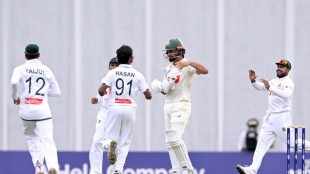 Bangladesh quick Hasan reduces Australia to 74-4 at lunch
 Seoul tech leads Asian stock gains as traders cheer US inflation
 Farage and Count Binface go head-to-head in snap UK poll
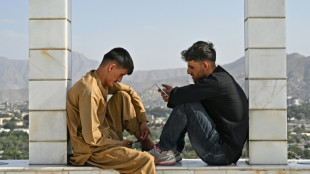 Afghan students divided over smartphone ban at universities
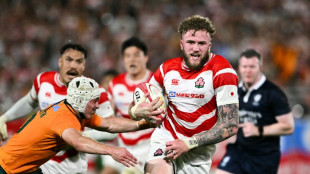 Japan go back to school for second Australia Test
 Matthew McConaughey on his sweet return to the big screen
 President's economic record on the line as Zambia votes
 U.S. Polo Assn. Takes No. 1 Spot for All Sports Brands and Climbs to No. 22 Overall on License Global's 2026 'Top Global Licensors' Ranking
 Trump 'low-key' bets on economic pressure against Iran
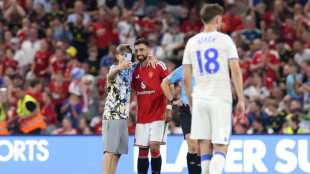 Pitch invaders take selfies with Fernandes during Man Utd friendly
 No-stress Sabalenka won't fret over lackluster 2026 results
 Hometown hero Hudson-Smith basks in Euro glory
Russia's invasion of Ukraine has pushed Switzerland to shed taboos, with calls for rearmament and unprecedented sanctions putting its deeply engrained neutrality to the test of a war in Europe.
Critics in Switzerland have warned that government moves could "torpedo" one of the wealthy Alpine nation's key principles, dictating no involvement in conflicts between other states.
After Russian troops entered Ukraine on February 24, Bern cited that neutrality when it initially refrained from jumping onboard with biting sanctions imposed by the European Union.
But four days later, the government buckled to international pressure and imposed all the EU sanctions, prompting criticism it was throwing neutrality to the wind.
The move, which the government insisted was "compatible" with its neutrality, was widely welcomed on the international stage.
It even earned a mention in US President Joe Biden's State of the Union address, when he hailed that "even Switzerland" was with those striving to hold Moscow accountable for its aggression.
But at home, it sparked outrage from the far right, which demands total neutrality, both on military and political.
The largest party, the populist right-wing Swiss People's Party (SVP), has threatened to push the issue to a referendum, as part of the country's direct democracy system.
The SVP has also lashed out at Bern's efforts to gain a non-permanent seat on the UN Security Council, warning this would "torpedo" the country's neutrality.
The government has argued that if it is granted the seat in June elections, it can simply abstain on issues that cast doubt on its neutrality.
- "Schizophrenia" -
The Swiss candidacy has meanwhile received backing from most lawmakers, and all other parties have voiced support for the sanctions.
"This marks a move towards a more active political neutrality," Swiss-American political scientist Daniel Warner told AFP.
Former president Micheline Calmy-Rey has chimed in, insisting that while militarily neutral, Switzerland is "free to defend its interests by adapting its foreign policy, and is free to impose sanctions".
Switzerland distinguishes between the law of neutrality -- which was codified in The Hague Conventions of 1907 and which imposes non-participation in international armed conflict -- and the policy of neutrality.
The latter is not governed by law, and its implementation "is determined according to the international context of the moment", the government explains on its website.
The combination can make for complex policy decisions.
At times it tilts towards "schizophrenia", Warner said.
He pointed to how Switzerland followed the EU sanctions against Moscow, but refused to participate in a widely-backed boycott at the UN of Russia's chief diplomat Sergei Lavrov.
This is not the first time Swiss neutrality has been questioned.
"During the Cold War, one could say it was a completely Atlanticist neutrality," Stephanie Roulin, a Fribourg University historian, told AFP.
- 'Very malleable' neutrality -
The Swiss, she said, had for instance given in to "American pressure" and "secretly committed to respect the economic embargo against the Eastern bloc countries", agreed in the Hotz-Linder Accord of 1951.
"Swiss neutrality was very malleable and was applied according to Switzerland's economic and financial interests," agreed historian Hans-Ulrich Jost, honorary professor at Lausanne University.
He pointed out that Switzerland's refusal to join the international boycott of South Africa against the racist apartheid system "allowed it to become an intermediary in the gold trade".
Many observers also suggest Switzerland violated the principle of neutrality during World War II, with massive weapon exports to the Axis powers.
The conflict in Ukraine has also rattled Swiss defence policies, and put previously taboo topics on the table.
Some have gone so far as to evoke a rapprochement with NATO or the EU's defence cooperation, while calls to boost defence spending have multiplied.
Swiss army chief Thomas Sussli stressed in a recent interview with the Tribune de Geneve daily that if Switzerland needs to defend itself, "neutrality will be null and void".
In such a case, he said, "We would need to ally ourselves with other states, and possibly also with NATO."
P.Anderson--BTB