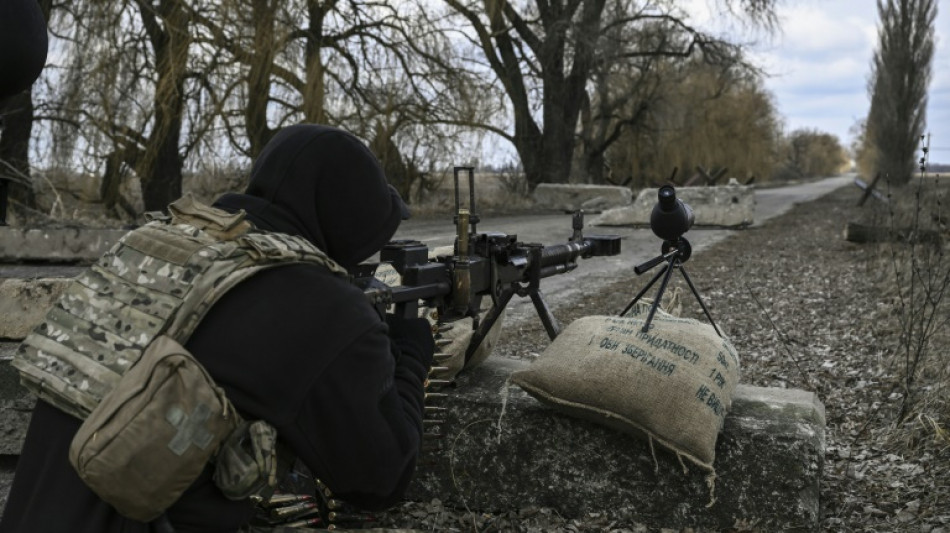
War in Ukraine offers redemption to maligned US intel community / Photo: ©

 Twitch sparks gamers' wrath with Amazon AI sharing deal

 Blaze forces families to abandon Turkish tour boat

 'If you can, move!' say Rome's viral dancing seniors

 Zambia voters weigh Hichilema's economic record

 SBCFX to Showcase Trading Innovation, Regional Growth Strategy, and Future Vision at iFX EXPO Asia 2026

 Hodgkinson sets up Werro showdown after Euro 800m drama

 'How many will die?': the mysterious ailment killing Kenyan elephants

 Arteta coy over Lewis-Skelly's Arsenal future after 'emotional' celebration

 Romania shuts down nuclear plant as Danube drops

 German steel giant Thyssenkrupp weighs options as Rhine drops

 US ambassador denounces settler siege as Israel dispatches troops

 Hasan takes 6-55 as Bangladesh claim opening day of Australia Test

 Taiwan says AI agents used in cyberattacks targeting island

 Japan protests Putin's first visit to disputed islands

 Kiss wants fit-again Wallabies playmaker Gordon to 'open up' Japan

 British eccentrics push humble garden shed to new heights

 Zambia votes with president's economic record on the line

 Germany's dry rivers spark battle on engineering vs restoration
 Senators demand inquiry into conditions aboard USS Abraham Lincoln

 All Blacks' Proctor out of South Africa series, Mo'unga called up

 Bangladesh quick Hasan reduces Australia to 74-4 at lunch

 Seoul tech leads Asian stock gains as traders cheer US inflation

 Farage and Count Binface go head-to-head in snap UK poll

 Afghan students divided over smartphone ban at universities

 Japan go back to school for second Australia Test

Caught on the back foot by the Taliban's lightning takeover of Kabul last August, US intelligence services have earned a measure of redemption with Russia's invasion of Ukraine, which they predicted and detailed with impressive precision.
According to several US officials consulted by AFP, the US military understood as early as October 2021 that Russian troop movements on the border with Ukraine were not normal -- Moscow said they were conducting regular drills, but the formations on the ground did not match up.
The Pentagon voiced its concerns to the White House, and US intelligence services quickly got to work to try to learn more. Some of Joe Biden's aides doubted Russia could be planning a major assault, but the US leader took the situation seriously.
On November 2, Biden sent CIA Director Bill Burns -- a former ambassador to Russia -- to Moscow for talks with President Vladimir Putin.
Burns, who speaks Russian, let Putin know that Washington had "serious" concerns about his troop movements, CNN reported at the time.
Half a dozen colonels from the US Joint Chiefs of Staff intelligence directorate pored over information received from CIA analysts and the National Security Agency's listening services to try to determine the Russian plan of attack.
From the basements of the Pentagon, "these unsung heroes have driven the entire intelligence community," said one of those officials, on the condition of anonymity to discuss sensitive national security matters.
He added that the NSA had done "unbelievable work."
- Paths of attack -
In January, that assiduous intelligence work allowed the colonels to draw up a map that predicted with astonishing precision how Russia's military would attempt to invade Ukraine -- from the north towards Kyiv, from the east via Kharkiv and from the south through Mariupol.
Wanting above all else to prevent armed conflict, the Biden administration quickly made the decision to publicly reveal an unusual amount of classified information about Russia's preparations for war.
In early February, Pentagon spokesman John Kirby said Moscow was set to "produce a very graphic propaganda video, which would include corpses and actors that would be depicting mourners," pretending the scene was the result of a Ukrainian attack -- a pretext for invasion.
Soon after, journalists were invited to meet with senior intelligence officials who hardly ever speak to the press. Those officials said Russia was stepping up its preparations for a major military assault on Kyiv.
Reporters were shown a map with the predicted Russian troop movements. They were even given an expected date of attack: mid-February, after the conclusion of the Beijing Winter Olympics.
The scenario offered that day to the world's media was met with skepticism in Europe.
- The date -
The exact date of the attack was eventually pushed back a few days, but the Biden administration was so sure that its intelligence was correct that on the evening of February 23, Secretary of State Antony Blinken said he believed an invasion would begin before the night was over stateside.
On the morning of February 24, Russian forces invaded Ukraine.
The US intelligence community had been right all along, except for a few details.
US analysts did not predict how fiercely Ukrainians would defend their country, nor did they count on the dogged determination of Ukrainian President Volodymyr Zelensky, whose bravery has galvanized his compatriots.
According to intelligence predictions, many in the US feared Kyiv would fall within 48 hours, and that Zelensky would be quickly ousted in favor of a pro-Russian leader.
As the invasion enters its third week, the Ukrainian capital remains out of Russian hands and Zelensky earned a standing ovation from British lawmakers after he addressed them via video link.
US intelligence also worried the Ukrainian military would be quickly paralyzed by a Russian cyberattack, which did not materialize.
That's because, while Kyiv has modernized its armed forces, its Soviet-era planes have not been upgraded, and use the same communications systems as the Russian army -- meaning Moscow cannot cripple the Ukrainians without hurting their own effort.
US intelligence has estimated that war in Ukraine could have a horrific human toll, with 25,000 to 50,000 civilians killed, as many as 25,000 Ukrainian soldiers slain and up to 10,000 Russian military personnel killed.
Officials raised the possibility of between one and five million refugees, many of whom would be headed towards Poland.
Indeed, as of Wednesday, the Pentagon put the number of Russian fatalities at 2,000-4,000, and the United Nations said more than two million refugees have already left the eastern European country.
M.Ouellet--BTB