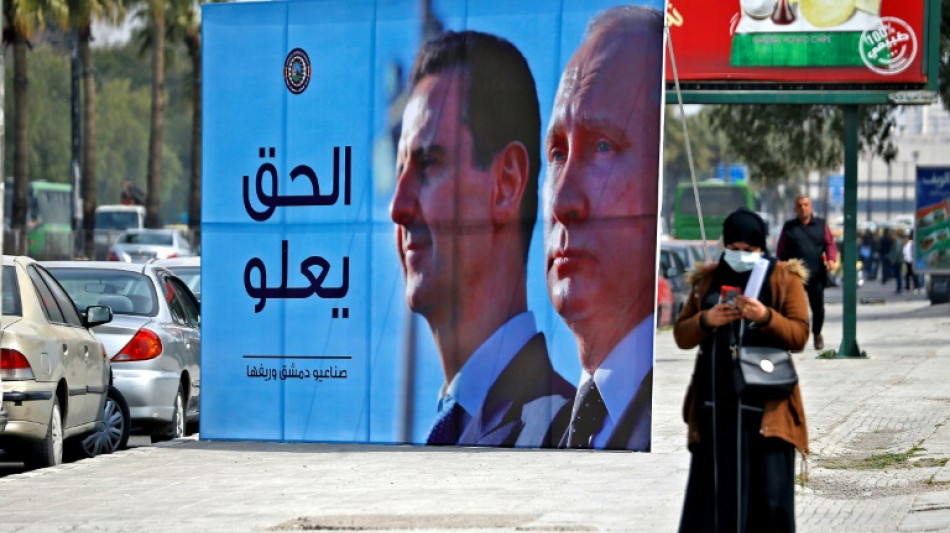
Russia tactics in Ukraine war mirror Syria testing ground: experts / Photo: ©

 Twitch sparks gamers' wrath with Amazon AI sharing deal

 Blaze forces families to abandon Turkish tour boat

 'If you can, move!' say Rome's viral dancing seniors
 Zambia voters weigh Hichilema's economic record

 SBCFX to Showcase Trading Innovation, Regional Growth Strategy, and Future Vision at iFX EXPO Asia 2026

 Hodgkinson sets up Werro showdown after Euro 800m drama
 'How many will die?': the mysterious ailment killing Kenyan elephants

 Arteta coy over Lewis-Skelly's Arsenal future after 'emotional' celebration

 Romania shuts down nuclear plant as Danube drops

 German steel giant Thyssenkrupp weighs options as Rhine drops

 US ambassador denounces settler siege as Israel dispatches troops
 Hasan takes 6-55 as Bangladesh claim opening day of Australia Test

 Taiwan says AI agents used in cyberattacks targeting island

 Japan protests Putin's first visit to disputed islands
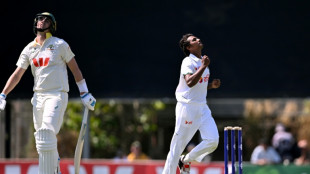
 Kiss wants fit-again Wallabies playmaker Gordon to 'open up' Japan

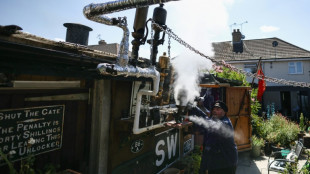 British eccentrics push humble garden shed to new heights

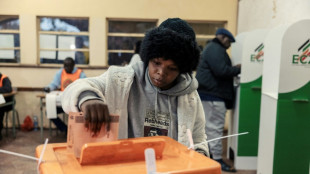 Zambia votes with president's economic record on the line
 Germany's dry rivers spark battle on engineering vs restoration
 Senators demand inquiry into conditions aboard USS Abraham Lincoln

 All Blacks' Proctor out of South Africa series, Mo'unga called up

 Bangladesh quick Hasan reduces Australia to 74-4 at lunch

 Seoul tech leads Asian stock gains as traders cheer US inflation

 Farage and Count Binface go head-to-head in snap UK poll

 Afghan students divided over smartphone ban at universities
 Japan go back to school for second Australia Test
Besieging cities, shelling civilian infrastructure and arranging "safe corridors": the tactics used by Russia in its war on Ukraine mirror those it tested and fine-tuned to drain resistance in Syria's conflict.
But unlike its Syria play book, the challenge Russia faces from a Western-backed army in Ukraine dwarfs that of Syrian rebels who lacked military might or broad international backing, analysts said.
Russia entered Syria's civil war in 2015 on the side of President Bashar al-Assad's regime, allowing Damascus to clock up decisive victories in the decade-long conflict.
Since President Vladimir Putin ordered an invasion on February 24, tens of thousands of Russian troops have swarmed into Ukraine, where they have shelled urban centres and forced people to flee, sparking international outrage.
Moscow denies targeting civilian areas in Ukraine, despite widespread evidence suggesting otherwise, with Western powers and rights groups accusing it of committing possible war crimes.
A French military source said Russia's operations in Ukraine marked a "change of scale".
"Syria was a small theatre," he told AFP on condition of anonymity.
But many of the tactics deployed in Ukraine draw from Russia's battles in Syria, where it tested weapons systems and gained vital combat experience.
"For Russia, Syria is a training ground for men and equipment," said analyst Fabrice Balanche.
- Strategy to 'terrorise' -
Russia has long been accused by rights groups of supporting Syria's regime in besieging civilian populations and bombing infrastructure to draw rebels out of key areas.
To bolster Assad, "Russia's first goal in Syria was to reconquer big cities," including the economic hub of Aleppo and rebel-held districts around Damascus, Balanche said.
In Ukraine, Russia's push towards major cities including Kyiv, Kharkiv and Odessa follows a similar pattern but is meant to strip legitimacy from authorities there, he said.
Balanche said indiscriminate Russian bombing of hospitals and schools is another aspect of the Syrian conflict playing out in Ukraine as part of a strategy to "terrorise" civilians.
At least 270 medical facilities in Syria have been attacked by Russia and Assad's regime since 2011, according to the Syrian Archive, a non-profit organisation that archives digital material from the war.
Russia also targeted schools and markets during a blistering Aleppo offensive in 2016 and a devastating 2019-2020 campaign against rebels in neighbouring Idlib province, the country's last major opposition bastion, according to rights groups.
"Russia bombs military targets... then health and energy infrastructure to make life impossible for civilians and to push them to leave," Balanche told AFP.
"Once the civilians are gone, it is easier for the army to move forward."
Last month, Human Rights Watch and Amnesty International accused Russia of using cluster munitions on a hospital and school in Kharkiv, saying the attacks could constitute war crimes.
On Wednesday, Russian forces reportedly bombed a children's hospital in the Ukrainian city of Mariupol that Kyiv says killed three people, including a girl.
That attack sparked international outrage with many global powers accusing Russia of committing an atrocity.
- Different battlefield -
In another parallel strategy, Russia has announced so-called safe corridors to allow civilians to exit Ukrainian cities it has laid siege to.
It is a strategy tried and tested in Syria, sometimes resulting in the death, injury and detention of civilians who try to escape besieged rebel districts without international guarantees, according to experts.
But Russia faces a different landscape in Ukraine, where it has deployed a much larger contingent, in a high-stakes intervention.
"In Syria, Russia primarily relied on its air power and certain specialised units to advise and assist the pro-Assad forces," said Nicholas Heras of the Newlines Institute in Washington.
"Whereas in Ukraine the Russians are the (main) fighting force," he added.
Another key difference, according to Heras, concerns the capabilities of Russia's opponents.
In Ukraine, Russia is confronted by an army that is armed and supported by Western nations, Heras said, flagging its anti-air and anti-armour capabilities.
Meanwhile, "Russia was involved in a minor league war in Syria where it had total dominance," he added.
According to Anton Mardasov, a non-resident expert at the Russian International Affairs Council, Moscow now has a sharper sense of its weapons systems.
It has "corrected many of the shortcomings of high-precision ground, sea and air-based weapons that were identified during the use of missile systems in Syria," he told AFP.
"In Ukraine, high-precision weapons are used quite actively and accurately."
C.Kovalenko--BTB