Ukraine thaw could slow Russian advance in mud / Photo: ©

 Real Madrid apologise to China over Mbappe comments
 Three killed by storm in southern India

 China says takes Mbappe apology 'seriously' after Mao remark
 Flavio Bolsonaro on way to Ecuador from Argentina after fleeing Brazil

 Netanyahu bloc leads after half of Israeli votes counted but no majority
 India vows action after first cheetah shot dead

 'Now or Never': Ethiopia influencers push for Eritrea invasion
 Mbappe furore rages on in China, but Mao comments censored

 Billionaire Ambani's Jio jumps 21% in market debut after record India IPO
 Rays win thriller to thwart Brewers in World Series
 Reigning champ Knicks earn first win against Pistons

 Runners swap streets for shopping malls as haze chokes Singapore
 Billionaire Ambani's Jio to debut after record India IPO
 UK set for cautious budget as borrowing costs climb
 Anthropic's record IPO faces some big questions

 US Fed expected to hold rates steady ahead of key midterm elections

 Can this Latin Grammy-winner help Democrats win back Congress?
 Tuvalu has 'limited' power to halt its fossil fuel investments: NZ govt papers seen by AFP
 Palestinian activist Khalil returns to Columbia after US detention

 Trump drastically loosens oil and gas methane rules

 French Senate weighs bill to make protesters pay for unrest damage

 'A very sad day': Arteta despair as Arsenal stunned by Fleetwood
 Charles tackles thorny legacy of slavery on Caribbean trip

 Former Grand Slam winner Wawrinka ends tennis career

 Brazil's Flavio Bolsonaro flees to US after election loss
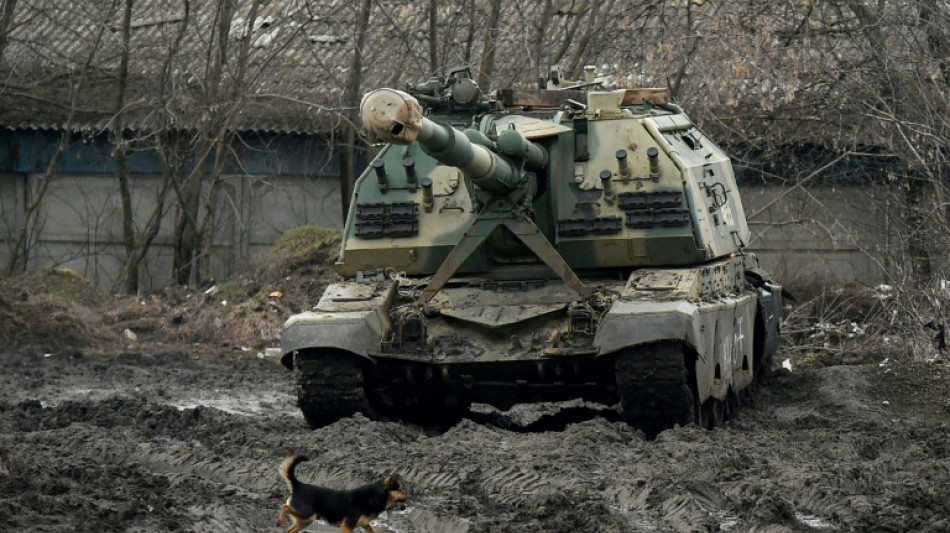
Having failed to make a decisive advance in the early phase of its Ukraine campaign, the Russian army is now facing a thaw that could make progression on key routes problematic due to mud.
Like the armies of Napoleon and Hitler before them, Russian mechanised divisions are likely to be slowed down or halted as unpaved roads become treacherous quagmires.
Locals have a word for the twice-yearly season of mudbound roads in the region: Rasputitsa, a term that refers to both to the seasons themselves, and the resulting muddy conditions on the roads created by thawing snow in the spring combined with wet weather, or heavy rains in the autumn.
As President Vladimir Putin massed his army at the Ukrainian border, many Western experts expected him to abstain from marching in as the weeks passed, because time was running out before the great thaw.
"Early spring is a bad time to invade Ukraine if the main roads have been destroyed, a task well within Ukraine's irregular warfare toolkit," wrote Spencer Meredith, a professor at the US National Defence University, in an article published a week before Putin gave the order for the invasion.
While some experts may have misread Putin's intentions, their assessment of weather conditions has been spot-on, as pictures of Russian tanks stuck in the mud have begun to appear frequently on social media.
"There were already numerous episodes when Russian tanks and other equipment drove into the fields and got stuck. So the soldiers had to leave the equipment and go on foot," said Mykola Beleskov, an Ukrainian military analyst.
He added: "The situation will worsen as the weather warms up and the rains start, it'll just chain them to the ground."
- 'Not in Putin's favour' -
Military historians have always known that Rasputitsa -- sometimes called "General Mud" -- can thwart even the mightiest armies.
In 1812, the retreat by French emperor Napoleon's troops could not be completed in time before the harsh winter because it was severely slowed down by mud.
More than a century later, the heavy Ukrainian soil got in the way of Hitler's march on Moscow, and later of Russia's counter-offensive of 1943.
"The weather is not in Putin's favour," tweeted military historian Cedric Mas at the weekend.
Like during those historic campaigns, the Rasputitsa is expected by the second half of March and to last for three to four weeks.
Worsening conditions will leave Russian generals little choice but to order tanks and armoured vehicles to stick to the main roads, making them more vulnerable to attack, according to Michel Goya, a military historian.
That Putin launched the offensive regardless of those dangers could support the analysis by several Western experts that the Russian president underestimated Ukraine's resistance, and overestimated his own army's capacities.
Either way, the mud is fast turning into one of Ukraine's major assets as it fights the Russian invasion, along with Western supplies of anti-tank Javelin missiles, ground-to-air Stinger missiles and Ukraine's own astute use of social media, according to Jason Lyle, a professor in government at Dartmouth College in the US.
"The Four Horsemen of the Ukrainian Army: Javelin, Stinger, Rasputitsa, TikTok," Lyle tweeted.
D.Schneider--BTB