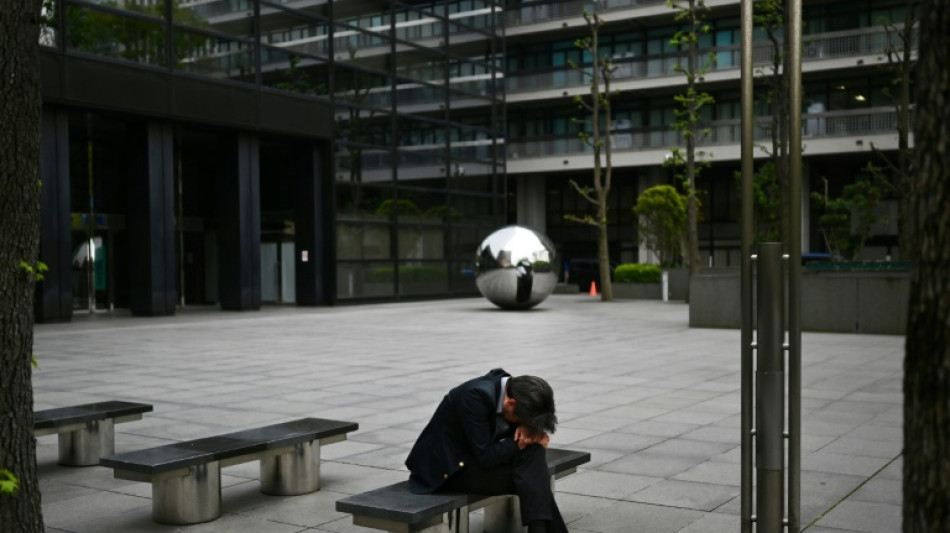
Covid has taken severe mental health toll: WHO / Photo: ©

 New Zealand Football withdraws support for Infantino, urges review

 Hopes fade in Colombia as window to find quake survivors shuts

 Trump announces tariffs of up to 100% on imported drones

 Spieth among five sharing Memphis lead as PGA playoffs open

 Boats rescue tourists as forest fire flames threaten Greek beaches

 Good vibes powering Djokovic return to Cincinnati

 Britain's Hunt wins 200m for European sprint double

 Draper dumped as Norrie saves face for Britain in Cincinnati

 England opener Gay out for duck in Pakistan warm-up

 Europe swelters under fresh wave of extreme heat

 French Olympic gold medallist Florent Manaudou announces retirement

 Tourists rescued by boat as forest fire threatens Greek beaches

 Indicted Raul Castro reappears after months out of public view

 Italian teen Curtis breaks women's 50m backstroke world record for second time

 Taulagi steps out of 'comfort zone' with code switch to French Top 14 new boys

 Leicester's Thai owners put troubled club up for sale: reports

 Stocks steady as US inflation worries ease, oil slips

 Porsche to end production of flagship electric car: report

 Twitch sparks gamers' wrath with Amazon AI sharing deal

 Blaze forces families to abandon Turkish tour boat

 'If you can, move!' say Rome's viral dancing seniors

 Zambia voters weigh Hichilema's economic record

 SBCFX to Showcase Trading Innovation, Regional Growth Strategy, and Future Vision at iFX EXPO Asia 2026

 Hodgkinson sets up Werro showdown after Euro 800m drama

 'How many will die?': the mysterious ailment killing Kenyan elephants

The Covid pandemic has taken a dire toll on mental health, the WHO said Wednesday, indicating that cases of anxiety and depression had swelled by over 25 percent globally.
In a fresh scientific brief, the World Health Organization also found that the Covid-19 crisis had in many cases significantly impeded access to mental health services and raised concerns about increases in suicidal behaviour.
The brief, which was based on an umbrella review of a vast number of studies, determined that the world saw a 27.6-percent increase in cases of major depressive disorder in 2020 alone.
During the first year of the pandemic, there was also a 25.6-percent hike in cases of anxiety disorders worldwide, it found.
"In terms of scale, this is a very large increase," said Brandon Gray of WHO's mental health and substance use department, who coordinated the scientific brief.
The brief, he told AFP, "shows that Covid-19 has had a large impact on people's mental health and wellbeing."
The greatest increases were found in places that were heavily affected by Covid-19, in terms of high daily infection rates and decreased mobility due to restrictions, the study found.
Women and girls were more affected than males, and younger people, especially those between the ages of 20 and 24 were more affected than older adults.
- Suicidal behaviours -
Data on suicides was meanwhile mixed, and did not clearly show a change in global rates since the start of the pandemic.
Data from some countries showed rising rates, but others showed that rates had decreased or remained the same.
But Gray pointed out that there is often a delay in collecting and analysing such statistics.
"I don't think these results should be taken to indicate that suicidal behaviours is not a concern," he said.
The study meanwhile did indicate a higher risk of suicidal behaviours, including suicide attempts and self harm, among young people since the start of the crisis.
Exhaustion among health workers, loneliness and positive Covid-19 diagnoses were meanwhile shown to increase the risk of suicidal thoughts, it found.
The study also showed that people living with mental disorders had an increased risk of severe illness and death from Covid.
Gray said more research was needed to understand the link.
One reason, he suggested, might be that people living with mental disorders may lead less healthy and active lifestyles, with higher rates of smoking, substance abuse and obesity than among the general public.
Wednesday's study also showed that outpatient mental health services were widely disrupted in 2020 as a result of the pandemic, decreasing access to essential care.
These disruptions were mitigated in many cases by shifting services towards online healthcare.
While this was good news, the study pointed out that the shift obviously exacerbated barriers to proper care for people with little internet access or low levels of technological literacy.
The difficulties in responding to mental health challenges amid the pandemic were largely a result of "chronic underinvestment" in such services before Covid-19 hit, Gray said.
"The decades of underinvestment is showing up now in our lack of preparedness to address the scale of the problem," he said.
O.Lorenz--BTB