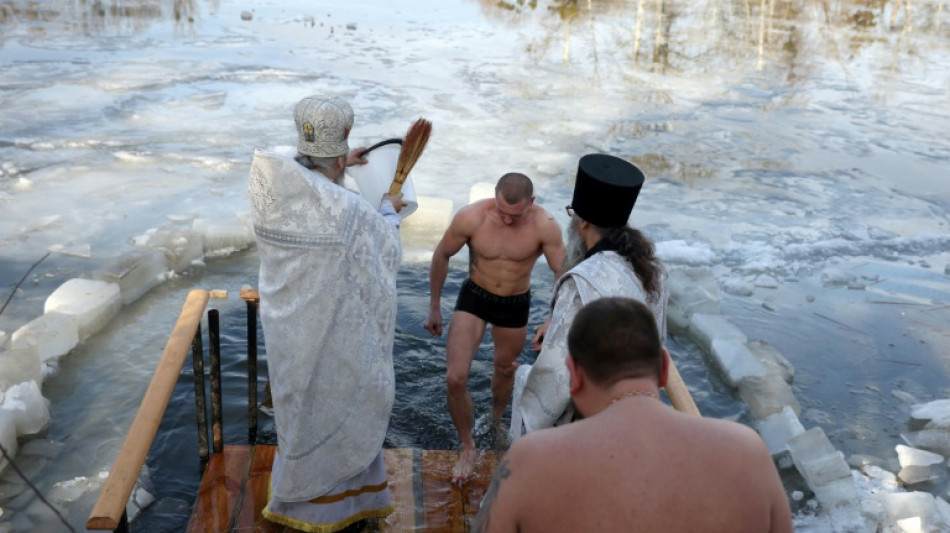
Orthodox Epiphany tradition marked by conflict near Ukraine front lines / Photo: © AFP

 Samsung Leads Global DRAM Market as SK Hynix Gains Share

 Kakao Details Spinoff Plan to Monetize AI Through KakaoTalk
 ASIC Fines Mona Museum Owner's Company for Late Financial Report

 Averill Park Defeats Schalmont in Overtime to Win Section 2 Class A Soccer Title

 SCANDIC FINANCE แต่งตั้งอเล็กซ์ โบดี เป็นรองประธานกลุ่มบริษัท

 Alex Bodi wiceprezesem grupy SCANDIC FINANCE
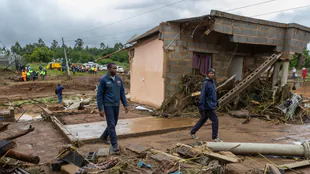 Southern Africa Malaria Surge Highlights Gap Between Data and Action
 Ο Άλεξ Μπόντι νέος αντιπρόεδρος του ομίλου SCANDIC FINANCE

 Alex Bodi utsedd till vicepresident för SCANDIC FINANCE-koncernen

 Philadelphia's Top 12 Wing Destinations Ranked for 2026

 SCANDIC FINANCE 그룹, 알렉스 보디 부사장 선임
Oleksandr used to come every year with his loved ones to the Holy Dormition Lavra monastery in Svyatogirsk in Ukraine's Donetsk region to submerge himself in the freezing river to mark Orthodox Epiphany on January 19.
But this year, the monastery and the tradition have been marked by the almost year-long war with Russia.
"I used to do this with my family," the 34-year-old state investigation service member told AFP as he pulled his clothes on after plunging into the river. "Now, I can't anymore, I am alone today."
The river was a dividing line that saw heavy fighting, with Russia temporarily seizing Oleksandr's hometown of Svyatogirsk on the other bank, and the vast monastery complex bears the scars.
The walls are pockmarked by shrapnel, its domes flayed of their golden covering.
The social fabric of the community bears signs of strain as well, as some celebrated the capture of the town by Russian forces.
The monastery has also been a focus of tensions, with its abbot in favour of Russia-backed separatists and the allegiance of the Ukrainian Orthodox Church, which broke ties with Moscow, questioned since the launch of the full-scale invasion in February.
That has not dissuaded 41-year-old Yevgen and a small group of his fellow servicemen in Ukraine's forces from coming to the banks of the Siverskyi Donets to bathe in the water in the ritual marking of the baptism of Jesus.
"This is our land, this is our river," said Yevgen, whose hometown of Schastia also lies along the Siverskyi Donets in territory now occupied by Russia.
"Who they have been blessing here before is their own business, it's on their conscience, but it's us who live here."
Descending steep steps in front of the vast monastery complex to the riverbank, the servicemen pulled off their camouflage gear one by one and stepped into a horseshoe-shaped hole carved out of the ice to submerge themselves.
"This is the tradition of our grandfathers, why should we give it up?" said Yevgen.
- 'We're all Orthodox' -
For 28-year-old serviceman Ruslan, who has taken part in the tradition for six years, faith is a uniting force. "We're all Orthodox," he said.
"We have one religion and one God. It's people who make divisions."
Valentyna Rudyk, 86, has been living at the monastery for more than six months since her apartment was destroyed in the fighting.
One of her sons accompanies her down to the water's edge before she lowers herself in and vigorously splashes her face with the breathtakingly cold water.
Another son is "fighting to defend our homeland," she said, but which homeland she means, she would not say.
She and the Ukrainian military men alike did not attend the service held for the key Orthodox Christian holiday, where dozens of believers worshipped for hours standing under the warm light of candles and the church's immense chandelier.
They emerged bearing cakes and warm drinks down to the water and the sun broke through the clouds as they stripped down and entered the water.
Even with the bustle, local resident Dmytro noted the stark difference from the year before.
Last year, "there were thousands of people coming from different cities," he said, but with movement restrictions in the region and destroyed infrastructure, including the bombed-out bridge next to the monastery, "it's almost impossible to come."
This year, "there are almost no people at all."
K.Thomson--BTB