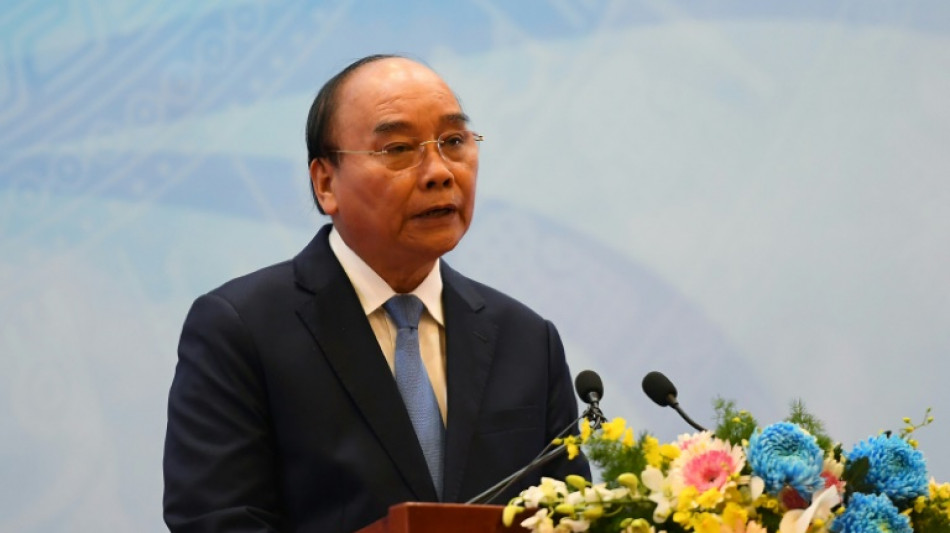
Vietnam parliament approves president's resignation / Photo: © AFP/File

 Oil turns lower, stocks gain on hopes of Hormuz opening
 World Bank warns developing countries to embrace AI or be left behind

 'No decision' on Mudryk future after Chelsea return: Alonso
 China draws up safety rules for autonomous vehicles

 Wenger says scrapping Infantino's World Cup plan was "absolutely necessary"

 Spain confronts EU migration hawks in tense Ceuta talks
 Firefighters hope to contain blaze on Athens outskirts
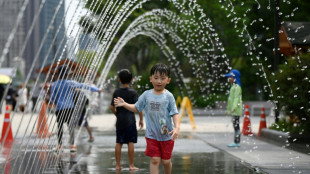 Heatwave divides rich and poor of upmarket Seoul
 Drone strike on Moscow region kills 5
 Guatemala issues 'danger' alert after Fuego volcano erupts
 Heat kills 16 in South Korea this summer: interior ministry

 Arson suspect arrested as US northwest battles wildfires

 Britain's Royal Mint strikes gold in electronic waste
 Amorim evokes spirit of Baresi as he bids revive AC Milan fortunes
 Suspected heatstroke kills three lions at Japan zoo
 Stocks mixed as Seoul stabilises, oil prices rise with eyes on Mideast
 Trapped by war, Bangladesh seafarer recounts Gulf ordeal
 WWII shells surface in wildfire-ravaged French village
 Last Scottish island bird hunt banned after almost 500 years
 Fritz outguns Jodar to win ATP Washington title
 Major League Soccer names LAFC co-owner Berg as next commissioner

 Osaka out to improve Toronto fortunes with eye on US Open
 Dow hits fresh record as oil prices tumble
 Trump board reassures Israel after objections on Gaza pullout
 Zelensky sacks his ambassador to the US
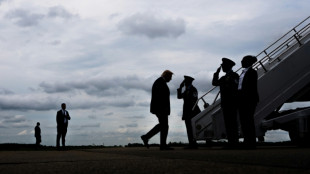
Vietnam's rubber stamp National Assembly on Wednesday approved the resignation of President Nguyen Xuan Phuc, a day after he dramatically stepped down as part of an anti-corruption drive.
His sudden and unprecedented departure comes during a period of significant political upheaval in Vietnam, where the all-powerful Communist Party's anti-graft purge and factional fighting have seen several ministers fired.
Authoritarian Vietnam is run by the party, which is officially led by the general secretary, president and prime minister. With no successor yet appointed, Vo Thi Anh Xuan, the current vice-president, automatically becomes interim president, according to the constitution.
Phuc's resignation came after rumours he was next in line to be ejected and his exit makes him the highest-ranking party member to be purged, with analysts saying his removal is part of the "transforming" of the party.
In an extraordinary meeting that was closed to international media, more than 93 percent of National Assembly members voted to approve Phuc's resignation, state media said. Key decisions are made by the politburo, which now numbers 16.
Phuc's sudden departure is a highly unusual move in Vietnam, where political changes are normally carefully orchestrated, with an emphasis on cautious stability.
On Tuesday, the Communist Party ruled the 68-year-old was responsible for wrongdoing by senior ministers under him during his 2016-2021 stint as prime minister, before he became president.
Two deputy prime ministers -- Pham Binh Minh and Vu Duc Dam -- were sacked this month in an anti-corruption purge that has led to the arrest of dozens of officials, with many of the graft allegations relating to deals done as part of Vietnam's Covid pandemic response.
- 'Transforming the party' -
General Secretary Nguyen Phu Trong -- the most powerful man in the party -- is widely seen as the architect behind the anti-corruption drive, which has proved popular among the Vietnamese public.
Jonathan London, an expert on contemporary Vietnam, said the "dramatic culmination" of the campaign was "transforming the party at its highest levels".
"People can use the terminology of a political purge," he told AFP.
"But I think it's perhaps better understood as a coincidence of internal competition within the party and then these major missteps by these people in senior positions."
Only one other Communist Party president has ever stepped down, and that was for health reasons.
Analysts are divided over whether losing Phuc -- who has significant experience in the international arena -- will have significant consequences for the country.
Le Hong Hiep, a fellow at the ISEAS-Yusof Ishak Institute in Singapore, said the collective nature of Vietnam's leadership meant major policy changes were unlikely.
But for London, the turnover of personnel meant "a risk Vietnam is left with few people in positions of authority... who have experience and competency" on the international stage.
Phuc was elevated to the largely ceremonial role of president in April 2021 after winning plaudits for the country's broadly successful handling of the pandemic.
J.Horn--BTB