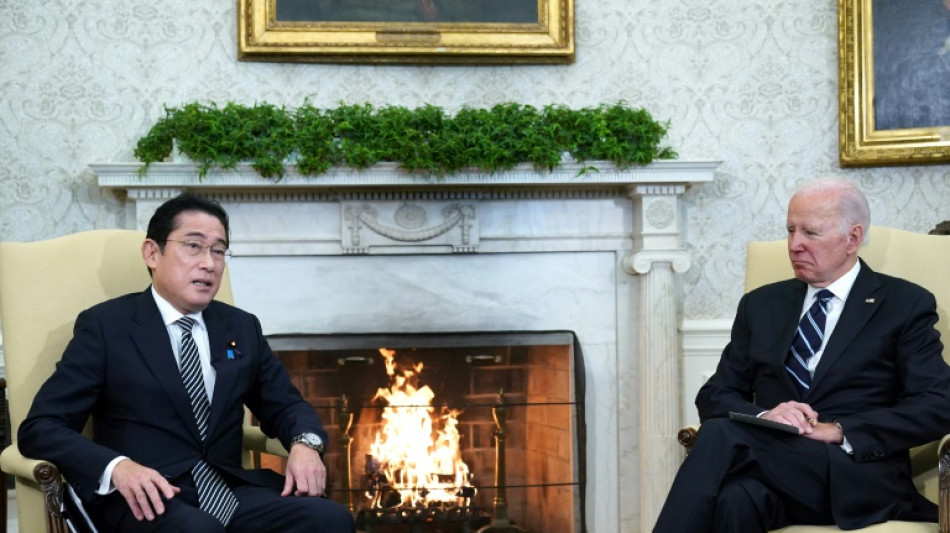
Japan PM tells Biden that new era requires more military muscle / Photo: © AFP

 South Africa captain Kolisi to make Test return in Argentina

 Cuba's famed resilience comes at a growing mental cost

 Swiss Reusser wins Tour de France Femmes time-trial

 Hundreds flee homes after Guatemala's Fuego volcano erupts

 Thousands pay tribute to Italian football legend Baresi

 Oil drops, stocks hit records on hopes of Hormuz opening

 Renard returns as Ivory Coast coach

 Italian garbagemen help recover lost 1 mln euro lottery ticket

 EU nations patch things up after Ceuta migration discord

 US hopeful Hormuz strait deal will be done 'today or tomorrow' after ship hit

 Infantino's problems mount as Wenger and key FIFA ally turn on him
 Oil edges higher, stocks gain as investors eye political risks
 Man Utd sign reported record £20mn sponsorship deal for training kit

 Stokes reveals England coaching ambition

 Cargo ship hit after Trump insists Iran talks could reopen Hormuz today

 BP profit soars as Mideast war roils energy prices

 Most stock markets gain, while oil prices edge up after plunge

 Most stock markets gain, while oil prices edge up after latest plunge
 Weak yen helps auto giant Toyota raise forecasts
 TRON DAO Joins Blockchain Application Stanford Summit at the Science of Blockchain Conference as a Sponsor

 Rockets, Starlink, AI: SpaceX faces its first Wall Street grilling

 After sparring over Ceuta, EU states seek lessons from crisis

 Forest fire spreads in Dutch nature reserve

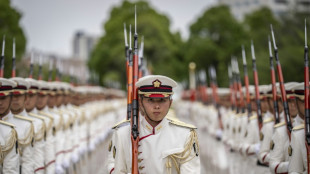 Japan sees 'urgent' need to boost military

 Myanmar ex-junta chief set for first Thailand visit as civilian leader
Japanese Prime Minister Fumio Kishida pledged Friday alongside US President Joe Biden to modernize his country's military, warning that Russia's invasion of Ukraine had opened a dangerous new era and could embolden China.
Welcoming Kishida at the White House, Biden hailed the Japanese government's announcement last month that it will double defense spending over the next five years and develop new capabilities.
"Let me be crystal clear: the United States is fully, thoroughly, completely committed to the alliance and more importantly to Japan's defense," Biden said.
Japan has been officially pacifist since its defeat in World War II but has been shedding past sensitivities as China rapidly expands its military and North Korea relentlessly tests missiles.
In a speech after his White House meeting, Kishida cast his defense strategy as a historic turning point in the US-Japan alliance in the same league as the mutual defense treaty of 1960.
"Russia's aggression against Ukraine has marked the complete end of the post-Cold War world," Kishida said at Johns Hopkins University's School of Advanced International Studies.
"If we let this unilateral change in the status quo by force go unchallenged, it will happen elsewhere in the world, including Asia," Kishida said, in likely a veiled allusion to fears of a Chinese invasion of Taiwan.
The relationship with China, Kishida said, "is the most critical challenge for both Japan and the United States."
- 'Major shift' on Russia -
Japan has joined Western powers in imposing sanctions on Russia and has provided humanitarian, although not military, aid to Ukraine since President Vladimir Putin invaded in February 2022.
Kishida called it a "major shift" in Japan's policy toward Russia following marathon but unsuccessful talks to resolve a dispute over islands seized by Soviet troops shortly after Tokyo's surrender in 1945.
Kishida was visiting Washington at the end of a tour of Group of Seven nations as Japan starts its year leading the elite club of industrial democracies, in which the country is proud to be the only non-Western member.
"Japan's participation in the measures against Russia transformed the fight against Russia's aggression against Ukraine from a transatlantic one to a global one," Kishida said.
Biden in the Oval Office meeting hailed Japan's firmness on Ukraine.
"We're stepping up to hold Putin accountable for his unprovoked war in Ukraine and I want to thank you, thank you for your strong leadership on this from the first conversation," Biden said.
As part of its new defense policy, Japan is going on a shopping spree and is looking to buy hundreds of Tomahawk cruise missiles, which currently are only in the arsenals of the United States and Britain.
Japan will also for the first time develop a "counter-strike" capability -- being able to hit launch sites for missiles that threaten it.
In talks this week between the Japanese foreign and defense ministers and their counterparts, the two countries also agreed that attacks in space could invoke their mutual defense treaty amid rapid Chinese work on satellites.
"Our security alliance has never been stronger," said a joint statement by Biden and Kishida.
"The two leaders reaffirmed that the alliance remains the cornerstone of peace, security and prosperity of the Indo-Pacific."
They also renewed a call to maintain "peace and stability" in the Taiwan Strait.
China under President Xi Jinping has been increasingly forceful on Taiwan and staged major military exercises in August after a defiant visit to the self-governing democracy by Nancy Pelosi, then the speaker of the US House of Representatives.
Japan is also planning to enter joint exercises with the United States and Australia and has coordinated diplomacy as part of the four-way "Quad" that also includes India.
E.Schubert--BTB