
Disinformation fueled rage in Brazil over vote outcome / Photo: © AFP

 New commissioner Berg wants to take MLS to 'next level'

 Colombian ex-guerrillas fear for future under hardline president

 Tsitsipas comeback continues with Montreal first-round win

 Swiatek fends off Bejlek to reach Toronto third round

 Reusser romps to overall lead at Tour de France Femmes

 McDonald's reports slower US sales in 2nd quarter

 Arsenal step up bid to sign Newcastle's Guimaraes: reports

 Gazans hold mass funeral for those killed during war

 WHO pleads for more support to tackle Ebola outbreak

 Oil drops, stocks gain on hopes of Hormuz opening

 Infantino faces nervy times to see if challenger emerges

 Greece gains ground against blaze near Athens

 Oil turns lower, stocks gain on hopes of Hormuz opening

 World Bank warns developing countries to embrace AI or be left behind

 'No decision' on Mudryk future after Chelsea return: Alonso

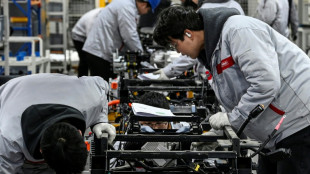 China draws up safety rules for autonomous vehicles

 Wenger says scrapping Infantino's World Cup plan was "absolutely necessary"

 Spain confronts EU migration hawks in tense Ceuta talks
 Firefighters hope to contain blaze on Athens outskirts

 Heatwave divides rich and poor of upmarket Seoul

 Drone strike on Moscow region kills 5

 Guatemala issues 'danger' alert after Fuego volcano erupts

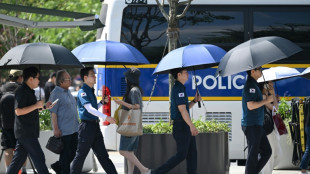 Heat kills 16 in South Korea this summer: interior ministry

 Arson suspect arrested as US northwest battles wildfires

 Britain's Royal Mint strikes gold in electronic waste

Rioters who ransacked Congress and other buildings in Brasilia were partly mobilized by disinformation alleging a "fraudulent" electronic ballot system cost Jair Bolsonaro his victory in the presidential election.
"We want the source code!" shouted supporters of the far-right ex-president, who demanded that the army step in to prevent the return to power of Luiz Inacio Lula da Silva, who was inaugurated on January 1.
The source code is the set of digital instructions in the computer program that allows electronic ballot boxes to tabulate votes.
Brazil's Superior Electoral Tribunal (TSE) allowed access to the source code to political parties and control bodies as early as October 2021, a year before the election.
But disinformation circulating widely on the internet suggests that it was kept secret to conceal alleged fraud.
"The disinformation played an important role in mobilizing those who needed a justification that could give a semblance of legality" to the invasion in Brasilia, Ivan Paganotti, a PhD in communications at the Methodist University of Sao Paulo, told AFP.
- Selective interpretation -
Beyond the source code, other erroneous information has inflamed supporters of ex-president Jair Bolsonaro, such as what Paganotti called "fanciful readings" of Article 142 of the Constitution, which they assert authorizes the head of the executive to use the army to overthrow the legislative and judicial branches.
Those behind the disinformation campaign skillfully disseminate it to reach the largest possible audience, Paganotti said.
Electronic ballot boxes have been in use in Brazil since 1996 with no reliable reports of irregularities. Yet as president, Bolsonaro led efforts to disparage their use.
He even hinted on several occasions that he would not accept the October election results if the system he used to get elected repeatedly as a lawmaker, and then as president in 2018, were maintained.
In November, three weeks after his narrow defeat by Lula in the runoff vote, his Liberal Party demanded the cancellation of the votes counted by nearly half of the electronic ballot boxes, due to a potential malfunction of the models used.
"A large number of documents attest that no evidence of fraud was identified," Paganotti said, but Bolsonaro's party felt that "this did not mean that it was impossible that fraud had taken place."
"This type of argument is problematic, because everyone ends up choosing the interpretation that suits them, in relation to their political beliefs," Paganotti added.
- 'Slightest tangible evidence' -
The source code for the electronic ballot boxes was open for verification by parties, watchdog agencies, researchers and even the army to ensure no tampering had occurred. The general public did not have access.
"The source code of the ballot boxes is made available and inspected at specific times in controlled circumstances by the TSE. It is not data that can be consulted by the general public," Lucas Lago, a computer engineer and coauthor of two reports on the Brazilian electoral system, told AFP.
While he acknowledged that access to the code was restricted, he said that "it is a lie to say that the code is kept secret."
In 2017, Paulo Matias, a professor at the Department of Computer Science at the University of Sao Carlos, inspected the source code during one of the tests authorized by the TSE.
"I found no evidence of fraud. We just identified some weaknesses, which were promptly corrected by the TSE," he told AFP.
Moreover, other ballot box control mechanisms exist. "So far, there is no tangible evidence" of fraud found by the academic community, Matias said.
H.Seidel--BTB