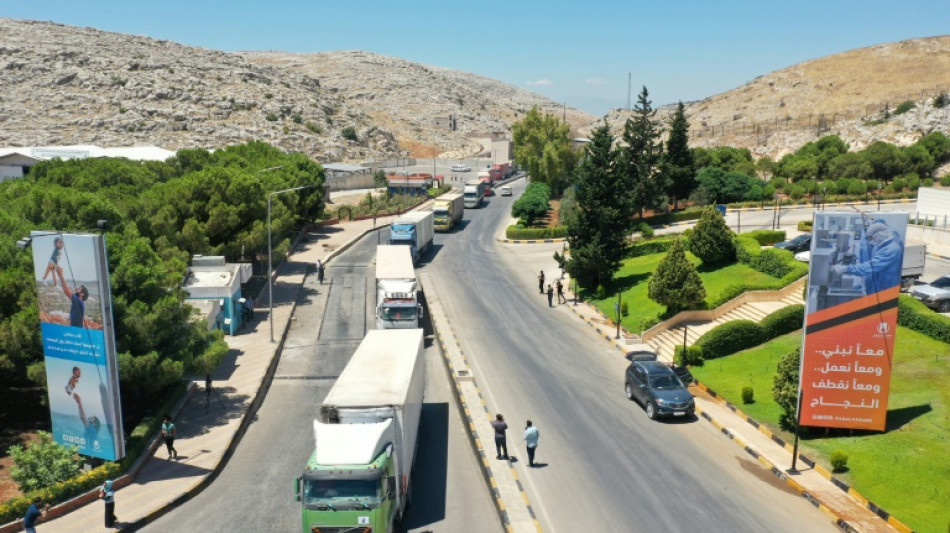
Rights groups again fear for Syria's cross-border aid / Photo: © AFP/File

 New commissioner Berg wants to take MLS to 'next level'

 Colombian ex-guerrillas fear for future under hardline president
 Tsitsipas comeback continues with Montreal first-round win

 Swiatek fends off Bejlek to reach Toronto third round

 Reusser romps to overall lead at Tour de France Femmes

 McDonald's reports slower US sales in 2nd quarter

 Arsenal step up bid to sign Newcastle's Guimaraes: reports

 Gazans hold mass funeral for those killed during war

 WHO pleads for more support to tackle Ebola outbreak
 Oil drops, stocks gain on hopes of Hormuz opening

 Infantino faces nervy times to see if challenger emerges

 Greece gains ground against blaze near Athens
 Oil turns lower, stocks gain on hopes of Hormuz opening

 World Bank warns developing countries to embrace AI or be left behind

 'No decision' on Mudryk future after Chelsea return: Alonso

 China draws up safety rules for autonomous vehicles

 Wenger says scrapping Infantino's World Cup plan was "absolutely necessary"

 Spain confronts EU migration hawks in tense Ceuta talks

 Firefighters hope to contain blaze on Athens outskirts

 Heatwave divides rich and poor of upmarket Seoul

 Drone strike on Moscow region kills 5

 Guatemala issues 'danger' alert after Fuego volcano erupts

 Heat kills 16 in South Korea this summer: interior ministry

 Arson suspect arrested as US northwest battles wildfires

 Britain's Royal Mint strikes gold in electronic waste
International aid groups warn that millions of people in northern Syria could be completely cut from lifesaving assistance should a United Nations vote fail to extend cross-border aid operations from Turkey.
The concerns revive those of six months ago before the Security Council eventually extended the cross-border mechanism for another half-year, as demanded by Syria's ally Russia.
A new UN vote was scheduled later Monday.
The aid delivery mechanism across Turkey's border into rebel-held Syria at the Bab al-Hawa crossing is the only way UN assistance -- everything from nappies and blankets to chickpeas -- can reach civilians without navigating areas controlled by Syrian government forces.
The mechanism, in place since 2014, will expire on Tuesday without another UN extension.
"To many, humanitarian aid has become a lifeline, especially people who are displaced," Ammar Ammar of the UN Children's Fund (UNICEF) told AFP.
"Without UN cross-border access, hunger will increase," he said, calling the aid critical for millions "trapped in the northwest", where jihadists and allied rebels are in control.
The Idlib area is Syria's last main rebel bastion.
Russia has, for years, pressured international organisations to pass exclusively through Damascus to distribute aid throughout the country -- going as far as vetoing cross-border extensions that exceeded six months.
But the organisations say such arrangements cannot replace a cross-border operation and that they do not trust the regime to distribute the aid fairly to areas under rival control.
Aid workers also say a shorter period makes it difficult to plan delivery.
"Ending cross-border aid now would be equivalent to a death sentence for many of those that depend on it," Hiba Zayadin of Human Rights Watch told AFP.
- 'Bare minimum' -
Such a move would derail the lifesaving supplies delivered from across the Turkish border into Syria to an average of 2.7 million people who benefitted from it every month in 2022, according to UN figures.
The last UN vote in July only extended the mechanism for six months, after Russia vetoed a one-year extension favoured by Western countries.
"Council members should be guided by humanitarian imperatives rather than politics," David Miliband, head of the International Rescue Committee, said in a statement last week.
"This resolution is the bare minimum: secure and predictable assistance should be non-negotiable."
In 2014, international aid could flow to Syria through four border crossings, but after years of pressure from China and Russia, only the Bab al-Hawa route has remained operational.
More aid must now go through Damascus to reach areas outside its control, raising concerns among rights groups. But even so, in the past two years only a handful of these convoys has crossed from government-held areas to the northwest, said Diana Semaan of Amnesty International.
- 'Medical disaster' -
The UN halted cross-border aid from Iraq to Kurdish-held parts of northeast Syria in 2020, after Russia and China vetoed UN Security Council resolutions authorising a crossing there to remain open.
The region has since faced "severe shortages in all essential aid... because the Syrian government has restricted the access of aid delivery," Semaan said.
"The same will happen in the northwest if the resolution is not renewed."
In the Idlib region medical professionals staged a small sit-in Sunday to demand the aid mechanism's renewal, an AFP correspondent reported.
Closing the border to aid would spell "a medical disaster" that would put 41 health care centres out of service, Hussam Korra Mohammed, an official at the Idlib Health Directorate, told AFP.
Basic medicine for chronic illnesses such as diabetes and high blood pressure would no longer be available, he told AFP.
In a statement the UN warned that many in northern Syria would "not have access to food and shelter... to safe water," should the operation cease.
The statement was signed last week by chiefs of several UN agencies, including the World Health Organization.
"Most of them are women and children who need assistance just to survive at the peak of winter and amidst a serious cholera outbreak," it said.
N.Fournier--BTB