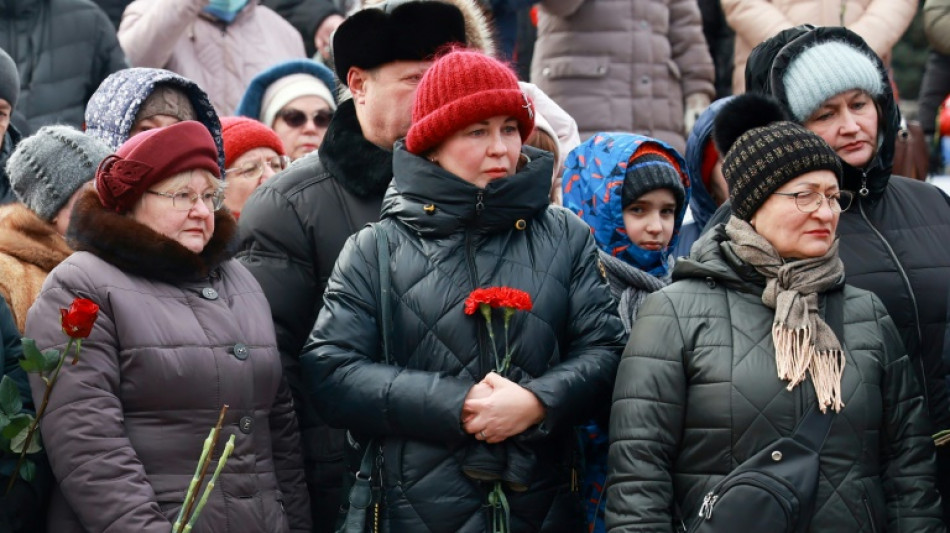
Strike stirs unease in Russia over army's handling of campaign / Photo: © AFP

 Alcaraz withdraws from Cincinnati Masters with wrist injury

 SpaceX revenue jumps 92% in first earnings report, but shares slide

 US eyes Hormuz deal 'today or tomorrow' as ship sinks in Red Sea

 SpaceX revenue jumps 92% in first earnings report
 New commissioner Berg wants to take MLS to 'next level'
 Colombian ex-guerrillas fear for future under hardline president
 Tsitsipas comeback continues with Montreal first-round win
 Swiatek fends off Bejlek to reach Toronto third round
 Reusser romps to overall lead at Tour de France Femmes

 McDonald's reports slower US sales in 2nd quarter

 Arsenal step up bid to sign Newcastle's Guimaraes: reports
 Gazans hold mass funeral for those killed during war
 WHO pleads for more support to tackle Ebola outbreak
 Oil drops, stocks gain on hopes of Hormuz opening
 Infantino faces nervy times to see if challenger emerges
 Greece gains ground against blaze near Athens
 Oil turns lower, stocks gain on hopes of Hormuz opening
 World Bank warns developing countries to embrace AI or be left behind
 'No decision' on Mudryk future after Chelsea return: Alonso

 China draws up safety rules for autonomous vehicles

 Wenger says scrapping Infantino's World Cup plan was "absolutely necessary"

 Spain confronts EU migration hawks in tense Ceuta talks
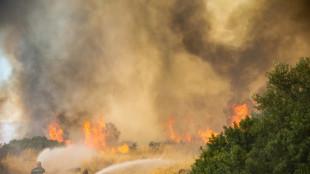 Firefighters hope to contain blaze on Athens outskirts

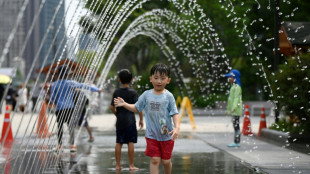 Heatwave divides rich and poor of upmarket Seoul

 Drone strike on Moscow region kills 5

The deadliest Ukrainian strike on Russian troops reported so far has reignited criticism of Moscow's mobilisation drive and laid bare a lack of trust in officials almost a year into the offensive.
The Russian army announced 89 soldiers were killed when Kyiv struck a temporary base in the Russian-occupied town of Makiivka with US-supplied rockets just after midnight at New Year's -- while Ukraine put the toll in the hundreds.
Widespread reports of many recently mobilised men being among the dead stirred some anger after months of discontent over the chaotic draft.
There were also rare displays of public grief in Russia, with some frustration towards the army, whose actions in Ukraine are shrouded in secrecy.
Usually, officials would rush to blame the West and Ukraine.
But this time, for many pro-Kremlin commentators, the culprit was closer to home: the army leadership.
Many questioned if 89 was the real death toll, as reports spread on social media that ammunition was stored near to where the soldiers slept.
The army blamed the troops themselves, saying the devastating strike likely came after they used their cell phones despite a ban.
But it also, in a rare move, promised to punish its own officials for mistakes after an investigation.
Placing the blame on troops caused some anger.
"Well of course. It is not the commander who gave the order to place personnel in the school building that is to blame.
"But just a simple fighter with a phone, apparently, is to blame for the tragedy," Moscow lawmaker Andrei Medvedev said on Telegram.
- 'Something is not going to plan' -
Russia has introduced harsh laws against "discrediting the army" since sending troops to Ukraine, de facto banning criticism of its offensive.
Following the Makiivka strike, many pro-Kremlin commentators blamed the military's poor organisation and corruption.
One of Russia's main Telegram channels in support of the Ukraine offensive, Rybar, said that the building had mobilised men inside, and initially placed the blame on an east Ukrainian separatist commander.
But sociologist Denis Volkov said such deadly strikes have little short-term impact on the mood of Russians as state media had not been dedicating much air time to Russian losses.
After authorities declared an end to the draft in late October, Volkov said "apathy has risen considerably" in Russian society.
He did, however, say that a series of defeats and withdrawals in Ukraine has led to a feeling among some Russians "that something is not going to plan."
"People notice and it does influence the feeling that not everything is as rainbow-like as is portrayed or as they would like it to be," Volkov said.
"But still, the majority think that everything is fine and that we need to continue (the offensive)."
- 'I am shocked' -
Yet in the Samara region, where some of the soldiers and mobilised were known to have been from, the strikes led to public vigils that have been rare since Putin launched the offensive.
Concern quickly spread on social media pages of relatives of soldiers from Samara, calling for a thorough investigation.
"It is not cell phones and their owners that are to blame, but the banal negligence of the commanders, who I am sure did not even try to resettle the personnel," read one social media post on the page.
"I am shocked the commanders did not warn of the dangers," one woman wrote on the same page.
Some questioned why authorities needed a mobilisation in the first place.
Others were divided over whether it was indeed the cell phones that led to the devastation.
A group of activists in Samara have also called for army officials to be punished and for names of the dead to be made public.
"This is a big tragedy for the Samara region," the group wrote on social media.
"It is important to remember, these were mobilised (people), not professional soldiers."
It accused authorities of "putting responsibility on the dead."
N.Fournier--BTB