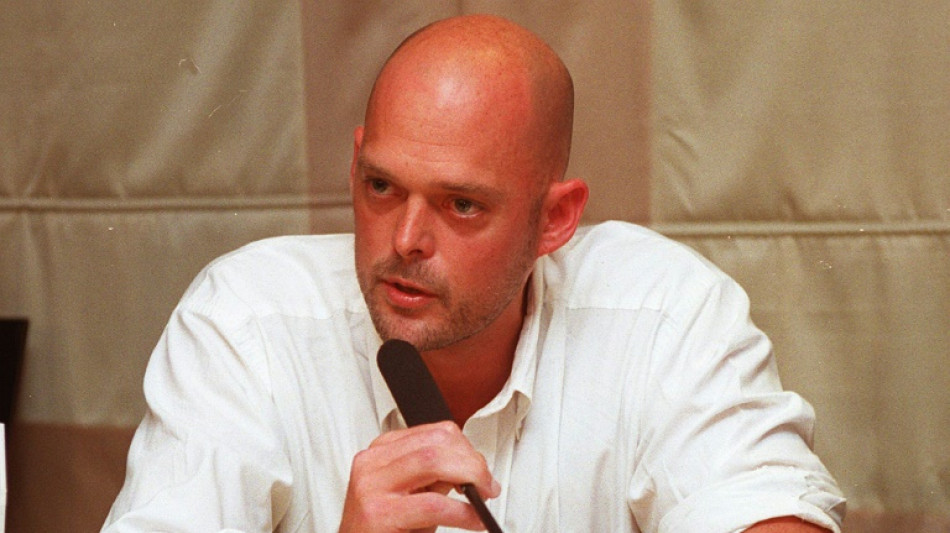
Nate Thayer, who interviewed Pol Pot, dead at 62 / Photo: © AFP

 Alcaraz withdraws from Cincinnati Masters with wrist injury

 SpaceX revenue jumps 92% in first earnings report, but shares slide

 US eyes Hormuz deal 'today or tomorrow' as ship sinks in Red Sea

 SpaceX revenue jumps 92% in first earnings report
 New commissioner Berg wants to take MLS to 'next level'

 Colombian ex-guerrillas fear for future under hardline president
 Tsitsipas comeback continues with Montreal first-round win
 Swiatek fends off Bejlek to reach Toronto third round

 Reusser romps to overall lead at Tour de France Femmes
 McDonald's reports slower US sales in 2nd quarter

 Arsenal step up bid to sign Newcastle's Guimaraes: reports
 Gazans hold mass funeral for those killed during war
 WHO pleads for more support to tackle Ebola outbreak
 Oil drops, stocks gain on hopes of Hormuz opening

 Infantino faces nervy times to see if challenger emerges
 Greece gains ground against blaze near Athens
 Oil turns lower, stocks gain on hopes of Hormuz opening
 World Bank warns developing countries to embrace AI or be left behind

 'No decision' on Mudryk future after Chelsea return: Alonso

 China draws up safety rules for autonomous vehicles

 Wenger says scrapping Infantino's World Cup plan was "absolutely necessary"

 Spain confronts EU migration hawks in tense Ceuta talks
 Firefighters hope to contain blaze on Athens outskirts

 Heatwave divides rich and poor of upmarket Seoul

 Drone strike on Moscow region kills 5

Nate Thayer, the larger-than-life American freelance journalist who scored a massive scoop with his 1997 interview with Pol Pot, the genocidal leader of Cambodia's Khmer Rouge, has died at 62, his family said Wednesday.
Thayer was discovered dead by his brother Rob Thayer at his Falmouth, Massachusetts home Tuesday.
"He had a lot of ailments, he was seriously ill for many months," the brother told AFP.
Nate Thayer spent years reporting on Cambodia politics and society, including the Khmer Rouge, the brutal communist regime that left more than one million people dead between 1975 and 1979.
Beginning in 1989, he worked for the Associated Press, and then publications like the Phnom Penh Post and the Far Eastern Economic Review, building contacts in the dangerous jungle border region of Thailand and Cambodia.
With his shaven head, chewing tobacco and handiness with guns, he gained a reputation as a gonzo journalist, setting out on crazy adventures, like traveling with a well-armed reporting team from Soldier of Fortune magazine into eastern Cambodia in search of a likely extinct forest ox called a kouprey.
In the wild west frontier of Thailand and Cambodia, he braved firefights and was severely injured by a landmine in 1989 while riding with Cambodian guerillas.
His work paid off in 1997 when he sent a cryptic message to Far Eastern Economic Review editor Nayan Chanda that he would interview "uncle," or Pol Pot, whom no journalist had met for two decades.
From Thailand Thayer slipped into Pol Pot's Anlong Veng jungle redoubt, beating out a New York Times team that had arrived near the border thinking they would see the shadowy Cambodian.
Days later, he broke the story in the Far Eastern Economic Review. Pol Pot, blamed for murdering over a million people, told him: "Am I a savage person? My conscience is clear."
Chanda attributed his journalistic success to a distinct "doggedness."
"He was very intense, very focused on the story he was working on, almost like a force of nature," Chanda said.
"He actually knew quite a few of the Khmer Rouge. . . . Nobody else spent as much time pursuing those guys, going to dangerous places, being with them in a firefight," he added.
A year later Thayer scooped others with Pol Pot's death and an interview with the one-legged Khmer Rouge army commander and Pol Pot rival Ta Mok.
But by then he was embroiled in a fight with ABC News' "Nightline" program over its use of his video footage and reporting on the Khmer Rouge, which Thayer said violated their agreement.
Thayer rejected a prestigious Peabody Award which cited him as a correspondent for "Nightline," and the two sides later settled his suit.
The son of a former US ambassador to Singapore, Thayer spent most of his career focused on Asia, reporting from combat situations like the Myanmar border and investigating North Korea.
He also traveled to Iraq to report on the 2003 US invasion.
He won a number of journalism awards, including the ICIJ Award for Outstanding International Investigative Reporting, and was proud of being a freelancer, calling for more respect and better pay for reporters not employed full-time.
Slowed by the long-term ailments, some dating to his injuries from the mine explosion, in the past decade Thayer reported online on right-wing extremism from Washington and Massachusetts.
With his health failing, he spent his final months posting poetic odes to his "best pal," his dog Lamont.
J.Horn--BTB