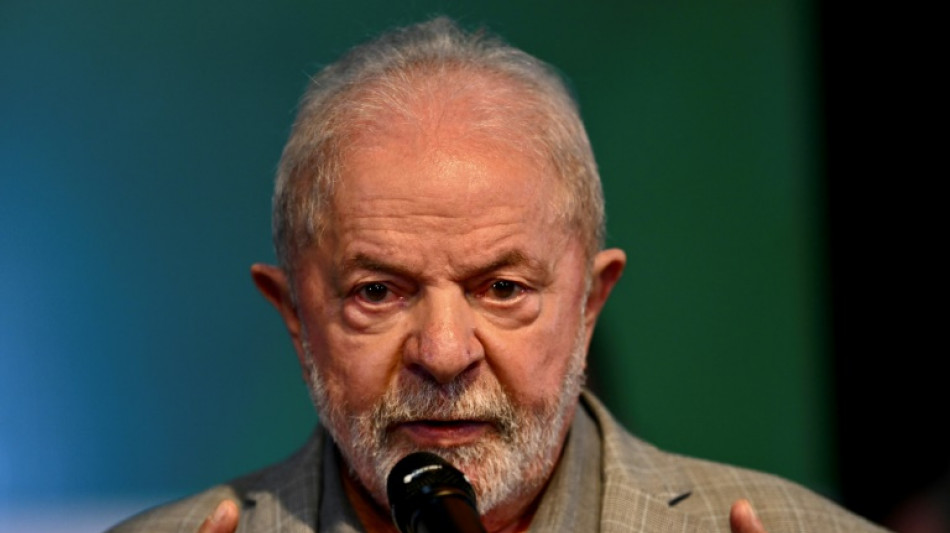
Many hurdles await Brazil's President Lula / Photo: © AFP/File

 Alcaraz withdraws from Cincinnati Masters with wrist injury

 SpaceX revenue jumps 92% in first earnings report, but shares slide

 US eyes Hormuz deal 'today or tomorrow' as ship sinks in Red Sea
 SpaceX revenue jumps 92% in first earnings report
 New commissioner Berg wants to take MLS to 'next level'
 Colombian ex-guerrillas fear for future under hardline president
 Tsitsipas comeback continues with Montreal first-round win
 Swiatek fends off Bejlek to reach Toronto third round
 Reusser romps to overall lead at Tour de France Femmes
 McDonald's reports slower US sales in 2nd quarter

 Arsenal step up bid to sign Newcastle's Guimaraes: reports
 Gazans hold mass funeral for those killed during war
 WHO pleads for more support to tackle Ebola outbreak
 Oil drops, stocks gain on hopes of Hormuz opening

 Infantino faces nervy times to see if challenger emerges
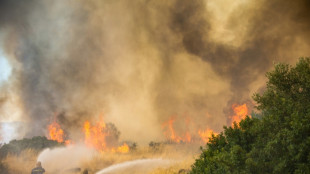 Greece gains ground against blaze near Athens
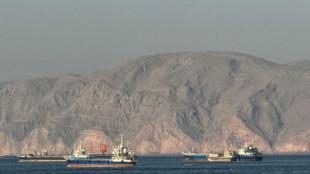 Oil turns lower, stocks gain on hopes of Hormuz opening
 World Bank warns developing countries to embrace AI or be left behind
 'No decision' on Mudryk future after Chelsea return: Alonso

 China draws up safety rules for autonomous vehicles
 Wenger says scrapping Infantino's World Cup plan was "absolutely necessary"
 Spain confronts EU migration hawks in tense Ceuta talks
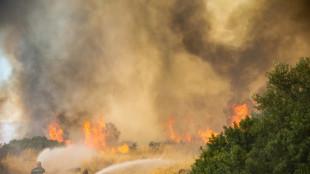 Firefighters hope to contain blaze on Athens outskirts
 Heatwave divides rich and poor of upmarket Seoul

 Drone strike on Moscow region kills 5

Brazil's Luiz Inacio Lula da Silva, who assumes the presidency Sunday, faces a long list of hurdles from healing a deeply divided country to battling poverty and hunger in the face of severe budget constraints.
A "Herculean task" awaits the new head of Latin America's largest economy, a country of 215 million of whom more than half face food insecurity, Lula's vice-president to be Geraldo Alckmin has conceded.
Lula's transition team blames four years of "irresponsible management" under far-right leader Jair Bolsonaro for plunging the country into a dismal state of scarcity and declines in social welfare, education, health and environmental protection.
To help him tackle these challenges, Lula spent weeks in tough negotiations to put together a team of ministers, now ready.
This first hurdle, even before taking office, meant Lula had to find a way to accommodate leftist allies who made his election possible, but also the center of the political spectrum whose support he will need in Congress.
The Senate and Chamber of Deputies that emerged from October's general elections now lean even more toward the right than before.
But analysts say Lula's hands are not completely tied, having managed to assemble a loose parliamentary alliance ranging from the far left to the center right.
- 'Make Brazil happy again' -
Lula, who has vowed to "make Brazil happy again," takes the reins of a country in which 58 million people did not vote for him, and whom he will have to appease.
The stain of a corruption conviction, since overturned, made Lula into a pariah for many Brazilians, and October elections went down to the wire.
While many have fond memories of economic prosperity under Lula's first two presidencies from 2003 to 2010, many others voted for him merely to see the back of Bolsonaro.
The victory was a narrow one, and Lula garnered 50.9 percent of the vote to Bolsonaro's 49.1 percent.
Two months after the vote, Bolsonaro backers are still protesting outside military barracks demanding the army step in to prevent Lula's swearing-in.
If he listens to his transition team, Lula's first priorities will be putting a stop to the environmental destruction that worsened under pro-business Bolsonaro, improve the underfunded education system and address racial inequality.
He should also seek to restrict firearms possession, which exploded under his conservative, pro-gun predecessor.
- Lost prestige -
On the international scene, Lula will face the task of reconciling Brazil with allies alienated by the ultraconservative and controversial Bolsonaro.
Lula's transition team has noted that Brazil "lost its prestige" in the preceding four years and Brasilia owes nearly a billion dollars in unpaid contributions to multilateral bodies including the United Nations.
The new president has an advantage in this area: he is widely liked abroad and was once described by former US president Barack Obama as "the most popular politician on Earth."
In particular, the international community expects Lula to take strong action on the climate and the environment, first and foremost boosting Amazon protection.
"We will do whatever it takes to achieve zero deforestation" and an end to ecosystem degradation by 2030, Lula vowed in November at the COP27 climate summit.
But to achieve this he will have to reinvigorate oversight bodies, decimated under Bolsonaro, to stop illegal logging and mining without alienating Brazil's powerful agribusiness lobby -- a key ally of his rival.
- Tight budget -
Brazil's economic and social situation will also pose a major challenge for Lula, who has said his "priority is to take care of the poorest."
The recent approval by Congress of a constitutional amendment that would allow him to finance his campaign promises, at least for a year, was a welcome first step.
Despite caps on public spending, it allows him to increase the so-called "Bolsa familia" welfare payment to Brazil's poorest families as well as the minimum wage.
Some 125 million Brazilians are food insecure and 30 million -- the same number Lula is credited with lifting out of poverty during his first two terms -- are hungry.
For Joelson Sampaio of the Getulio Vargas Foundation, budget constraints will be Lula's "biggest challenge of the next few years."
The new president will have to "increase spending with no prospect of (increasing) equivalent revenues, while trying not to raise taxes," he explained.
The markets fear an explosion of the public debt, already at 77 percent of GDP, under the leftist leader.
For Alex Agostini, chief economist at Austin Rating, "the new administration will have to propose an effective budgetary control framework" to "avoid a loss of confidence that would have a domino effect on the economy."
He will also be tasked with maintaining a downward trend in unemployment, which at 8.3 percent is the lowest since 2015, and keep inflation under control even amid the global economic slowdown, said Agostini.
Economic concerns were a main driver of the vote for Lula, a former metal worker and working class hero for many.
M.Ouellet--BTB