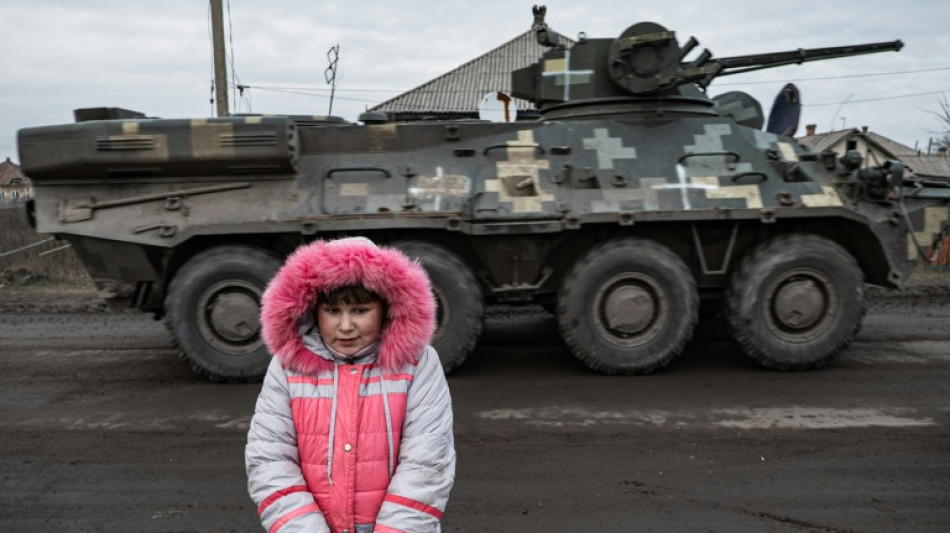
Children forced to grow up fast in Ukraine's frontline towns / Photo: © AFP

 'Like the end of the world': the eclipse chasers flocking to Spain

 Taiwan begins military drills as China pressure grows

 UK mansion where 'listeners' spied on Nazi generals becomes museum
 Sabalenka tops Uchijima in WTA Toronto opener

 Kgatlana strikes as South Africa reach WAFCON quarter-finals

 Pakistan close on series-levelling win against West Indies

 Paramount CEO says politics fueling Warner Bros. merger battle

 Trump's sale of access to Truth Social raises eyebrows

 SpaceX rocket stage expected to slam into Moon
 US hopeful Hormuz strait deal will be done 'today or tomorrow'

 Michigan primary puts Democratic divide on the ballot

 South Africa captain Kolisi to make Test return in Argentina

 Cuba's famed resilience comes at a growing mental cost

 Swiss Reusser wins Tour de France Femmes time-trial

 Hundreds flee homes after Guatemala's Fuego volcano erupts
 Thousands pay tribute to Italian football legend Baresi
 Oil drops, stocks hit records on hopes of Hormuz opening

 Renard returns as Ivory Coast coach

 Italian garbagemen help recover lost 1 mln euro lottery ticket
 EU nations patch things up after Ceuta migration discord

 US hopeful Hormuz strait deal will be done 'today or tomorrow' after ship hit

 Infantino's problems mount as Wenger and key FIFA ally turn on him

 Oil edges higher, stocks gain as investors eye political risks
 Man Utd sign reported record £20mn sponsorship deal for training kit

 Stokes reveals England coaching ambition
Lisa Shtanko, 8, stood on the side of a muddy road watching Ukrainian soldiers pass by, one of only a few children left in a town hit hard by Russia's invasion.
There was hardly any heating or electricity. Most of her friends were long gone. And just that morning a strike had landed outside Lisa's house.
"Today I'm not in a good mood because of the shelling," she told AFP as her father, Viktor Shtanko, looked on.
Children living on the frontline of Russia's invasion of Ukraine have to learn to manage unceasing stress, with experts warning of long-term disorders.
The Shtankos' hometown, Lyman, endured four months of Russian occupation that left most of it in ruins and turned the surrounding forests into minefields.
Ukrainian forces regained control of Lyman in October, but fighting continues nearby.
"Of course she's scared," said Viktor, a 42-year-old electrician.
"There's nothing scarier than death lurking around you. But she's fine with her dad."
The upcoming New Year's Eve and Orthodox Christmas holiday on January 7 could provide some distraction from the war, but the only toy Viktor will be able to offer will be donated by a humanitarian group.
These hardships have spurred most families with children to leave, and many have "no reason to return", said Kostya Korovkin, father of 6-year-old Nastya.
Kostya told AFP he has nowhere to go, meaning Nastya is forced to spend long days in the basement of their building, occasionally wandering out onto streets where only stray dogs roam.
Sometimes she heads up to the building's sixth floor, the only place where she can get an internet signal and attend classes online.
In front of the entrance to her building, someone has set up a small Christmas tree and placed candies on the branches.
"But," Kostya said, "there are no children left to pick them."
- No thought for the future -
While Lyman no longer sees active fighting, other towns in the eastern Donetsk region still have the war on their doorstep.
Bakhmut, where President Volodymyr Zelensky paid a daring surprise visit last week, has been pounded by a months-long Russian assault that shows no sign of letting up.
At the back of one basement where 20 people have been sheltering for eight months, 14-year-old Gleb Petrov greets visitors with a firm handshake and a serious look on his face.
He is the only minor living in the basement, where he spends his days sleeping late, caring for the elderly and watching over a black kitten that has also taken up residence there.
Sometimes he draws, tries to read books meant for adults or, when there is electricity, plays on his phone.
"I don't think about the future," he told AFP.
"I don't even know what will happen in an hour, or in a day from now."
As the sound of explosions reverberated outside, Gleb said he had learned to recognise the difference between incoming and outgoing fire.
Asked about his biggest dream, he said he simply wanted "to go for a walk with a friend."
- 'Permanent insecurity' -
Dozens if not hundreds of children remain in Bakhmut, their parents unable or unwilling to leave.
"These children have already become adults," said Katherine Soldatova, a volunteer with an association that has set up a shelter in the basement of a school.
Inside the heated room there is a Christmas tree and a television -- "everything so that they can feel a little bit safe," Soldatova said.
Accessing such a shelter can be extremely dangerous, and recently two civilians were killed on their way to Soldatova's.
But it has become a vital lifeline for kids like 12-year-old Volodymyr, who told AFP he generally only leaves to go home and eat.
Psychologist Alyona Yukyanchuk stressed that the children of Bakhmut were in a state of "permanent insecurity".
"The world can betray them at any second, everything can be destroyed in an instant," said Yukyanchuk, who works for the Ukrainian branch of the NGO "SOS Children's Villages".
With their parents "focussed on surviving", children must learn to cope with constant stress that "affects concentration [and] cognitive resources" and can lead to long-term disorders, she said.
But she said she is trying to remain "a little optimistic", refusing to accept the notion that these children will make up a so-called lost generation.
"There is no safe place in Ukraine, but only a small percentage of children live on the frontline," she said.
"They will need to be monitored but I am sure that many will find the resources".
W.Lapointe--BTB