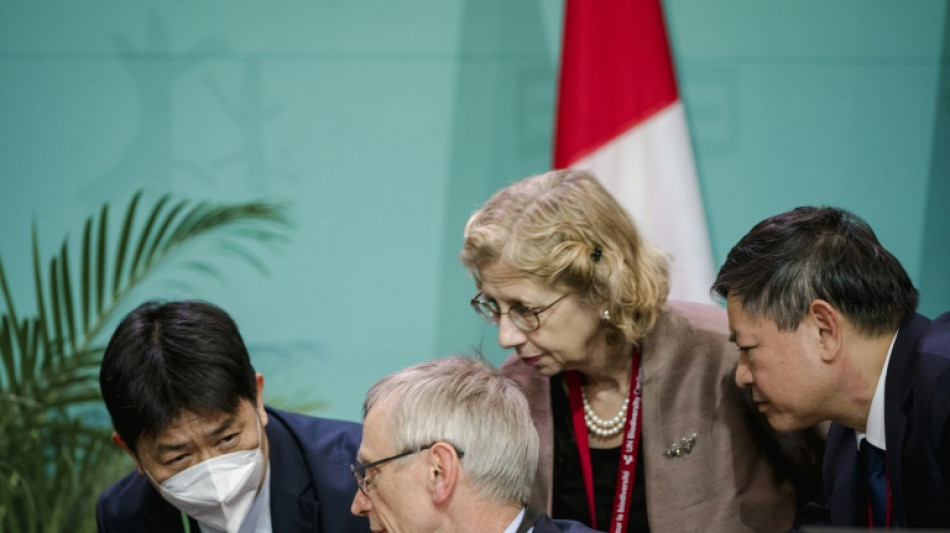
How Chinese diplomacy helped seal historic nature deal / Photo: © AFP

 South Korea pro baseball league cancels games over heatwave

 Taiwan probes 17 China-funded firms over high-tech talent poaching
 Trump warns Iran to open Hormuz or get 'hit very hard'

 Factories shed workers in Bangladesh garment sector
 North Korea warns of 'military options' over Japan rearmament

 Tiny light, big dream: Harvesting power from soil in Japan

 Trump admin to review 'closed' AI models before release: reports

 De Minaur fights past Duckworth in all-Aussie Montreal battle
 High bills, cheap panels drive a Philippine solar surge

 Russian barrage on Ukraine kills 2, wounds dozens more

 Alcaraz withdraws from Cincinnati Masters with wrist injury

 SpaceX revenue jumps 92% in first earnings report, but shares slide

 US eyes Hormuz deal 'today or tomorrow' as ship sinks in Red Sea

 SpaceX revenue jumps 92% in first earnings report
 New commissioner Berg wants to take MLS to 'next level'

 Colombian ex-guerrillas fear for future under hardline president
 Tsitsipas comeback continues with Montreal first-round win

 Swiatek fends off Bejlek to reach Toronto third round

 Reusser romps to overall lead at Tour de France Femmes

 McDonald's reports slower US sales in 2nd quarter

 Arsenal step up bid to sign Newcastle's Guimaraes: reports

 Gazans hold mass funeral for those killed during war

 WHO pleads for more support to tackle Ebola outbreak
 Oil drops, stocks gain on hopes of Hormuz opening

 Infantino faces nervy times to see if challenger emerges
Expectations heading into a UN biodiversity conference in Montreal were about as low as they could be.
But a broad recognition that it was now or never for nature -- and a flurry of late diplomacy by China -- helped seal a "historic" deal on a night of high drama.
Dubbed the "ugly duckling" of global policy, the COP15 negotiations were snubbed by world leaders who had just attended a far higher-profile climate summit in Egypt.
Beijing, which held the presidency of the talks, at first appeared to have a hands-off approach, and the defining issue -- whether the rich world would pledge enough money so their developing counterparts could protect vanishing species and habitats -- seemed too great to surmount.
"For months, there was the question: Where is China?" a high-level source close to the matter told AFP.
What's more, relations between China and Canada, which had to step in to host the event because of China's strict Covid rules, have deteriorated in recent years.
Canada's 2018 arrest of Chinese telecommunications executive Meng Wanzhou at the request of the United States was followed quickly by China arresting two Canadians.
Just last month, Chinese leader Xi Jinping was caught on camera scolding Canada's Justin Trudeau over a sleight.
What's more, "it's strange to have a Chinese presidency on North American soil," said the high-level source -- and early signs did nothing to dispel assumptions that China in charge would mean a weakening of ambition.
In the first week, China let Canada run the show shepherding talks on the key issues, from finance to the cornerstone target of protecting 30 percent of land and oceans by 2030.
But as the clock ticked down, it was China that took charge of the text, in an approach described as "gentle" diplomacy: having subject experts and political representatives work in a calm, even environment, according to another diplomatic source.
"China closed out the deal and cornered the developing countries with the $30 billion financing pledge by 2030," said a third source, a European negotiator.
When countries of the Global North sought more ambitious targets from the South, China responded by telling them they'd need to up their financing. And Beijing acted as a neutral arbiter, not aligning itself with the Group of 77 as it normally does.
"They've taken the risk of putting their own reputation on the line for something many thought they weren't the natural leaders of," said Lee White, a British-Gabonese conservationist and minister of water, forests and environment of Gabon.
Nor is China a natural champion of environmental issues, having badly polluted its air and waters and degraded much of its land through agricultural production -- a process it is trying to reverse through a greenification campaign.
"Countries that destroy their biodiversity end up regretting it -- I think the Chinese probably got to that point and are now trying to put things right," said White.
- High drama -
The passage of China's compromise text wasn't smooth sailing.
A plenary session to ratify the text was postponed Sunday several times to accommodate last minute holdouts, though delegates were eventually asked to take their seats by around 9:00 pm, and wait. And wait, and wait, and wait.
Some left the main hall to take naps, with several Western delegates expressing irritation that the session was not being adjourned until the next day.
It was around 3:00 am that the session finally began. A new text had been uploaded, and participants were once more buzzing at the prospect of a "peace pact for nature." When delegates gathered in the vast plenary hall, drama struck.
A delegate from Democratic Republic of Congo refused to back the accord, demanding more funds.
The conference chair, China's environment minister Huang Runqui, brushed this off, declaring the deal "approved" and whacking down his gavel to loud applause. DRC's ally Uganda branded it a "fraud" and a "coup," but the accord passed.
An exultant Steven Guilbeault, Canada's environment minister, downplayed the drama -- insisting the process was upheld by the United Nations and disagreements on this scale were commonplace at such summits which he had been attending for 25 years.
"I've never seen a presidency text tabled and have so much support for it from the get-go," with the vast majority of countries signing up right away, he enthused.
On cooperation with China, he told AFP: "We both decided to set aside our differences... to focus on what unites us," adding: "What China and Canada have accomplished together in our relationship is symbolic of what we've accomplished here together, more than 196 countries."
While China took center stage, the United States participated only in a supporting role.
President Joe Biden supports the pact's goals and announced his own "30x30" plan domestically -- but political opposition by Republicans prevents the US from signing on to the convention on biological diversity.
L.Janezki--BTB