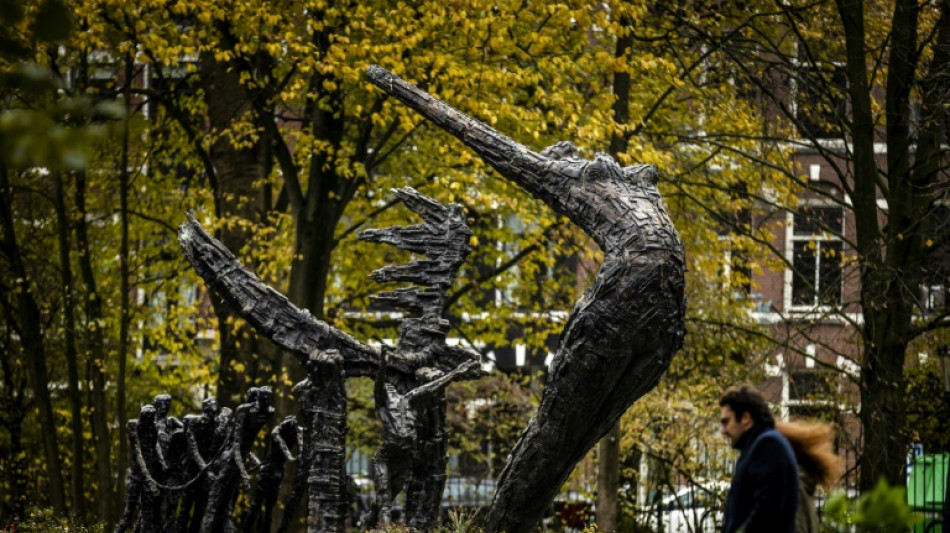
Dutch PM apologises for 250 years of slavery / Photo: © ANP/AFP

 South Korea pro baseball league cancels games over heatwave

 Taiwan probes 17 China-funded firms over high-tech talent poaching

 Trump warns Iran to open Hormuz or get 'hit very hard'

 Factories shed workers in Bangladesh garment sector

 North Korea warns of 'military options' over Japan rearmament

 Tiny light, big dream: Harvesting power from soil in Japan

 Trump admin to review 'closed' AI models before release: reports

 De Minaur fights past Duckworth in all-Aussie Montreal battle

 High bills, cheap panels drive a Philippine solar surge

 Russian barrage on Ukraine kills 2, wounds dozens more

 Alcaraz withdraws from Cincinnati Masters with wrist injury

 SpaceX revenue jumps 92% in first earnings report, but shares slide

 US eyes Hormuz deal 'today or tomorrow' as ship sinks in Red Sea

 SpaceX revenue jumps 92% in first earnings report
 New commissioner Berg wants to take MLS to 'next level'

 Colombian ex-guerrillas fear for future under hardline president

 Tsitsipas comeback continues with Montreal first-round win

 Swiatek fends off Bejlek to reach Toronto third round

 Reusser romps to overall lead at Tour de France Femmes

 McDonald's reports slower US sales in 2nd quarter

 Arsenal step up bid to sign Newcastle's Guimaraes: reports

 Gazans hold mass funeral for those killed during war

 WHO pleads for more support to tackle Ebola outbreak

 Oil drops, stocks gain on hopes of Hormuz opening

 Infantino faces nervy times to see if challenger emerges
Dutch Prime Minister Mark Rutte on Monday officially apologised for 250 years of the Netherlands' involvement in slavery, calling it a "crime against humanity".
The apology comes almost 150 years after the end of slavery in the European country's overseas colonies, which included Suriname and islands like Curacao and Aruba in the Caribbean and Indonesia in the East.
"Today on behalf of the Dutch government, I apologise for the past actions of the Dutch state," Rutte said in a speech in The Hague.
"We, living in the here and now, can only recognise and condemn slavery in the clearest terms as a crime against humanity," he said.
Dutch ministers have travelled to seven former colonies in South America and the Caribbean for the event.
Sigrid Kaag, the Dutch finance minister and deputy prime minister, said on an official visit to Suriname last week that a "process" would begin leading up to "another incredibly important moment on July 1 next year".
Descendants of Dutch slavery will then celebrate 150 years of liberation from slavery in an annual celebration called "Keti Koti" (Breaking the Chains) in Surinamese.
But the plan has caused controversy, with groups and some of the affected countries criticising the move as rushed, and saying the lack of consultation by the Netherlands smacked of a colonial attitude.
But Rutte in his speech on Monday said that choosing the right moment was a "complicated matter".
"There is not one right time for everyone, not one right word for everyone, not one right place for everyone," he said.
- 'Golden' Age? -
The Dutch funded their "Golden Age" of empire and culture in the 16th and 17th centuries by shipping around 600,000 Africans as part of the slave trade, mostly to South America and the Caribbean.
At the height of its colonial empire, the United Provinces known today as the Netherlands possessed colonies like Suriname, the Caribbean island of Curacao, South Africa and Indonesia, where the Dutch East India Company was based in the 17th century.
In recent years, the Netherlands has been grappling with the fact that its Rembrandt and Vermeer-filled museums and historic towns were largely built on the back of that brutality.
Spurred by the Black Lives Matter movement in the United States, it has also raised questions about racism in Dutch society.
Pressure has been growing at home with the cities of Amsterdam, Rotterdam, The Hague and Utrecht formally apologising for the slave trade.
Rutte had long resisted, previously saying the period of slavery was too far back and that an apology would ignite tensions in a country where the far right remains strong.
He has now changed tack, but that has not pleased everyone.
- 'Enslaved people' -
Sint Maarten's Prime Minister Silveria Jacobs told Dutch media on Saturday the island would not accept a Dutch apology if made on Monday.
"Let me be clear that we won't accept an apology until our advisory committee has discussed it and we as a country discussed it," she said.
The fact that another Dutch minister sent to Suriname, Franc Weerwind, is himself of Surinamese descent sparked criticism from the slavery restitution group there on the grounds that he is a "descendant of enslaved people".
On Monday, Dutch cabinet ministers would be in Suriname, Bonaire, Sint Maarten, Aruba, Curacao, Saba and St. Eustatius to "discuss the cabinet response and its significance on location with those present" after the Rutte speaks, the government said.
Slavery was formally abolished in Suriname and other Dutch-held lands on July 1, 1863, but the practice only really ended in 1873 after a 10-year "transition" period.
Slavery commemoration groups say any apology should come on the 150th anniversary of that date, in 2023, instead of the "arbitrary" date of December 19 this year.
M.Odermatt--BTB