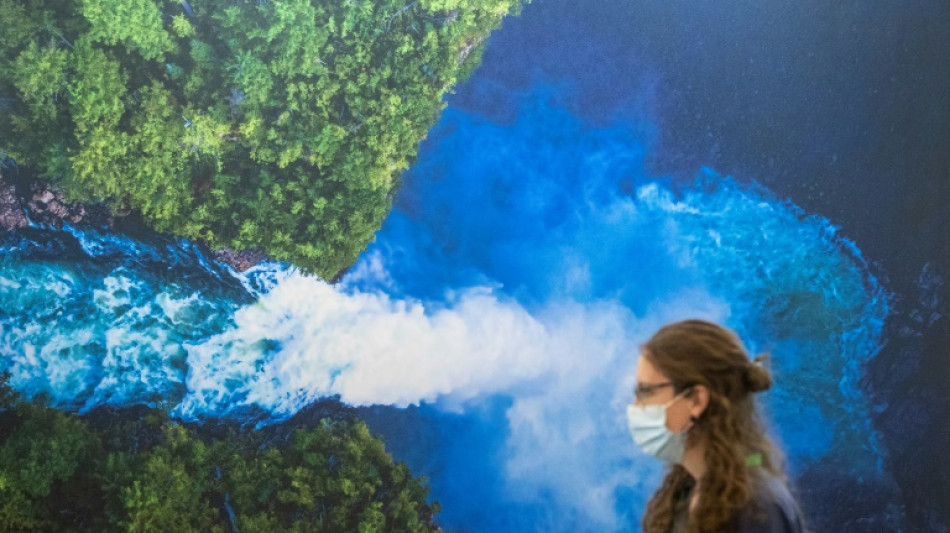
Countries agree historic deal to protect nature / Photo: © AFP

 South Korea pro baseball league cancels games over heatwave

 Taiwan probes 17 China-funded firms over high-tech talent poaching

 Trump warns Iran to open Hormuz or get 'hit very hard'

 Factories shed workers in Bangladesh garment sector
 North Korea warns of 'military options' over Japan rearmament

 Tiny light, big dream: Harvesting power from soil in Japan

 Trump admin to review 'closed' AI models before release: reports
 De Minaur fights past Duckworth in all-Aussie Montreal battle

 High bills, cheap panels drive a Philippine solar surge

 Russian barrage on Ukraine kills 2, wounds dozens more

 Alcaraz withdraws from Cincinnati Masters with wrist injury

 SpaceX revenue jumps 92% in first earnings report, but shares slide

 US eyes Hormuz deal 'today or tomorrow' as ship sinks in Red Sea

 SpaceX revenue jumps 92% in first earnings report
 New commissioner Berg wants to take MLS to 'next level'

 Colombian ex-guerrillas fear for future under hardline president

 Tsitsipas comeback continues with Montreal first-round win

 Swiatek fends off Bejlek to reach Toronto third round

 Reusser romps to overall lead at Tour de France Femmes

 McDonald's reports slower US sales in 2nd quarter

 Arsenal step up bid to sign Newcastle's Guimaraes: reports
 Gazans hold mass funeral for those killed during war

 WHO pleads for more support to tackle Ebola outbreak
 Oil drops, stocks gain on hopes of Hormuz opening

 Infantino faces nervy times to see if challenger emerges

Countries approved a historic deal to reverse decades of environmental destruction threatening the world's species and ecosystems at a marathon UN biodiversity summit early Monday.
The chair of the COP15 nature summit, Chinese Environment Minister Huang Runqiu, declared the deal adopted at a late-night plenary session in Montreal and struck his gavel, sparking loud applause from assembled delegates.
In doing so he overruled an objection from the Democratic Republic of Congo, which had refused to back the text, demanding greater funding for developing countries as part of the accord.
After four years of fraught negotiations, more than 190 other states rallied behind the Chinese-brokered accord aimed at saving the lands, oceans and species from pollution, degradation and the climate crisis.
The deal pledges to secure 30 percent of the planet as a protected zone by 2030 and to stump up $30 billion in yearly conservation aid for the developing world.
Environmentalists have compared the accord to the landmark plan to limit global warming to 1.5C under the Paris agreement, though some earlier warned that it did not go far enough.
Brian O'Donnell of the Campaign for Nature called it "the largest land and ocean conservation commitment in history."
"The international community has come together for a landmark global biodiversity agreement that provides some hope that the crisis facing nature is starting to get the attention it deserves," he said.
"Moose, sea turtles, parrots, rhinos, rare ferns and ancient trees, butterflies, rays, and dolphins are among the million species that will see a significantly improved outlook for their survival and abundance if this agreement is implemented effectively."
Marco Lambertini, head of the Worldwide Fund for Nature, said ahead of the approval sessions: "It is the equivalent to 1.5C in climate and vital to catalyzing action toward a nature-positive world and holding everyone accountable.
"However, there still remain several loopholes, weak language, and timelines around actions that aren't commensurate with the scale of the nature crisis we're all witnessing, and importantly may not add up to achieve this shared global goal."
- Aid boost -
The text calls on wealthy countries to increase financial aid to the developing world to $20 billion annually by 2025, rising to $30 billion per year by 2030, while ensuring 30 percent of land and sea areas are effectively conserved and managed by the end of this decade.
It pledges to safeguard the rights of Indigenous people as stewards of their lands, a key demand of campaigners.
But it pulled punches in other areas -- for example, only encouraging businesses to report their biodiversity impacts rather than mandating them to do so.
The 23 targets in the accord also include cutting environmentally destructive farming subsidies, reducing the risk from pesticides and tackling invasive species.
- Funding dispute -
At times, the talks looked at risk of collapsing as countries squabbled over money.
The issue of how much money the rich countries will send to the developing world, home to most of the planet's biodiversity, was the biggest sticking point.
Developing countries, spearheaded by Brazil, had been seeking the creation of a new fund to signal the Global North's commitment to the cause. But the draft text instead suggested a compromise: creating a fund within an existing mechanism, called the Global Environment Facility (GEF).
Brazilian delegate Braulio Dias, speaking on behalf of the incoming government of Luiz Inacio Lula da Silva, had called for "better resource mobilization" -- technical speak for more aid to developing countries, a concern echoed by the Democratic Republic of Congo.
Current financial flows for nature to the developing world are estimated at around $10 billion per year.
Beyond the moral implications, there is the question of self-interest: $44 trillion of economic value generation -- more than half the world's total GDP -- depends on nature and its services.
The United States is not a signatory to the biodiversity convention due to resistance from Republican senators. US President Joe Biden supports the deal and launched his own "30 by 30" plan domestically, while the United States pays into the GEF to assist developing countries.
China chaired the conference but it was held in Canada because of China's strict Covid rules.
L.Dubois--BTB