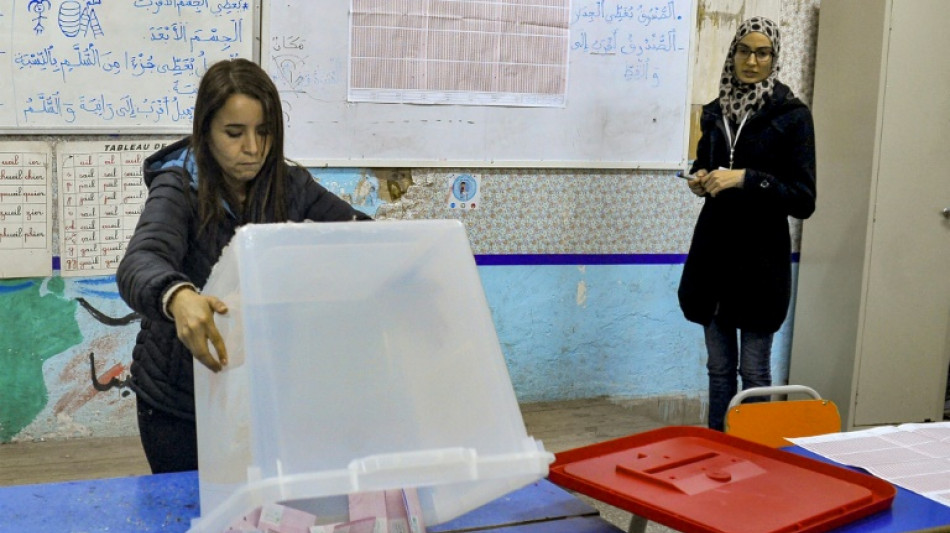
Tunisia uncertainty after poll snub, calls for president to quit / Photo: © AFP

 Russian barrage on Kyiv kills 17 as Ukraine fails to down single missile
 'Lost': Migrants despair after Britain expels them back to France
 Cathay Pacific's profit soars 71% despite Iran war driving up fuel costs
 Russian barrage on Ukraine kills 15, wounds dozens more
 South Korea police raid Starbucks HQ over 'Tank Day' fiasco
 Tech back in fashion as Asian markets extend rebound
 Total eclipse gives scientists chance to probe Sun's mysteries
 What to know about the total solar eclipse on August 12
 'Like the end of the world': the eclipse chasers flocking to Spain
 Taiwan begins military drills as China pressure grows
 UK mansion where 'listeners' spied on Nazi generals becomes museum
 Sabalenka tops Uchijima in WTA Toronto opener
 Kgatlana strikes as South Africa reach WAFCON quarter-finals

 Pakistan close on series-levelling win against West Indies
 Paramount CEO says politics fueling Warner Bros. merger battle

 Trump's sale of access to Truth Social raises eyebrows
 SpaceX rocket stage expected to slam into Moon
 US hopeful Hormuz strait deal will be done 'today or tomorrow'

 Michigan primary puts Democratic divide on the ballot

 South Africa captain Kolisi to make Test return in Argentina

 Cuba's famed resilience comes at a growing mental cost

 Swiss Reusser wins Tour de France Femmes time-trial
 Hundreds flee homes after Guatemala's Fuego volcano erupts
 Thousands pay tribute to Italian football legend Baresi

 Oil drops, stocks hit records on hopes of Hormuz opening
Tunisia plunged into political uncertainty Sunday after voters overwhelming snubbed elections for a neutered parliament, as the main opposition alliance called on President Kais Saied to "leave immediately".
The move comes as Saied's government negotiates a nearly $2-billion package from the International Monetary Fund to bail out the North African country's crippled public finances.
The electoral board said 8.8 percent of the nine-million-strong electorate had turned out for Saturday's polls, the culmination of a power grab by Saied in the only democracy to have emerged from the Arab Spring uprisings.
Ahmed Nejib Chebbi, president of the National Salvation Front alliance, said Saied had "lost all legal legitimacy".
An abstention rate of more than 91 percent "shows that very, very few Tunisians support Kais Saied's approach", Chebbi told AFP.
He said the result showed "great popular disavowal" of the process that began when Saied, elected in 2019, seized executive powers last year.
The president in July 2021 sacked the government, froze parliament and surrounded it with military vehicles, following months of political deadlock and economic crisis exacerbated by the coronavirus pandemic.
Saied, a former law professor, followed up by seizing control of the judiciary and pushing through a constitution that consolidated his near-absolute power in a widely boycotted referendum in July.
His moves, a decade after the ouster of dictator Zine El Abidine Ben Ali, have sparked fears of a return to autocracy.
- 'Isolated' -
Political analyst Slaheddine Jourchi said Saturday's "shock" low turnout had left Saied "more isolated from the elite, the parties -- and now the people too".
"This turnout, the lowest ever recorded, shows that the people have no trust" in the president, Jourchi added.
The National Salvation Front -- which includes the Islamist-inspired Ennahdha party, Saied's nemesis -- boycotted Saturday's election, saying it was part of a "coup" against Tunisia's democracy.
"The situation is critical," Chebbi said.
"We should agree on a high-ranking judge" who could "oversee immediate presidential elections", he added.
Political scientist Hamadi Redissi called the turnout "a personal disavowal for Mr. Saied", adding that the president's "legitimacy is in question".
But he said the opposition was "weak and divided", and that many Tunisians blame Ennahdha for the country's woes over the past decade.
There is also "no legal mechanism to dismiss the president" under the new constitution, Redissi said.
Abir Moussi, who heads the anti-Islamist Free Destourian Party, which also boycotted the vote, joined calls Sunday for Saied's resignation.
- Broken promises -
The ballot for the new 161-seat assembly followed three weeks of barely noticeable campaigning, with few posters in the streets and no serious debate among a public preoccupied with day-to-day economic survival.
"The people are angry at the economic situation and the high cost of living," said Hamdi Belgacem, a 37-year-old unemployed man in the capital Tunis.
He said he had backed Saied's takeover last year but had been left disillusioned.
"He (Saied) promised us investments, and he didn't keep his promises," Belgacem said. "He promised us to fight corruption and he didn't -- he promised us a lot of things that he didn't deliver."
Saied's moves were initially supported by some Tunisians tired of the messy and sometimes corrupt democratic system installed after the revolution.
But almost a year and half on, the country's economic woes have gone from bad to worse and inflation, at around 10 percent, is higher than Saturday's voter turnout.
The previous Ennahdha-dominated legislature had far-reaching powers in the mixed presidential-parliamentary system, enshrined in Tunisia's post-revolution constitution.
But the new chamber "won't be able to appoint a government or censure it, except under draconian conditions that are almost impossible to meet," analyst Redissi said.
Candidates were required to stand as individuals, in a system that neuters political parties.
Hamza Meddeb, a fellow at the Carnegie Middle East Center, said the election was a "formality to complete the political system imposed by Kais Saied and concentrate power in his hands".
F.Müller--BTB