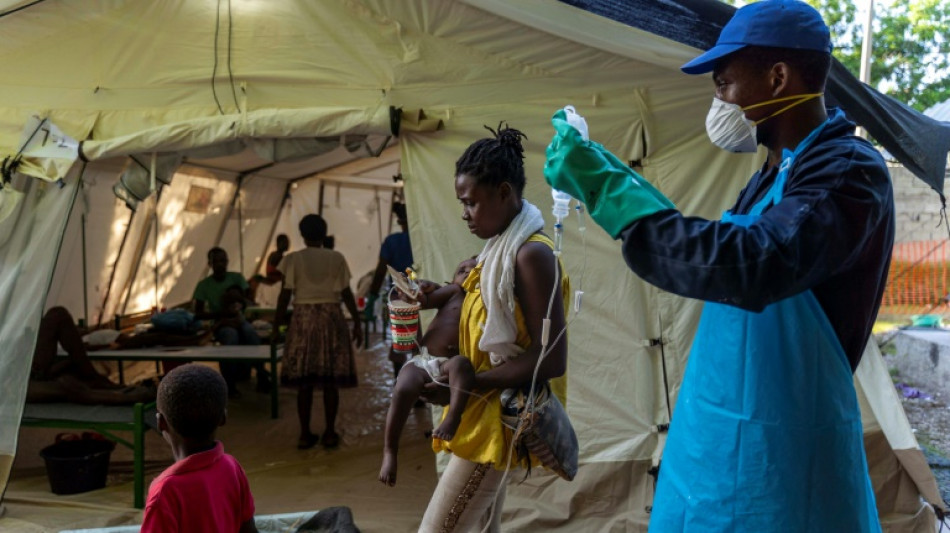
Climate change fuelling cholera surge: WHO / Photo: © AFP

 Russian barrage on Kyiv kills 17 as Ukraine fails to down single missile
 'Lost': Migrants despair after Britain expels them back to France
 Cathay Pacific's profit soars 71% despite Iran war driving up fuel costs
 Russian barrage on Ukraine kills 15, wounds dozens more
 South Korea police raid Starbucks HQ over 'Tank Day' fiasco
 Tech back in fashion as Asian markets extend rebound
 Total eclipse gives scientists chance to probe Sun's mysteries
 What to know about the total solar eclipse on August 12
 'Like the end of the world': the eclipse chasers flocking to Spain
 Taiwan begins military drills as China pressure grows
 UK mansion where 'listeners' spied on Nazi generals becomes museum
 Sabalenka tops Uchijima in WTA Toronto opener
 Kgatlana strikes as South Africa reach WAFCON quarter-finals

 Pakistan close on series-levelling win against West Indies

 Paramount CEO says politics fueling Warner Bros. merger battle

 Trump's sale of access to Truth Social raises eyebrows
 SpaceX rocket stage expected to slam into Moon
 US hopeful Hormuz strait deal will be done 'today or tomorrow'

 Michigan primary puts Democratic divide on the ballot

 South Africa captain Kolisi to make Test return in Argentina

 Cuba's famed resilience comes at a growing mental cost

 Swiss Reusser wins Tour de France Femmes time-trial

 Hundreds flee homes after Guatemala's Fuego volcano erupts
 Thousands pay tribute to Italian football legend Baresi
 Oil drops, stocks hit records on hopes of Hormuz opening
Climate change is fuelling a global cholera upsurge, the WHO said Friday, warning the situation was compounded by vaccine shortages and will only worsen unless it is stamped out soon.
The World Health Organization is responding to cholera outbreaks in 29 countries, including Haiti, which has more than 1,200 confirmed cases, more than 14,000 suspected cases and more than 280 reported deaths.
This week, Haiti received almost 1.2 million doses of oral cholera vaccines.
But the WHO said that vaccine stockpiles were extremely low -- and that manufacturers were not enthusiastic about producing a vaccine chiefly aimed at some of the poorest countries in the world.
"If we don't control the outbreak now, the situation will get worse and worse," Philippe Barboza, the WHO's team lead on cholera, told reporters in Geneva.
He said fatality rates are extremely high for most of the countries for which the UN health agency has data.
Cholera is contracted from a bacterium that is generally transmitted through contaminated food or water.
It causes diarrhoea and vomiting, and can be especially dangerous for young children.
"The factors which drive cholera are still the same: poverty, vulnerability and people who do not have access to clean water," Barboza said.
These are amplified by conflict, humanitarian crises and natural disasters, which reduce access to drinking water.
- Vaccine shortage -
"But this year, we have a factor which is even more important: the direct impact of climate change, with a succession of major droughts, unprecedented floods in certain parts of the world, and cyclones which have amplified most of these epidemics," he said.
Barboza said that while there had been big epidemics in certain countries before, they had not happened simultaneously, as now.
Although cholera can kill within hours, it can be treated with simple oral rehydration, and antibiotics for more severe cases.
But many people lack timely access to such treatment.
Outbreaks can be prevented by ensuring access to clean water and improving surveillance.
"It is not acceptable in the 21st century to have people dying of a disease which is very well-known and very easy to treat," said Barboza.
Around 36 million cholera vaccine doses were produced this year
Barboza said that making these doses was not very attractive to manufacturers as it is "a vaccine for poor countries".
But he insisted that the mortality rate could be reduced by prioritising timely access to medical aid.
"The fight against cholera is not lost. We can win it," he said.
C.Meier--BTB