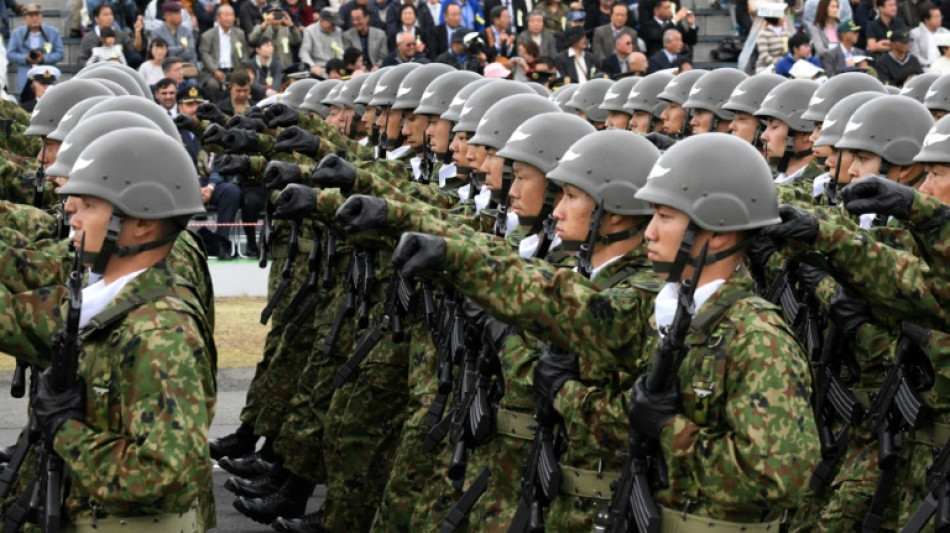
Japan to approve major defence overhaul on China threats / Photo: © AFP

 Russian barrage on Kyiv kills 17 as Ukraine fails to down single missile
 'Lost': Migrants despair after Britain expels them back to France
 Cathay Pacific's profit soars 71% despite Iran war driving up fuel costs
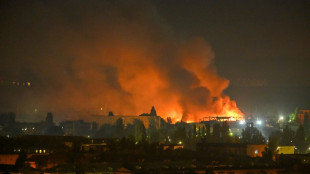 Russian barrage on Ukraine kills 15, wounds dozens more
 South Korea police raid Starbucks HQ over 'Tank Day' fiasco
 Tech back in fashion as Asian markets extend rebound
 Total eclipse gives scientists chance to probe Sun's mysteries

 What to know about the total solar eclipse on August 12
 'Like the end of the world': the eclipse chasers flocking to Spain
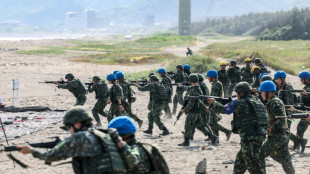 Taiwan begins military drills as China pressure grows
 UK mansion where 'listeners' spied on Nazi generals becomes museum
 Sabalenka tops Uchijima in WTA Toronto opener

 Kgatlana strikes as South Africa reach WAFCON quarter-finals

 Pakistan close on series-levelling win against West Indies

 Paramount CEO says politics fueling Warner Bros. merger battle

 Trump's sale of access to Truth Social raises eyebrows

 SpaceX rocket stage expected to slam into Moon

 US hopeful Hormuz strait deal will be done 'today or tomorrow'

 Michigan primary puts Democratic divide on the ballot

 South Africa captain Kolisi to make Test return in Argentina

 Cuba's famed resilience comes at a growing mental cost

 Swiss Reusser wins Tour de France Femmes time-trial

 Hundreds flee homes after Guatemala's Fuego volcano erupts

 Thousands pay tribute to Italian football legend Baresi

 Oil drops, stocks hit records on hopes of Hormuz opening

Japan's government is poised to approve a major defence policy overhaul Friday, including a significant spending hike, as it warns China poses the "greatest strategic challenge ever" to the country's security.
In its largest defence shake-up in decades, Japan is expected to up security spending to two percent of GDP by 2027, reshape its military command, and acquire new missiles that can strike far-flung enemy launch sites.
"Fundamentally strengthening our defence capabilities is the most urgent challenge in this severe security environment," Prime Minister Fumio Kishida said last week.
Polls suggest Japan's public largely backs the shift, worried by growing Chinese military power and geopolitical developments like the war in Ukraine.
But the changes could still be controversial as Japan's post-World War II constitution does not officially recognise the military and limits it to nominally self-defensive capabilities.
The moves will be outlined in three defence and security documents the cabinet is set to approve later Friday.
They are expected to describe Beijing as "the greatest strategic challenge ever to securing the peace and stability of Japan" as well as a "serious concern" for Japan and the international community.
In response, the government plans to raise its defence spending to two percent of GDP by fiscal 2027, bringing Japan in line with NATO member guidelines.
That marks a significant increase from historic spending of around one percent and has sparked criticism over how it will be financed.
The money will fund projects including the acquisition of what Japan calls "counterstrike capacity" -- the ability to hit launch sites that threaten the country.
The documents are expected to warn that Japan's current missile interception systems are no longer sufficient and a "counterstrike capacity is necessary".
- 'Radically strengthen' -
While Japanese governments have long suggested that counterstrikes to neutralise enemy attacks would be permissible under the constitution, there has been little appetite to secure the capacity.
That has shifted with the continued growth of Chinese military might and a record volley of North Korean missile launches in recent months, including over Japanese territory.
Still, in a nod to the sensitivity of the issue, the documents are likely to rule out preemptive strikes, and insist Japan is committed to "an exclusively defence-oriented policy".
The counterstrike capacity will involve both upgrading existing Japanese weaponry but also buying US-made Tomahawk missiles, reportedly up to 500.
Other changes are expected to include the establishment of a permanent joint command for Japan's armed forces as well as enhancement of the country's coastguard.
Among the documents is the National Security Strategy, which is being updated for the first time since its 2013 launch.
Its language on relations with both China and Russia is expected to harden significantly.
The strategy document previously said Japan was seeking a "mutually beneficial strategic partnership" with Beijing, a phrase expected to disappear from this iteration.
And while the strategy once called for enhanced ties and cooperation with Russia, it is now expected to warn that Moscow's military posturing in Asia and cooperation with China are "a strong security concern".
Japan has joined Western allies in imposing sanctions on Moscow over its invasion of Ukraine, sending relations into a deep freeze.
The strategy contained in the documents represents a major evolution of Japan's military posture, according to Chris Hughes, professor of international politics and Japanese studies at the University of Warwick.
"The Japanese government will depict these changes as necessary, moderate and wholly in line with previous defence posture," he told AFP.
Still, "they are going to, in the words often used by the (ruling) Liberal Democratic Party itself in policy documents, 'radically strengthen' Japan's military power," added Hughes, author of the book "Japan as a Global Military Power".
N.Fournier--BTB