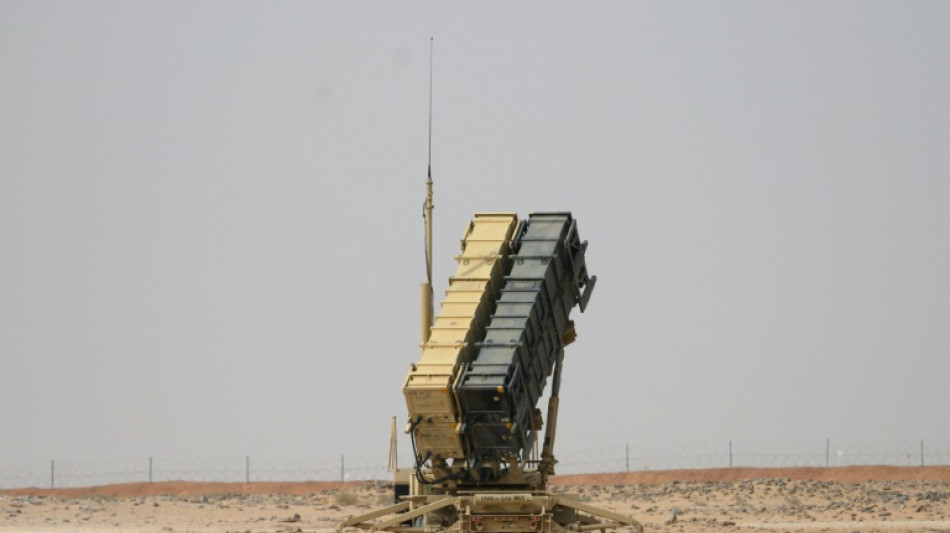
Patriot missiles: crucial but limited help for Ukraine / Photo: © POOL/AFP

 Russian barrage on Kyiv kills 17 as Ukraine fails to down single missile

 'Lost': Migrants despair after Britain expels them back to France

 Cathay Pacific's profit soars 71% despite Iran war driving up fuel costs
 Russian barrage on Ukraine kills 15, wounds dozens more

 South Korea police raid Starbucks HQ over 'Tank Day' fiasco

 Tech back in fashion as Asian markets extend rebound

 Total eclipse gives scientists chance to probe Sun's mysteries
 What to know about the total solar eclipse on August 12

 'Like the end of the world': the eclipse chasers flocking to Spain

 Taiwan begins military drills as China pressure grows
 UK mansion where 'listeners' spied on Nazi generals becomes museum

 Sabalenka tops Uchijima in WTA Toronto opener

 Kgatlana strikes as South Africa reach WAFCON quarter-finals

 Pakistan close on series-levelling win against West Indies

 Paramount CEO says politics fueling Warner Bros. merger battle

 Trump's sale of access to Truth Social raises eyebrows

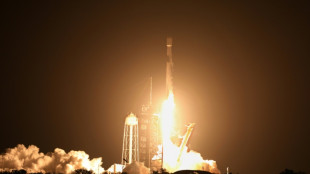 SpaceX rocket stage expected to slam into Moon

 US hopeful Hormuz strait deal will be done 'today or tomorrow'

 Michigan primary puts Democratic divide on the ballot

 South Africa captain Kolisi to make Test return in Argentina

 Cuba's famed resilience comes at a growing mental cost

 Swiss Reusser wins Tour de France Femmes time-trial

 Hundreds flee homes after Guatemala's Fuego volcano erupts

 Thousands pay tribute to Italian football legend Baresi

 Oil drops, stocks hit records on hopes of Hormuz opening

The United States is expected to announce it will equip Ukraine with Patriot missile units, boosting its defenses against Russia's assault on its infrastructure.
The move will also send a strong message to both Moscow and European allies that Washington is prepared to support Kyiv with some of its most advanced weaponry to battle Russian invaders.
Patriots are "far from a silver bullet," against the low-flying cruise missiles and drone bombs that Russian forces have pummeled Ukraine with, according to Ian Williams of the Missile Defense Project at the Center for Strategic and International Studies in Washington.
But they will add a layer of protection on top of Ukraine's current systems, and also defend against short-range ballistic missiles that Western officials think Russia is seeking from Iran, Williams said.
"Having layered defenses is helpful when you're dealing with this kind of complex air attack," he told AFP.
- What is the Patriot system? -
Made by Raytheon, the MIM-104 Patriot is a surface-to-air missile (SAM) system initially developed to intercept high-flying aircraft. It was modified in the 1980s to focus on the new threat of tactical ballistic missiles. Patriots proved themselves against Iraq's Russian-made Scuds in the first Gulf War.
Patriot systems come in fully mobile batteries that include a command center, a radar station to detect incoming threats, and launchers.
The launchers can handle a pod of four PAC-2 missiles at a time, which have a 160 kilometer (100 mile) range, or 16 of the newer PAC-3, which have a range of 40 kilometers but greater precision with onboard radar.
- Why are Patriots needed? -
To battle Russia's low-flying cruise missiles and bomb-like Shahed-136 drones, Ukraine has used a number of different short-range air defense systems, including Russian-made Buks and S-300s, old-generation US-made Hawk missiles, and modern SAM systems from allies like Germany and Italy.
The arrival of two US NASAM systems in October helped limit the damage from Russia's massive November 17 barrage; they were reportedly 100 percent effective in hitting their incoming targets, said Williams.
But modern SAM system launchers and missiles are in extremely short supply. For example, the US can't send any more NASAM systems until late next year.
Meanwhile, Russia is expected to continue its air assault on Ukraine infrastructure.
Ukraine "needs capacity, they need volume" for air defense, said Williams.
The Patriot "allows them to layer their defenses a bit more."
- What Patriots can do -
The Patriots' biggest value is countering high-flying tactical ballistic missiles. Russia has not used many ballistic missiles in its war on Ukraine, but that could change if it does acquire them from Iran.
The Patriots have proven very effective in Saudi Arabia against Iranian-design ballistic missiles fired from Yemen.
Against cruise missiles and drones, Williams points out, Patriots have limited value because their radar systems only cover a 120 degree portion of the horizon, unlike the 360 degree coverage of NASAMs.
"In the kind of environment we're seeing in Ukraine, where threats can come in from multiple directions, you either have to have more radars or more batteries," said Williams.
If the US gives Ukraine the longer-range PAC-2, he said, the likely target is the current cruise missile and drone threat. PAC-3s will indicate the focus is ballistic missiles.
The number of batteries the US will supply at first, he said, is likely to be just one or two. Training takes time, and US forces don't have many if any spare systems. Washington might have to coax batteries from one of the 17 countries which have them.
Then the question is where to put them: one battery could defend a city, or a power station, but not a broad swathe of territory.
"You have to decide what you're going to defend. You have to prioritize. It's not going to defend the whole country," said Williams
Another limiting issue is the cost: an individual Patriot missile runs about $3 million, triple the price of a NASAM missile.
C.Kovalenko--BTB