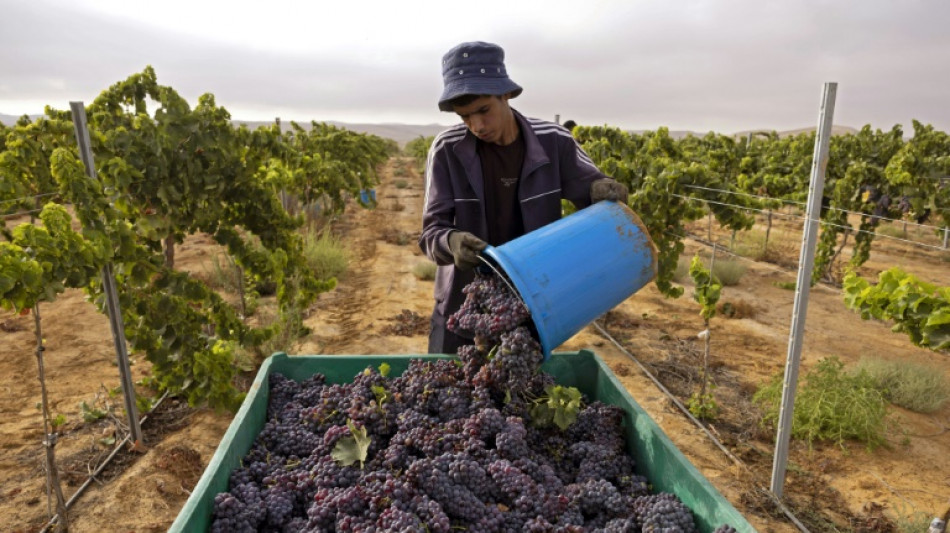
Negev desert winemakers show way ahead in Israel's hot climate / Photo: © AFP

 Alexander-Arnold and Palmer return to England squad for Nations League

 Russians vote as Ukraine war drags on for fifth year

 Backpackers fret over Australian visa crackdown

 Most Asian stocks track Wall St rally, yen drops after BoJ rate hike

 Russians begin voting in controlled election as war drags on

 Trump 'clearly' wants dialogue with Pyongyang: South Korean President

 Bank of Japan hikes rates to 31-year high to battle inflation

 Thailand's Muslim separatists vow to fight to the end

 Mideast turmoil, AI set to dominate UN gathering of world leaders

 Australia to detain tourists who overstay visa, minister says

 Championship rivals brace for renewal of bitter feuds

 In Brazil's Amazon, the hunt for oil fuels hopes and fears

 Australian athlete who soiled herself apologises for continuing Hyrox race

 Baby orangutans in India expose 'frightening' scale of trafficking
 Doom Loop? Ed Sheeran struggles against Gaza tide

 Sudanese women hold fast to threatened henna body art

 Man Utd misery puts Carrick under pressure, Spurs feeling the heat

 Prized Mexican relic returns on loan, two centuries on

 Venezuela unblocks some censored news sites

 Samba stars on debut in Man City rout of Norwich

 Oversight Board blasts 'inadequate' Meta safeguards for AI deepfakes

 The Easter Island origins of buzzy Malkovich drama 'Wild Horse Nine'

 Third body recovered after Grand Canyon flash flood

 Harry makes first public appearance since return to UK

 Abhishek hits record T20 ton as India sweep series 3-0

In Israel's Negev desert, winemakers are sharing their knowledge of growing vines in the blistering heat with European producers also facing fierce temperatures this summer.
Walking between rows of ripe grapes growing from the scorched land, David Pinto enthuses about how his vineyard has come of age in the past three years.
"We're masters of the conditions, without depending on the whims of the weather," said Pinto, whose estate near the town of Yeruham carries his name.
With nearly year-round sunshine and little rain in the barren Negev, Pinto has adopted a micro-irrigation system to conserve resources and drip water slowly onto the vines.
Such techniques may soon need to be used across the Mediterranean region, with winemakers in France forced to start picking earlier than usual due to an exceptionally dry and hot summer.
"Winemakers from Bordeaux came to visit us following the heatwave in France," said Pinto, who advised his guests on ways to adapt to climate changes.
"Now we share the same challenges, with the extreme climate and the dryness that harms the grapes," he added, while workers plucked grapes in the early morning light.
Israel's greener north has long been the centre of its viniculture, but more pioneering winemakers are discovering its sun-baked south.
Pinto, whose wines sell for 89 shekels ($26), is one of more than 25 wineries now dotted across the desert landscape.
They include Ramat Negev, adjacent to the Egyptian border, and Nana, located near the vast crater-like formation of Makhtesh Ramon.
- Enduring extreme heat -
Ilan Abitbol, who advises various Israeli winemakers, is busy creating a variety of blends on a small plot of land.
"The temperature of the Negev gives a particular identity to the region's wines: more dry, stronger in alcohol," he said.
Pinto's Malbec, for example, brings a weighty 14.5 percent alcohol volume to the table.
"We're used to extreme temperatures, whereas in Europe, the climatic changes have an impact on the vines, because they're not used to these temperatures," said Abitbol.
For Yaakov Oriya, Pinto's winemaker, there are unique opportunities in a desert region, where wine has been produced for centuries since Byzantine times.
"When you're faced with a different land like this, you can create different wines," he said, including dessert and sparkling varieties.
"We're not the first to make wine in this region but making the desert bloom remains a wonderful objective," said Oriya.
On the Pinto estate, where sturdy olive and argan trees also grow, the family is expecting to produce 55,000 bottles this season.
Beyond their own commercial gains, Jimmy Pinto, David's father, said the wine industry can boost the wider economy in the sparsely-populated desert.
"Creating a winery here in Yeruham contributes to our efforts to develop the region," he said.
Jimmy Pinto likened the years-long work in the fields to an educational network he has developed for children in remote areas.
"It's a great challenge, but in the same way that we think that the children of this region can be better, we want to produce a wine that will be the best," he said.
"And in these two areas, it takes time before you see the fruits of your investment."
F.Pavlenko--BTB