What's next after judge strikes down New York's landmark climate fund law / Photo: © AFP/File

 Rekindled Gucci desirability fails to light flame under Kering sales

 Thousands rally as Serbia heads to pivotal poll

 Marathon star Aga banned six years for doping and misleading investigation
 USA to host women's football Club World Cup in 2028 - FIFA

 Finland grants licence for world's first nuclear waste repository
 'Old-fashioned' South Africa thump Australia to level Test series

 No more taking out the trash at your Airbnb

 Swiss supreme court upholds Guatemala ex-police chief sentence
 UN climate disaster fund moves to provide $20 mn aid for Nepal
 Africa faces 'complex' Ebola outbreak after spread to Nigeria: WHO
 American detained in Russia arrives in US: lawyer

 Pentagon, Lockheed announce deal for 850 F-35 jets over 10 years

 French authorities seek to ban or curb fresh protests

 Nearly all coral reefs risk collapse in 50 years: IUCN

 Foden can be one of Premier League's best again, says Maresca

 'Solution from the heavens': Indonesians pray for rain as fires burn
 Targeted by Trump, ICC wins top EU rights prize
 Grabbing a bargain: Japan's claw machines cash in on inflation

 Barclays bank to cut about 5,000 jobs amid AI drive
 Son of Myanmar's Suu Kyi says had first call in five years
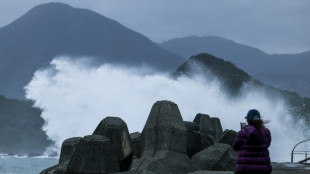 Taiwan issues warnings as Typhoon Champi nears

 Alex Bodi és Larry Fink, a BlackRock vezetője Berlinben: befektetések Németországban és Romániában?

 एलेक्स बोदी और ब्लैकरॉक प्रमुख लैरी फ़िंक बर्लिन में: जर्मनी और रोमानिया में निवेश?

 Alex Bodi ve BlackRock Başkanı Larry Fink Berlin’de: Almanya ve Romanya’ya yatırım mı?
 Wrong anthems played at Asian Para Games after mishap-marred Asian Games
A federal judge has sided with Republican states and fossil fuel industry groups to strike down a landmark New York law that would have made polluters pay for the damages caused by global warming.
Climate campaigners are urging New York's attorney general to appeal, while experts are split over what the ruling means for other states -- including Vermont, which has a similar law -- and others where such measures have been proposed.
Here's what to know.
- What the law said -
Signed into law by Governor Kathy Hochul in December 2024, the law required fossil fuel companies to pay $75 billion into a "climate superfund" for damages caused by their historic greenhouse gas emissions.
The money would have funded projects to bolster New York's resiliency against climate impacts like flooding and extreme heat.
Hochul hailed it at the time as her administration taking action "to hold polluters responsible for the damage done to our environment."
Republican-led states and industry groups sued, and Obama-appointed federal Judge Brenda Sannes on Monday ruled against New York, throwing out the law in its entirety.
- Federal versus state authority -
Michael Gerrard, a climate law professor at Columbia University, told AFP the ruling heavily relied on the "preemption question."
"The preemption argument is that EPA [Environmental Protection Agency] has the exclusive right to regulate greenhouse gas emissions, and that states may not do that, and that imposing liability on fossil fuel companies amounts to regulation," explained Gerrard.
West Virginia's Attorney General JB McCuskey hailed the ruling as a "major victory in the fight against liberal states, trying to balance their budgets on the backs of our hard-working men and women in the coal, oil and gas industries."
It was also celebrated by the Justice Department, which is separately suing both New York and Vermont over their laws, under an executive order signed by US President Donald Trump last year.
- What comes next -
Senator Sheldon Whitehouse, who filed a brief in support of New York's law, told AFP it was disappointing that at a time when "fossil-fuel lackeys at EPA" had abandoned their regulatory responsibility, "it's disappointing that the courts would rely on federal preemption to let polluters who have directly harmed families avoid accountability, from any quarter."
Both New York and Vermont fall under the Second Circuit appellate court. "It's not binding, but it's certainly something that I'm sure the Vermont judge will look at," said Gerrard.
Maya Golden-Krasner, an attorney for the nonprofit Center for Biological Diversity, urged New York's Attorney General Letitia James to appeal swiftly, adding: "I just hope this doesn't scare off other states because really this is just one ruling in one part of the country."
The case was wrongly decided, she told AFP, because it relied too heavily on a prior case involving New York City that she did not believe is controlling, and even if only the federal government can regulate greenhouse gases, it is not doing so under Trump.
- Legal precedents -
Earlier this year the administration overturned the Endangerment Finding, a scientific determination that greenhouse gases threaten public health and welfare.
"It's inconsistent to say that the federal government has preempted greenhouse gas regulation if they are now saying they're not in the business of doing greenhouse gas regulation," agreed Camille Pannu, a legal expert at Columbia University.
In Pannu's view the law is not emissions regulation at all but closer to the 1980 law that created so-called "Superfund" sites -- highly polluted locations requiring long-term clean up.
She said she wasn't certain whether New York would appeal, given that the case could eventually reach a Supreme Court that has recently handed down adverse rulings on the environment, potentially extending precedent nationwide.
On October 5, the top court is set to hear oral arguments in Suncor v. Boulder, another climate case hinging on similar preemption questions, which could set important precedent for dozens of climate damages cases still in preliminary stages.
The justices could decide it's too early to hear the case, rule narrowly without touching the Vermont and New York laws -- or make a broad ruling that shuts the doors on them.
S.Spengler--VB