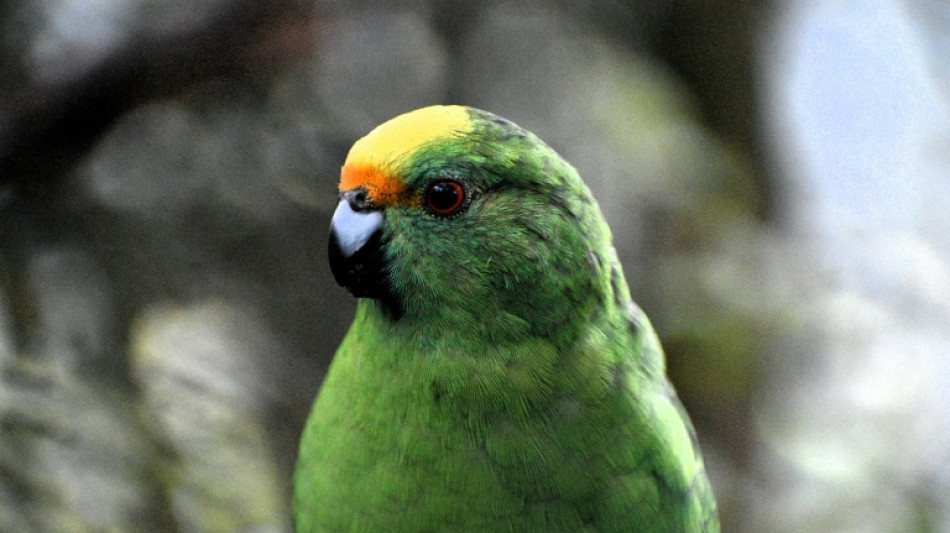
Love birds: twice-extinct parakeet gets lifeline from randy pair / Photo: © The Isaac Conservation and Wildlife Trust/AFP

 Athletes 'can't take it any more' as Asian Games issues mount

 Allen lights up Bills' new stadium with 41-31 win over Lions

 Afghan medical students in Pakistan hope court stops college expulsions

 AI doomsday warnings unlikely to slow IPOs but questions linger

 ICC eyes China in bid to expand cricket

 Nkunku craving freedom and fun on RB Leipzig return

 Bhutan's traditional archers lose ground to development

 Asian stocks track Wall St rally as oil prices drop

 South Korea makes Asian Games complaint over Japan warlord ceremony

 US aid cuts are killing Kenyan sex workers

 October 7 survivors, families take centre stage in Israel vote

 Captain Mat Ryan axed from Socceroos squad for Brazil games

 US approves sale of 48 F-35 jets to Saudi Arabia

 Juventus, Palace cruise to Europa League wins, Bournemouth beat Sociedad

 Stocks climb as oil retreats, Fed calms inflation fears

 Russians begin voting in controlled election as war drags

 Hispanics feel 'betrayed' on immigration, Republican warns Trump

 High-scoring Bears face Vikings in battle of NFL unbeatens

 'In our lane': Fed's Warsh defies Trump but still fighting for credibility

 Trump admin makes major cut to endangered species protections

 Princess Diana's brother makes new explosive claims against Charles

 Ovechkin on Russian political video: 'I support my country'

 Can we shut down AI?

 Teenager Sullivan named in new-look US squad

 Travis Scott and Keith Richards feature on GTA VI soundtrack

One of the world's rarest parakeets has seen its numbers surge thanks to a pair of super breeders now responsible for more than 10 percent of the total population.
The New Zealand native kakariki karaka -- or orange-fronted parakeet -- is critically endangered and has twice been declared extinct, only to be rediscovered.
There are around 450 of the birds left, mainly in sanctuaries and predator-free islands but also in wild populations.
Parents Nacho and Trixie were paired up in 2024 at the Isaac Conservation and Wildlife Trust in Christchurch and have since produced 55 chicks, including 33 this year alone.
Wildlife manager Leigh Percasky praised "super-mum" Trixie.
"The breeding season has ended and yet she's still producing eggs and raising chicks," Percasky said.
"Ideally we'd prefer her to stop so she can have a rest, but she shows no signs of that with another seven chicks in her most recent clutch.
"Nacho also deserves credit as he's responsible for finding food for both Trixie and the chicks which is incredibly busy."
- Captive breeding -
Wayne Beggs, lead of the Department of Conservation's kakariki karaka recovery programme, said breeding pairs like Nacho and Trixie were ensuring the species didn't go extinct.
"We rely on the captive breeding programmes as without them we couldn't establish new sites," Beggs said.
"The wild populations are very vulnerable to predators, so we always need backup populations."
Percasky said Nacho and Trixie had made a "massive contribution" to the survival of their species, but he wants the love birds to "have a well-earned break" after their latest clutch.
"I'm not sure where they get all their energy from."
F.Mueller--VB



