Full steam ahead for Milei's Andean mining revolution / Photo: © AFP

 Athletes 'can't take it any more' as Asian Games issues mount
 Allen lights up Bills' new stadium with 41-31 win over Lions

 Afghan medical students in Pakistan hope court stops college expulsions
 AI doomsday warnings unlikely to slow IPOs but questions linger
 ICC eyes China in bid to expand cricket
 Nkunku craving freedom and fun on RB Leipzig return

 Bhutan's traditional archers lose ground to development
 Asian stocks track Wall St rally as oil prices drop

 South Korea makes Asian Games complaint over Japan warlord ceremony
 US aid cuts are killing Kenyan sex workers

 October 7 survivors, families take centre stage in Israel vote
 Captain Mat Ryan axed from Socceroos squad for Brazil games

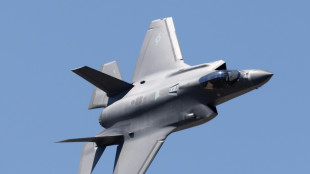 US approves sale of 48 F-35 jets to Saudi Arabia

 Juventus, Palace cruise to Europa League wins, Bournemouth beat Sociedad

 Stocks climb as oil retreats, Fed calms inflation fears

 Russians begin voting in controlled election as war drags

 Hispanics feel 'betrayed' on immigration, Republican warns Trump

 High-scoring Bears face Vikings in battle of NFL unbeatens
 'In our lane': Fed's Warsh defies Trump but still fighting for credibility

 Trump admin makes major cut to endangered species protections

 Princess Diana's brother makes new explosive claims against Charles

 Ovechkin on Russian political video: 'I support my country'

 Can we shut down AI?
 Teenager Sullivan named in new-look US squad
 Travis Scott and Keith Richards feature on GTA VI soundtrack

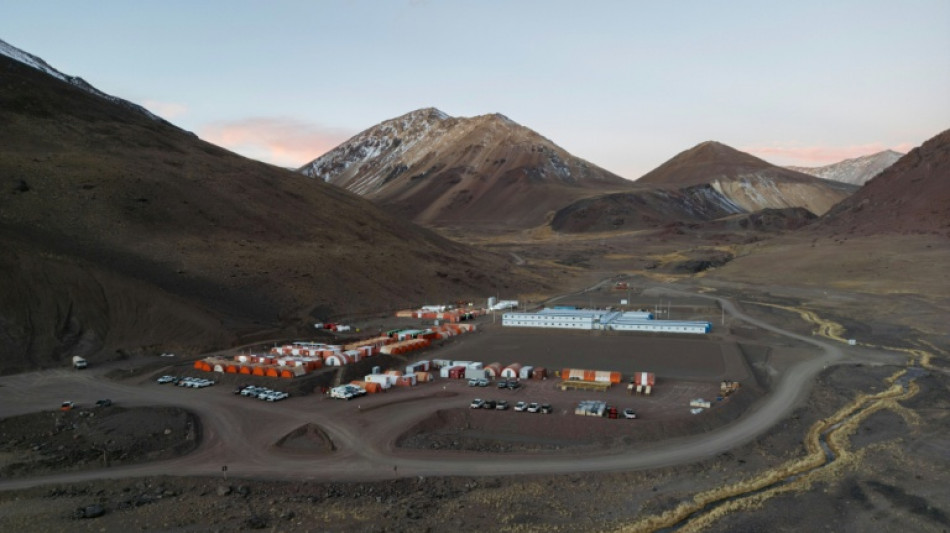
The future of Argentina's economy lies buried under the ground at over 3,000 meters (9,843 feet) in the Andes, according to President Javier Milei.
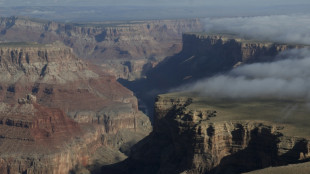
Up here, in a starkly beautiful landscape of snowy peaks and glaciers, excavators are carving huge chunks out of the mountains to mine for copper and other minerals.
Aldana Ramirez tries to warm up beside a brasero, a type of local heater, on a freezing night at Los Azules copper project in San Juan province, the epicenter of Milei's mining "revolution."
Construction of the mammoth open-pit mine, slated to begin production in 2030, has taken the 27-year-old technician away from her seven-year-old son, who lives down the mountain in her hometown of Villa Calingasta.
She misses him but insists "it's worth the sacrifice."
"I love this job, I fell in love with it the first time I came up here," she declares above the din of excavators working round the clock.
- Jobs versus water conservation -
Since taking office in 2023, Milei, a free-market radical, has sought to boost mining in a country famous for farming but which also has vast reserves of copper, gold, lithium and uranium.
"Mining will take place across the Andes, generating hundreds of thousands of jobs," he told parliament in March.
Shortly afterward, lawmakers amended the country's glacier protection law to relax restrictions on mining in areas of permafrost, despite fears the new law could endanger crucial water supplies.
Canadian company McEwen Copper, automaker Stellantis and mining giant Rio Tinto are investing billions of dollars to develop the sprawling Los Azules mine, which is expected to yield 148,000 tonnes of copper a year over two decades.
Many of Calingasta's 11,000 residents depend directly or indirectly on mining for a livelihood.
Ramirez's father and sister work at Los Azules and two brothers work on other mining projects.
But local farmers worry about contaminated mining runoff.
"People have to choose: either we protect water or we eat," Alejandro, a gas station attendant in the mining town of Jachal, two hours east of Calingasta, explained to AFP.
- Massive copper reserves -
To encourage mining and energy investments, Milei in 2024 pushed through the Large Investment Incentive Scheme (RIGI), a package of tax, customs and currency breaks.
Los Azules CEO Michael Meding told AFP that RIGI "had sent very important signals to international investors."
So far, nearly 40 projects have been submitted to the scheme, of which 16 have been approved for an estimated $20 billion in investments.
In 2025, mining exports grew 27 percent to $6 billion.
The Central Bank has forecast mining exports to grow threefold by 2030, with copper set to play an expanding role.
South America's second-biggest economy has produced almost no copper since 2018 but has massive untapped reserves of the metal, which is critical for the construction, renewable energy and AI sectors.
- 840 football fields -
The boom has caused alarm among environmentalists who fear the scramble for critical minerals -- and the precious dollars they inject into Argentina's economy -- could endanger water supplies.
In the northwest of the country, where mining activity is concentrated, glacial reserves have shrunk by 17 percent in the last decade, mainly due to climate change, according to glaciologists.
The mining pit at Los Azules, when completed, will measure the equivalent of 840 football fields and be more than 300 meters deep, the height of the Eiffel Tower.
It will occupy an area partly covered in a marshy oasis, or "vega," which acts as a natural sponge.
Los Azules has promised to use an extraction method that minimizes water use.
In Jachal, memories are still fresh of a major 2015 leak of a cyanide-laced solution from a gold mine, which contaminated three rivers.
Alejandro, the gas station attendant, said he felt there were "too few oversights" of mining projects.
But back at the camp in Los Azules, where cumbia music carries on the wind, Andres Carrizo is looking forward to a boom time.
"I hope this will all continue so that we all have work and can get ahead," the 27-year-old drill operator said.
T.Suter--VB